
Jib Crane vs. Overhead Crane: What Is the Difference, and Which Should You Choose for Your Workshop?
Factory managers and mechanical fabrication shops face an engineering and investment crossroads when they begin equipping their halls with lifting equipment. The technical discussion between process engineers and facilities managers centers on choosing the system that delivers the highest production return at the lowest possible construction cost. Choosing between investing in a jib crane or installing an overhead bridge crane is not merely a comparison of two sizes of lifting equipment. It is an operational study that depends on the flow of materials, the architectural layout of the hall, the area to be covered, and how independent the individual work stations need to be, so that no logistical bottlenecks arise to hold up production.
What Is the Basic Difference Between a Jib Crane and an Overhead Crane?
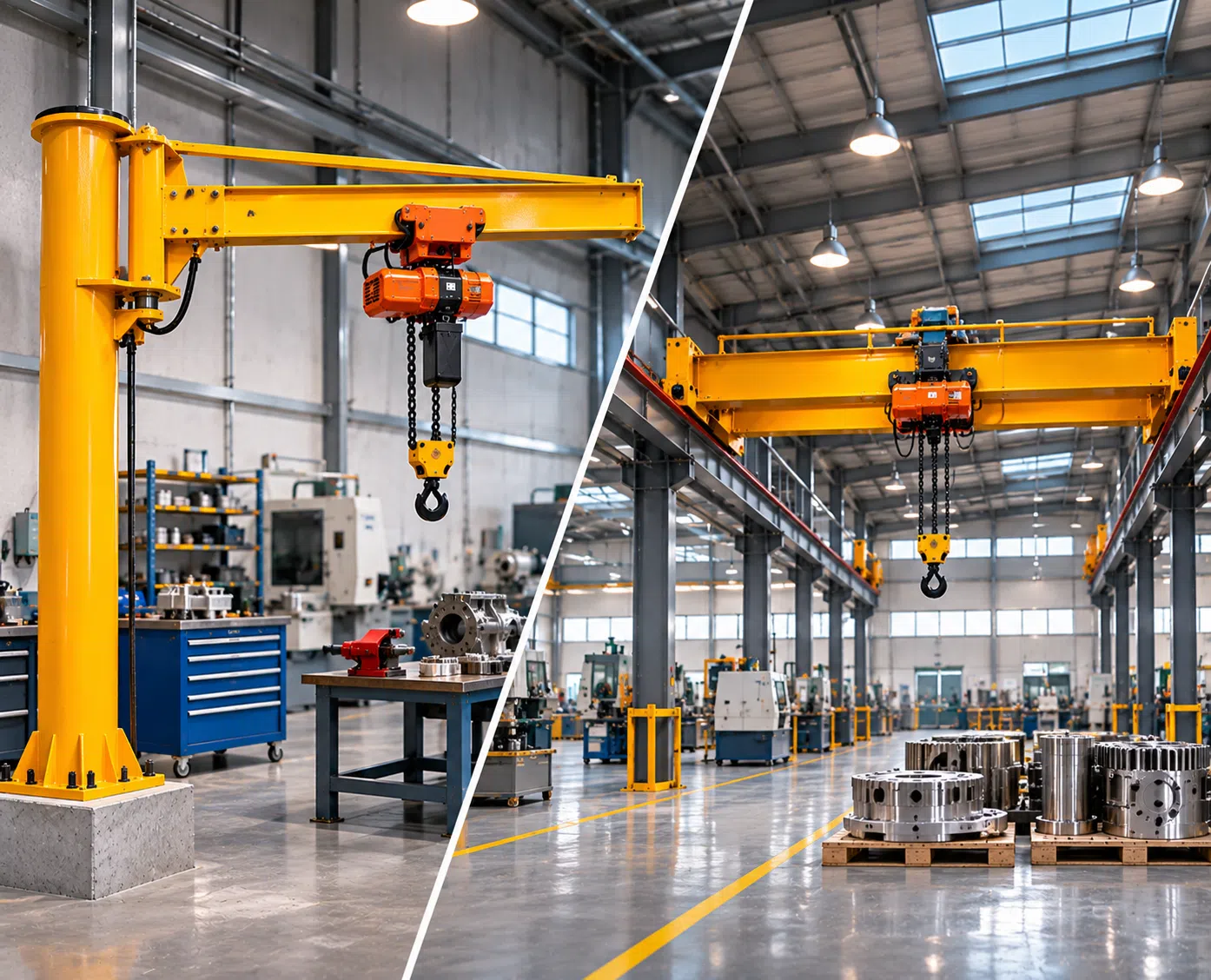
The fundamental difference lies in the spatial coverage and operational function. An overhead crane provides full rectangular (three-dimensional X-Y-Z) coverage of the entire hall through a moving bridge resting on parallel overhead runways, serving the long-distance transport of major loads. A jib crane provides focused circular or semicircular coverage dedicated to one or two work stations, through a horizontal arm that rotates around an independent column or a wall bracket, serving quick, repetitive lifting operations without disrupting the rest of the hall.
Choosing precisely between the two systems pays off in direct, practical returns:
- Complete elimination of long waiting times for technicians at production and maintenance machines.
- Matching structural capital costs to the nature and capacity of the workshop's actual loads.
- Making the best use of the floor and overhead space available in the work environment.
Engineering Anatomy and Working Mechanism of Each System
The mechanical nature of each system differs to serve different motion requirements in production halls:
1. The Jib Crane (Cantilever Crane)
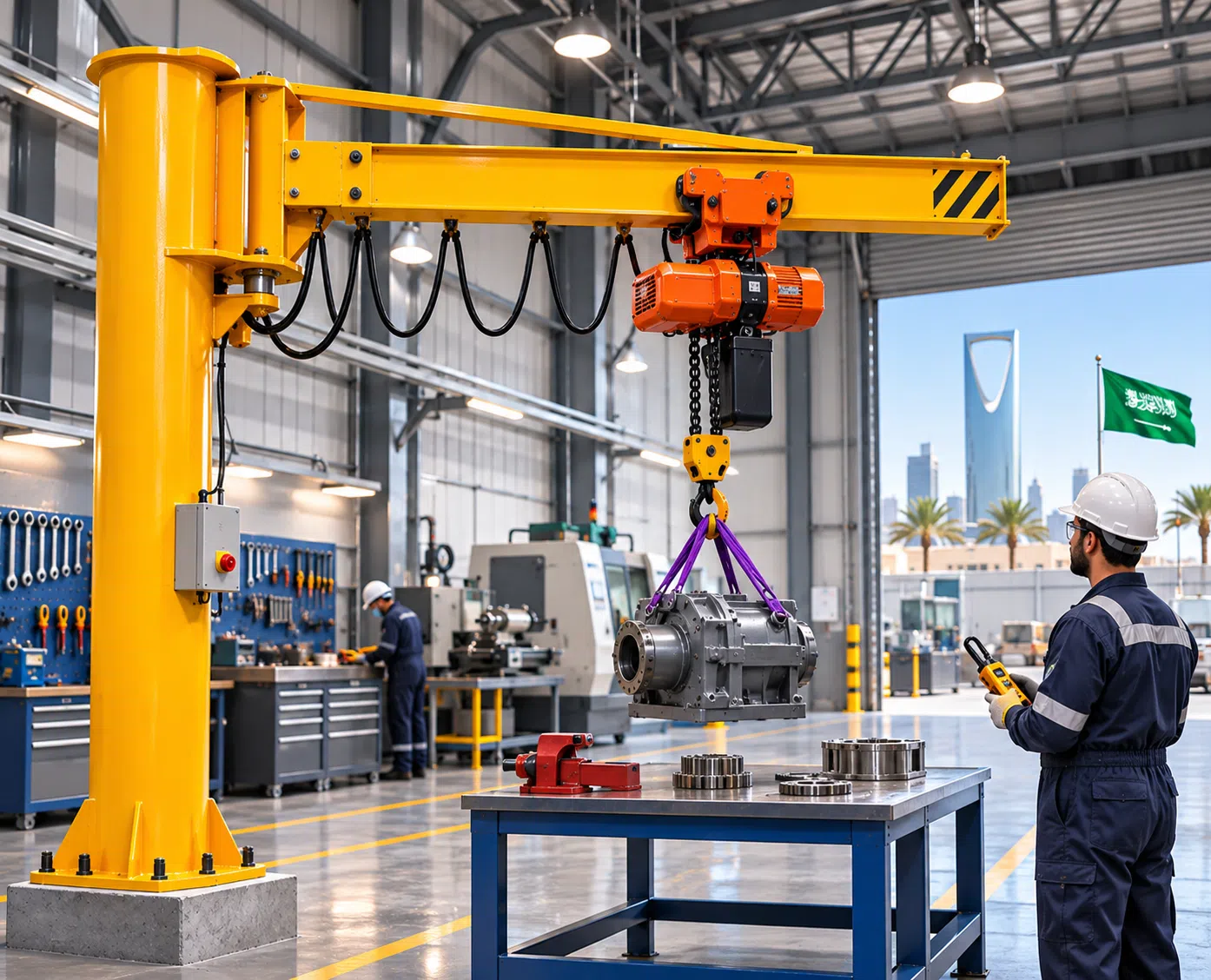
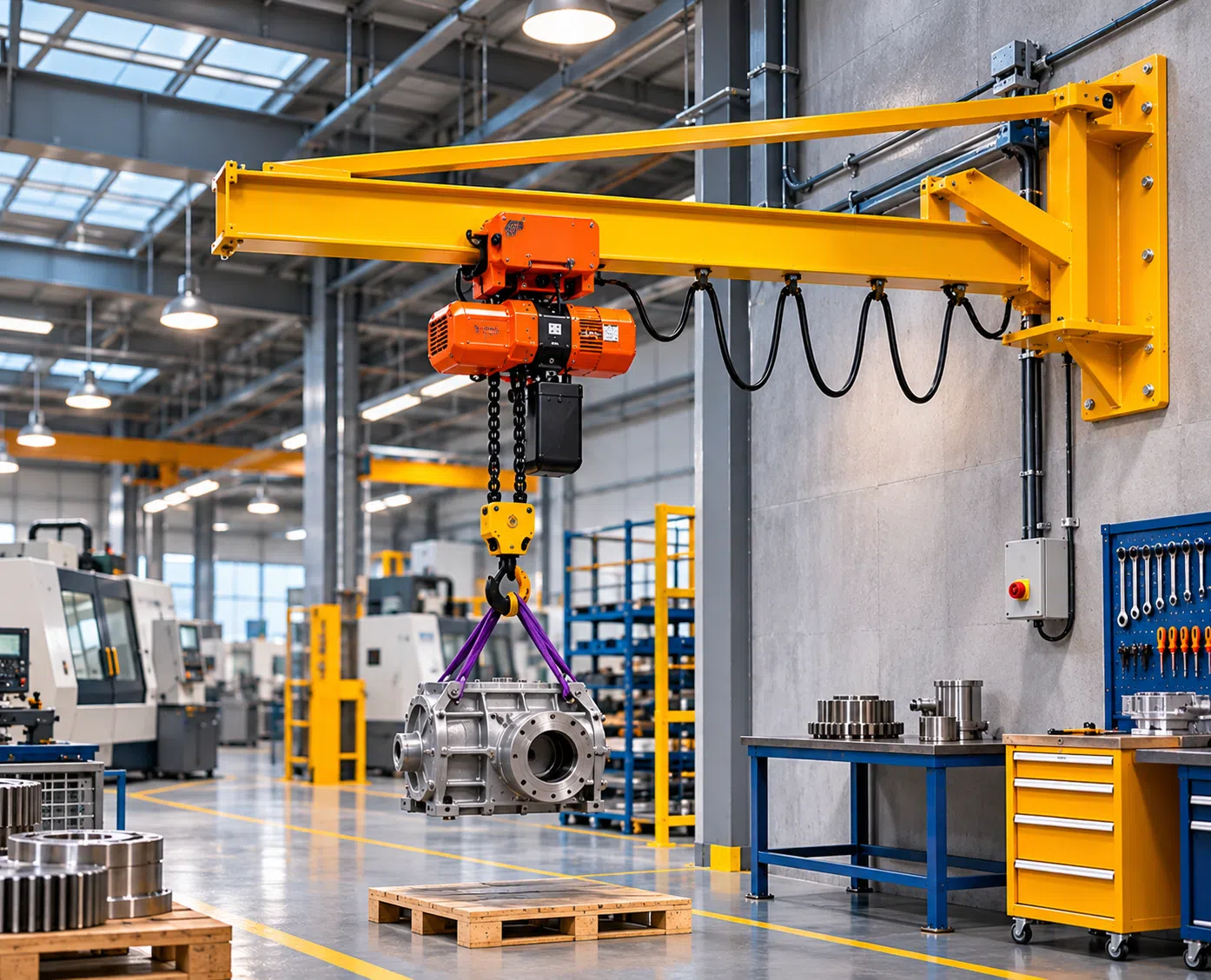
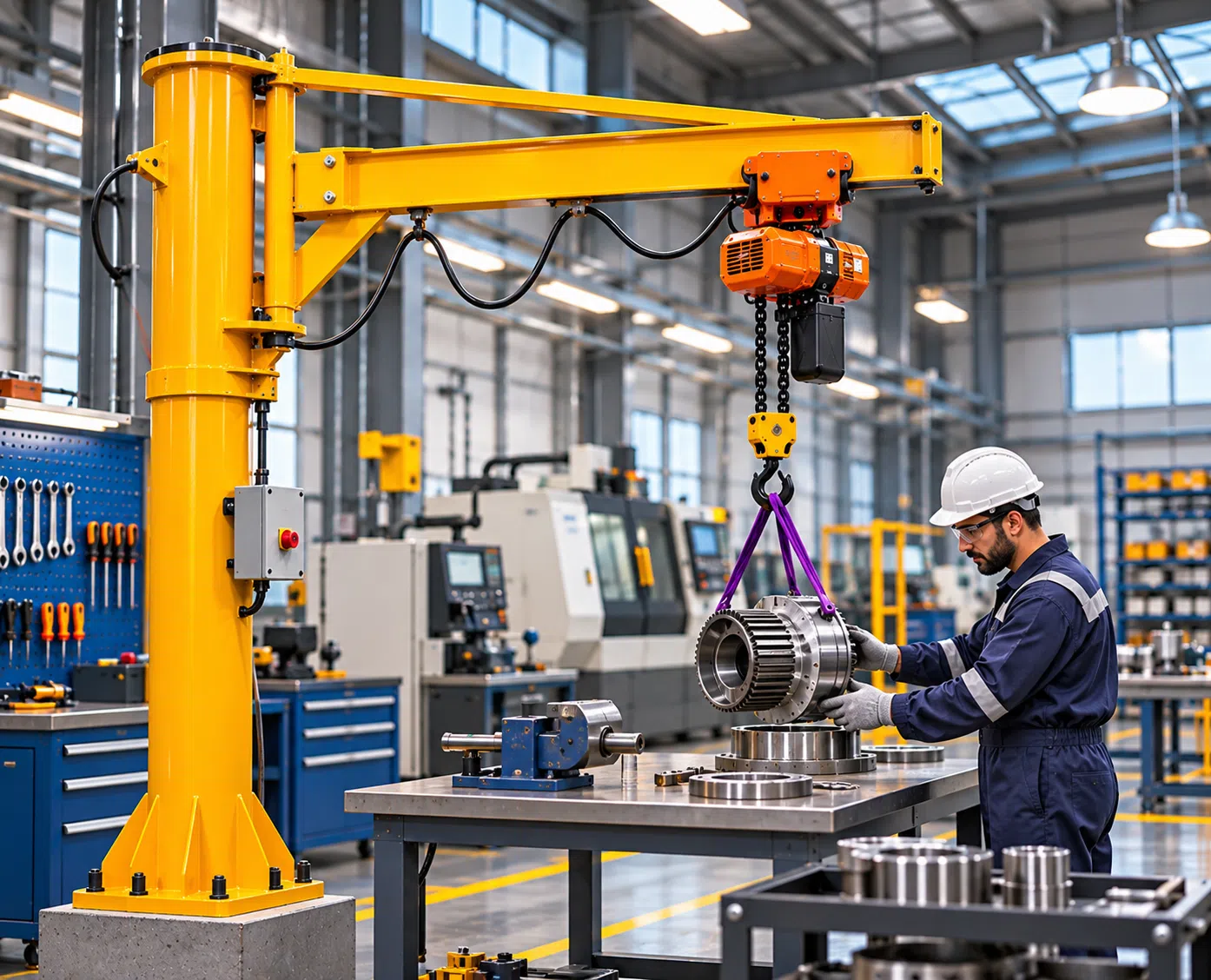
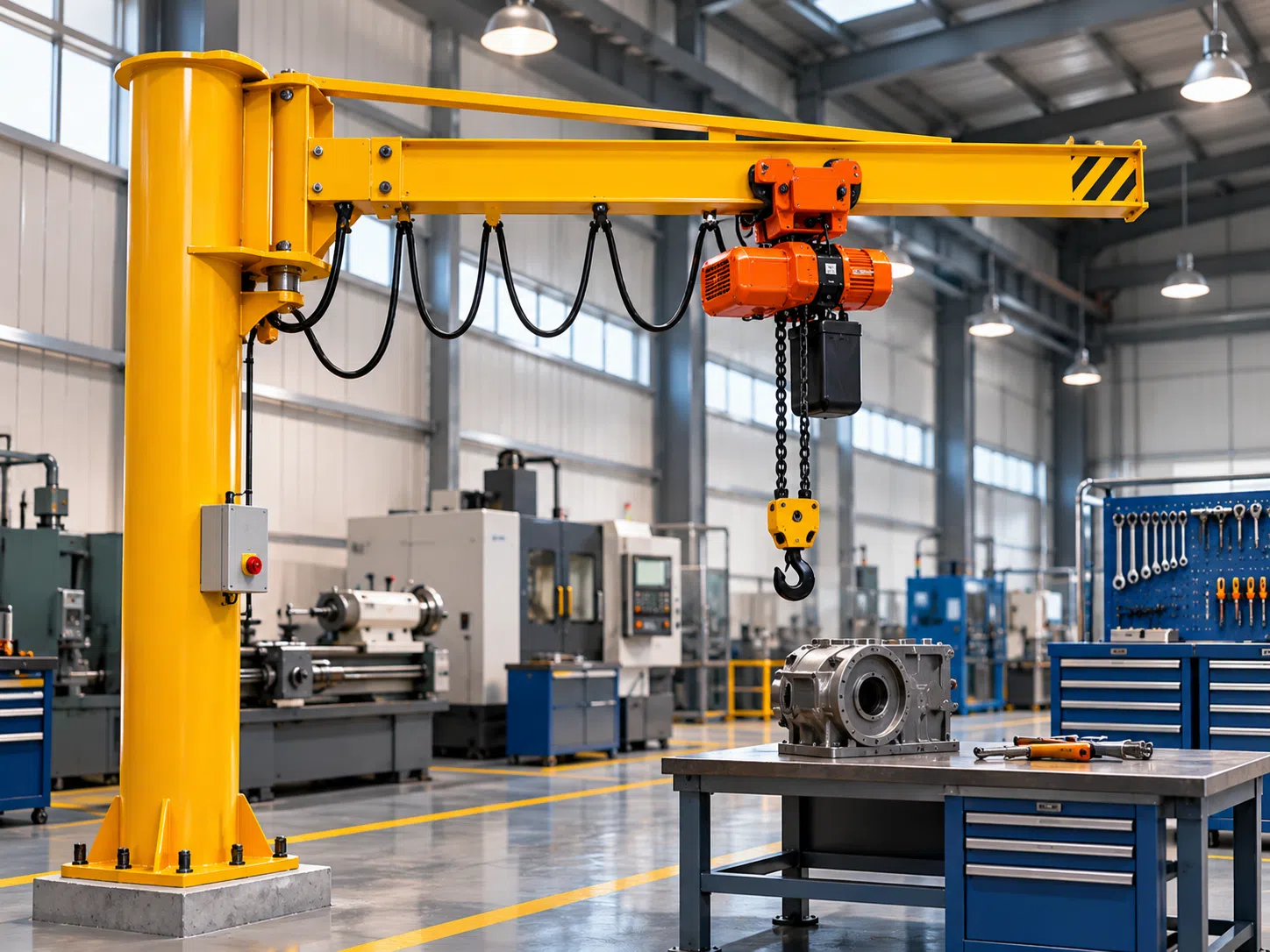
It relies on an extended horizontal steel arm (boom) fixed at one end to an independent vertical column set in the concrete floor, or mounted directly on the building's columns and walls. The hoist and trolley travel along this arm, which can rotate 180 degrees (wall-mounted type) or a full 360 degrees (free-standing type), covering a sector-shaped work area dedicated to loading and unloading CNC machines or dismantling engines at individual maintenance stations.
2. The Overhead Crane (Bridge Crane)
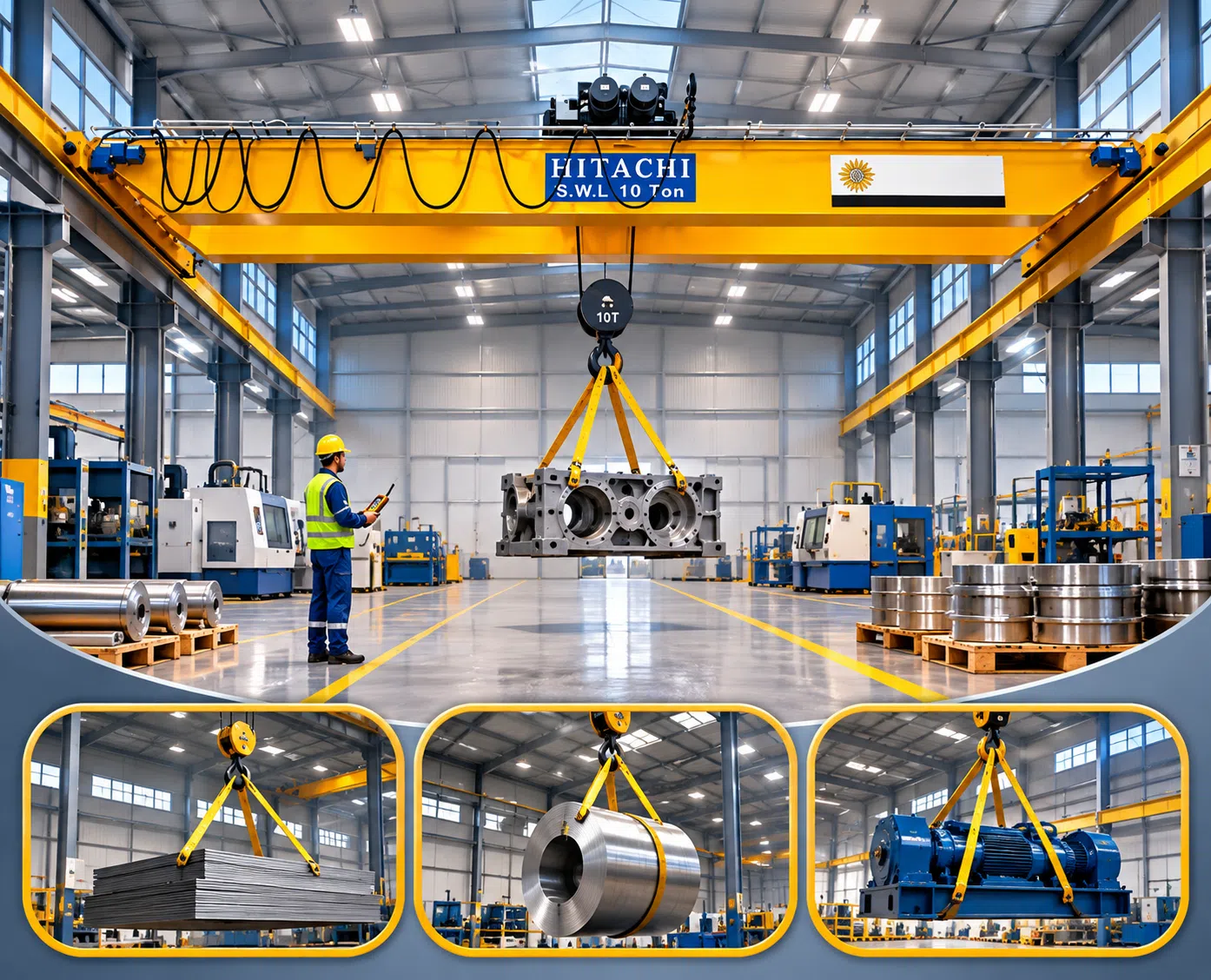
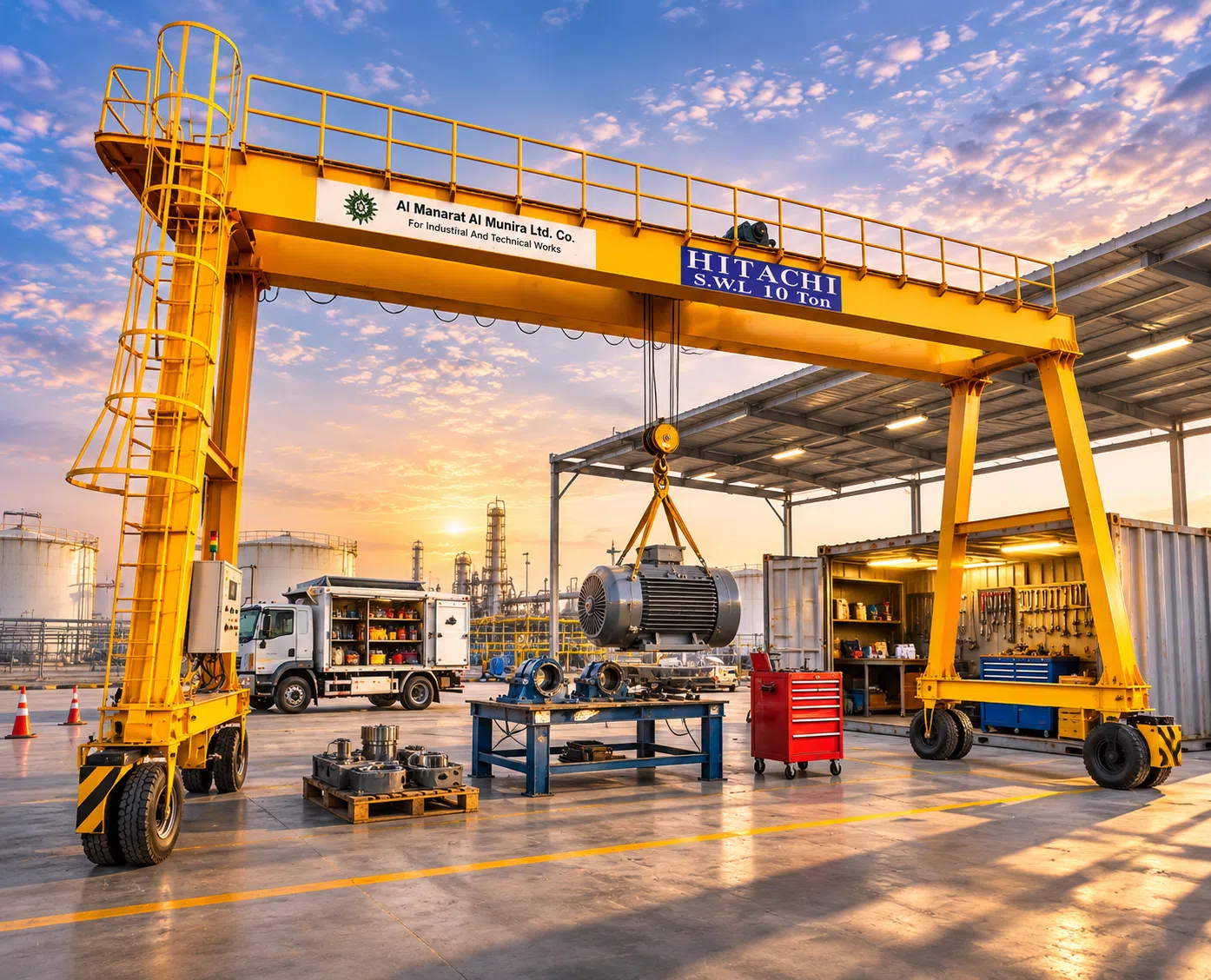
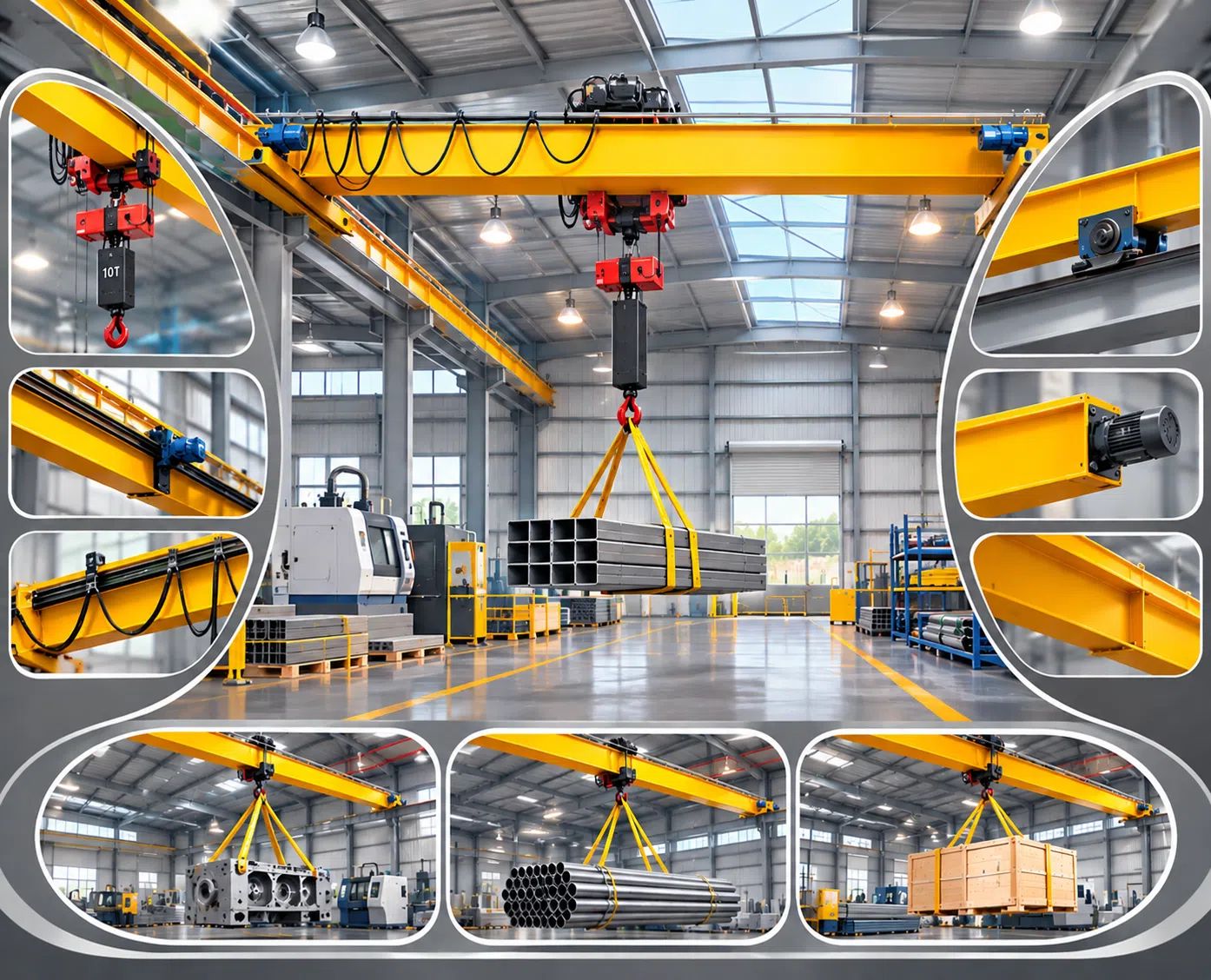
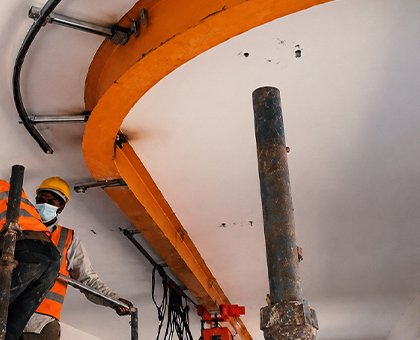
It consists of a wide steel bridge (single or double girder) spanning the entire width of the hall, with both ends resting on end trucks that travel lengthwise over runway beams fixed to the hangar columns. The hoist trolley travels across the bridge, giving the system the ability to lift and move loads to any point in the rectangular area of the hall over distances of tens or hundreds of meters.
Comprehensive Comparative Analysis: Jib Crane vs. Overhead Crane
The points below set out the direct technical, operational and investment differences between the two systems to help you make the best decision for your work environment:
- Coverage range and engineering area: The overhead crane covers the entire hall with three-dimensional motion that carries loads from one end of the hangar to the other, while the jib crane is limited to a circular or semicircular area defined by the radius of its arm (usually 2 to 7 meters), dedicated to serving a particular machine or inspection bench.
- Lifting capacities and load range: The overhead crane excels at handling very heavy loads and huge blocks, starting from 5 tons and easily exceeding 100 tons, while the jib crane is designed to serve light and medium loads efficiently, from 250 kg up to a maximum of 5 or 10 tons for repetitive operations.
- Capital cost and foundation work: The overhead crane requires a large capital investment that includes parallel runway beams the length of the hall, strong support structures, a heavy bridge and multiple travel motors, while the jib crane has a very economical manufacturing and installation cost, a small fraction of the cost of an overhead crane, with light civil foundation requirements.
- Operational flexibility and waiting-time management: With a single overhead crane, the other technicians stop work waiting for it to become free to move a small part. Here the jib crane offers a smart decentralized solution that gives each technician their own hoist to complete immediate tasks freely, without any waiting.
- Impact on the building's structure: The overhead crane imposes huge dynamic loads and lateral reaction forces on the hangar's columns and walls, while free-standing jib cranes need only independent concrete floor foundations, placing no stress on the workshop's roof or walls.
How Do You Choose the Right System for Your Workshop?
The engineering choice can be settled by following clear guiding criteria based on your production line priorities and available budget:
When Should You Choose the Jib Crane?
- If your lifting operations are confined to dedicated work cells (such as feeding a specific milling machine or lathe).
- When you want to reduce capital costs and avoid costly structural modifications to the facility's roof.
- If the loads handled are light to medium (less than 5 tons) and require fast, independent lifting and lowering.
- In maintenance workshops, to dismantle and assemble engine and pump parts over inspection benches without moving the load over long distances.
- As a supporting, complementary solution beneath the runway of an existing overhead crane, to end operational bottlenecks at critical assembly stations.
When Is the Overhead Crane the Required Choice?
- If material movement requires long-distance load transport linking the raw material receiving area to the final shipping area across the hall.
- When handling heavy weights above 10 tons and extra-long items such as steel beams, pipes and sheet metal coils.
- In major production lines, foundries and heavy structural fabrication plants that require three-dimensional handling over open areas.
- If the workshop is free of obstructions and relies on a continuous flow of material from one station to another along the length of the hall.
Working Together: How Do the Two Systems Operate Side by Side in Modern Halls?
Comparing the two systems does not necessarily mean ruling one out. Advanced industrial facilities adopt a hybrid strategy that combines the overhead crane with a network of jib cranes to achieve the highest logistical efficiency:
- The overhead crane as the main transport artery (Macro Handling): It receives heavy raw materials and unloads them from trailers at the start of the hall, or moves finished products to shipping and storage platforms.
- Jib cranes as local lifting tools (Micro Handling): They are fixed next to machines on wall columns or floor bases to take on detailed handling tasks and hold delicate parts in position inside machines for several hours, without tying up the main overhead crane that serves the rest of the workshop.
How Does Al Manarat Al Monerah Support You in Choosing and Equipping Your Industrial Crane?
Al Manarat Al Monerah (almanratalmonerah.com) has a prominent engineering presence and extensive experience in supplying and manufacturing advanced lifting systems in the Kingdom of Saudi Arabia and the Middle East, offering comprehensive services that secure the highest return on your investment:
- Engineering inspection and on-site material flow analysis: We study the work paths, part weights and structural layout of your workshop to provide an impartial technical assessment that determines precisely whether the hall needs a jib crane, an overhead crane or a combination of both.
- Manufacturing and supply to international standards (FEM/ISO/CMAA): We build steel structures from high-strength sections and equip cranes with European motors and gearboxes and smart variable frequency drives (VFD) that prevent load swing and save energy.
- Installation and precision laser alignment: Specialized engineering crews supervise the foundations and anchoring bases, or laser-align the overhead runway beams, to ensure smooth travel and long life for wheels and bearings.
- Load testing and calibration certificates: We carry out on-site static load (125%) and dynamic load (110%) tests and provide inspection certificates recognized by civil defense and industrial inspection bodies.
- Preventive maintenance contracts and immediate spare parts availability: Local warehouses stocked with motors, brakes, lifting chains, wire ropes and encrypted wireless controls ensure a fast response that protects your workshop from sudden breakdowns.
Al Manarat Al Monerah gives you direct access to its engineering experts for complete technical consultation and a detailed quotation that puts the most suitable solution for your workshop in your hands, raising its productive capacity with the highest standards of field safety.
Frequently Asked Questions About Jib Cranes and Overhead Cranes
Can a jib crane be installed in a workshop that already has a working overhead crane?
Yes, absolutely, and this is the most common application in modern factories. The jib crane is installed at a low height beneath the travel path of the overhead crane to serve specific fabrication stations, freeing the overhead crane to move large pieces only and eliminating worker waiting periods.
Which is easier to relocate when moving to a new or leased workshop?
The jib crane is much easier to dismantle, move and reinstall. Wall-mounted models only require unbolting the fixings from the columns, and free-standing models can be unbolted from their foundation anchors and moved, with a new foundation poured at the leased workshop. An overhead crane, by contrast, requires dismantling tens of meters of runway beams and complex electrical lines, and re-aligning the rails by laser at the new site at great cost.
What is the difference in periodic maintenance cost between the two systems?
The maintenance cost of a jib crane is very low because its mechanical parts are simple, limited to a single pivot axis, a hoist unit and a small trolley. An overhead crane requires higher maintenance budgets to inspect the long runway beams, the multiple end truck wheels, the long-travel and cross-travel motors, and the extended electrical feed systems.
Read also: Why Jib Cranes Boost Individual Worker Productivity