
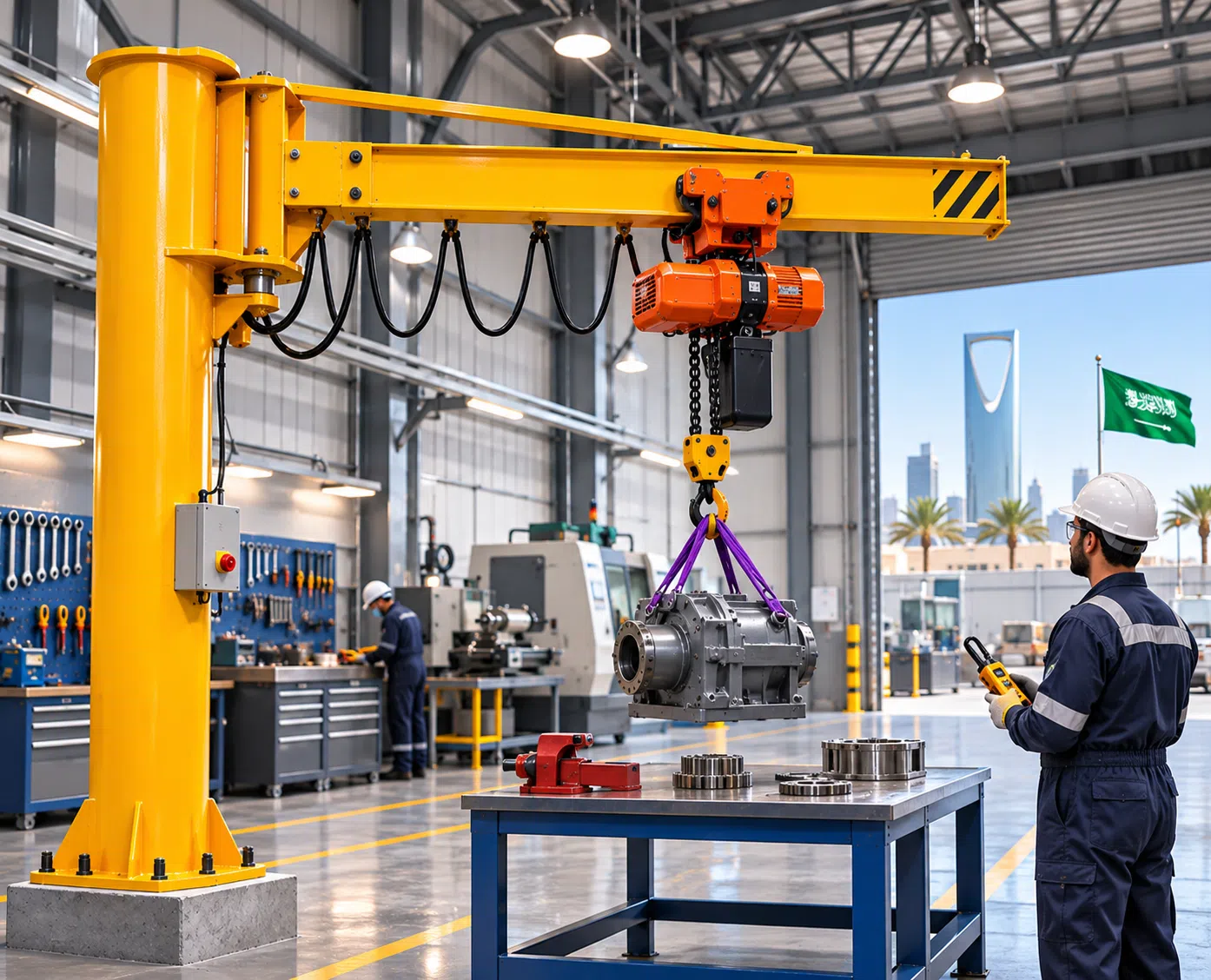
Why Does Your Maintenance Workshop in Saudi Arabia Need a Jib Crane?
Mechanical workshops and industrial maintenance centers in the Kingdom of Saudi Arabia are undergoing a rapid operational transformation that keeps pace with the major development drive launched by Vision 2030. The fleets of heavy transport, excavation and mining equipment, and construction machinery have grown, and they require fast, precise routine maintenance that cannot tolerate delays in delivering equipment to field projects. The work environment in the major industrial cities, from Riyadh, Dammam and Jeddah to Jubail and Yanbu, imposes harsh space and climate pressures. Crowded halls demand that every square meter be used efficiently, and high temperatures increase the physical strain on workers while dismantling and handling engines and heavy parts. In this crowded operating setting, investing in a jib crane in Saudi Arabia stands out as one of the most worthwhile mechanical solutions for making individual workstations independent and securing a safe, fast logistics flow that multiplies the pace of maintenance work at the lowest possible construction cost.
Why Is the Jib Crane Important for Maintenance Workshops in Saudi Arabia?
The jib crane is the ideal mechanical option for Saudi maintenance workshops thanks to its ability to serve inspection and operating stations with a flexible rotation range of up to 360 degrees without occupying traffic aisles, dedicating a crane to each technician to prevent long waits for the shared overhead cranes, and providing designs that are structurally and climatically compatible with the Saudi Building Code and the intense summer temperatures.
Equipping your workshop with this system secures direct operational and investment returns:
- Shortening maintenance downtime and the time to dismantle engines and pumps by more than 40%.
- Freeing the hall's floor aisles for forklifts and equipment carts, and avoiding congestion of vehicles.
- Achieving full compliance with the occupational safety requirements approved by civil defense and the Ministry of Human Resources and Social Development.
How Does the Jib Crane Support Workshop Efficiency in Saudi Industrial Cities?
The role of the jib crane goes beyond simply carrying weights. It provides fundamental solutions to the daily challenges of work in the local industrial environment:
1. Relieving the Main Overhead Crane (Overhead Crane)
In most workshops of authorities and large companies such as MODON, a single overhead crane running the length of the hangar is assigned to serve everyone. This situation forces technicians to wait a long time until the crane is free to move a small part, which holds up the maintenance station. The jib crane offers a decentralized solution that gives each workbench complete independence to raise and lower parts without waiting.
2. Resistance to Climate Changes and Extreme Heat
Temperatures inside non-air-conditioned workshops in summer reach record levels, accompanied by wind and active dust. Jib crane systems made for the Saudi market are built with motors with superior thermal insulation (Class H), advanced electrical protection ratings (IP55/IP65), and enclosed brakes that keep dust out and prevent sudden stoppages.
3. Using Space in Rented and Prefabricated Buildings
A wide segment of workshops rely on rented hangars where fundamental changes to the roofs or building complex bridge beams are not permitted. Free-standing jib cranes, or ones mounted on existing columns, offer a flexible solution fixed to concrete foundations with pre-tensioned bolts, which makes it easy to dismantle the system and move it in the future when relocating to another facility.
The Types of Jib Crane Best Suited to Workshops in the Kingdom
Crane designs vary to match the engineering layouts of Saudi factories and workshops:
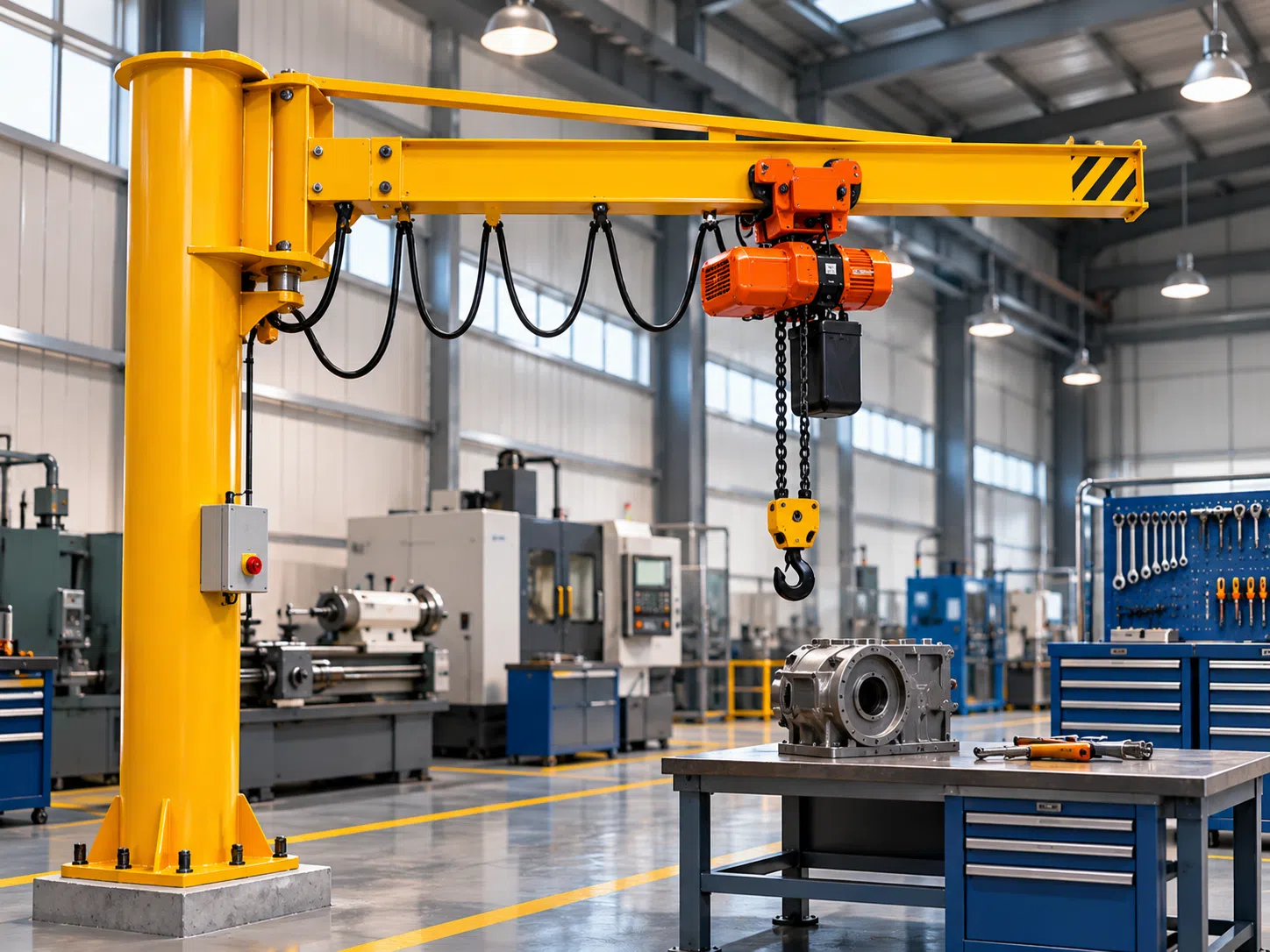
1. Free-Standing Pillar Jib Crane (Pillar Jib Crane)
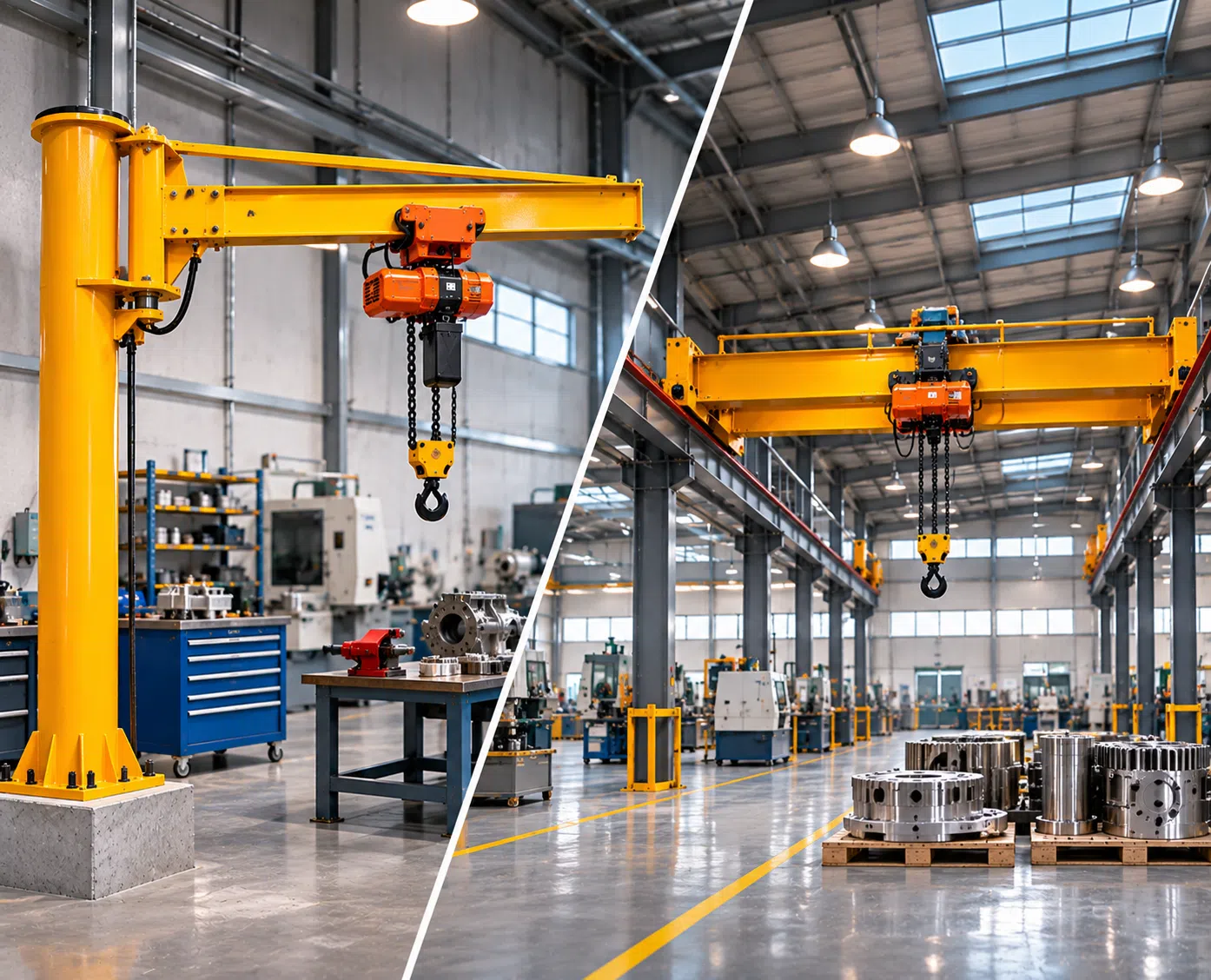
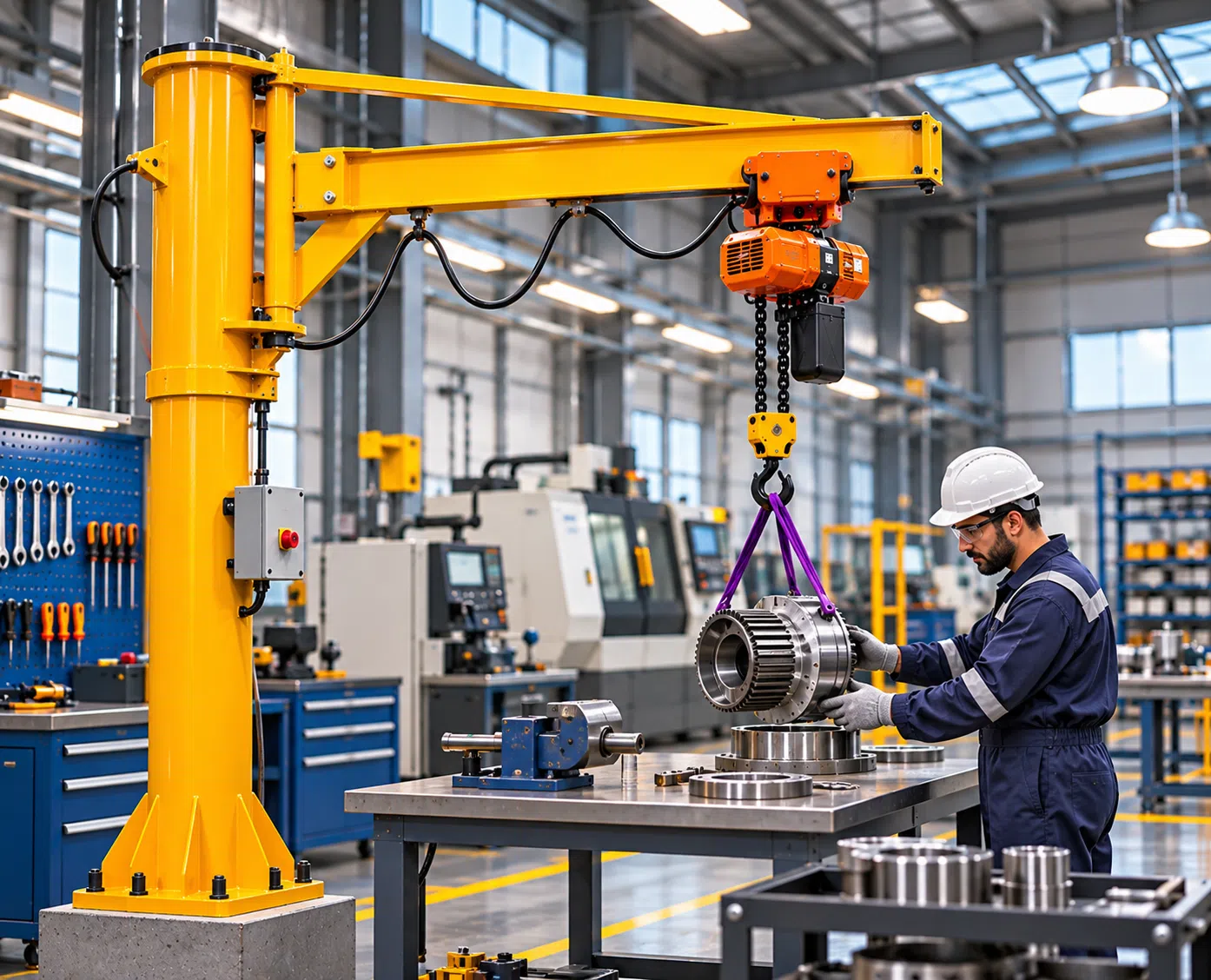
It rests on a solid steel column fixed into the hall floor and provides free 360-degree rotation. This design is the most suitable standard for heavy diesel engine maintenance stations and construction equipment refurbishment workshops in Riyadh and Jeddah, where it serves two opposite workbenches at once with weights starting at 500 kg and reaching 10 tons.
2. Wall-Mounted Jib Crane (Wall-Mounted Jib Crane)
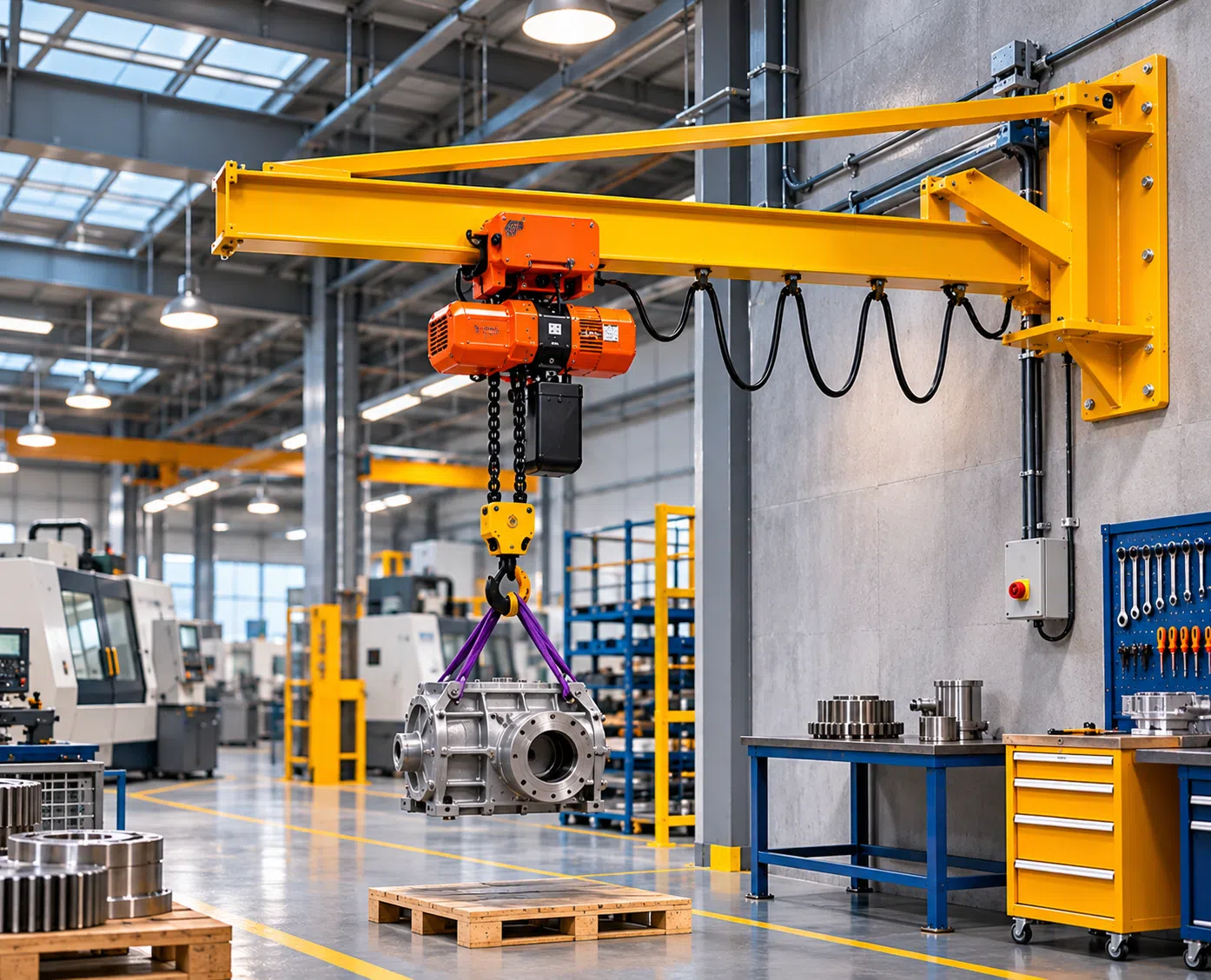
The jib arm is mounted directly on reinforced concrete walls or the existing steel hangar columns, with a rotation angle of up to 180 or 200 degrees. Its major advantage is leaving the workshop floor completely clear, which makes it ideal for rows of assembly stations and metal turning stations lined up beside the walls in the machining workshops of Dammam and Jubail.
3. Wall-Traveling Jib Crane (Wall-Traveling Crane)
The jib arm travels on a runway beam fixed along the workshop wall beneath the overhead crane runway. This type combines jib reach with the ability to move between several consecutive rooms or inspection sections to serve maintenance of pumps and petroleum valves in energy plants.
Comparative Analysis: Jib Crane vs. Mobile Hydraulic Lifters (Engine Cranes)
Many maintenance workshops rely on manual mobile hydraulic lifters (engine cranes) to move parts. The following points show the fundamental and direct operational differences between them and the fixed jib crane:
- Space consumed and freedom of floor movement: Manual hydraulic lifters impose wide floor legs that eat up hall space, obstruct technicians' movement and snag on cables and pipes, while the jib crane leaves the work area empty with a suspended overhead rotating motion that does not cut across walkways.
- Maneuverability and load stability: A mobile lifter is affected by floor bumps and cracks, which can make the engine swing and fall during manual pulling, whereas the jib crane provides balanced, steady mechanical motion with a controlled rotation angle that prevents any dangerous vibration.
- Lifting capacities and maximum available height: The capacity of manual hydraulic lifters is mostly limited to 1 to 2 tons with short lift heights that do not exceed a truck's edge, while the jib crane lifts weights exceeding 5 to 10 tons with clear heights that easily reach above large equipment platforms.
- Physical effort and occupational safety: Operating manual lifters requires strenuous hydraulic pumping and tiring muscle pulling in hot weather, which raises back injury rates, while the jib crane works with a fully electric system and wireless controllers that let you lift and move weights with the click of a button and no strain at all.
Occupational Safety Standards and Compliance with Saudi Civil Defense Requirements
Mechanical systems in Saudi facilities require strict protective requirements that qualify them to pass periodic inspection:
- Structural fixing that resists overturning moment: Adhering to the design of concrete foundations according to the Saudi Building Code (SBC) and using high-strength anchor bolts that ensure the steel column withstands the severe bending moment at the arm's maximum reach.
- Mechanical rotation angle limiters: Fitting the rotation axis with adjustable mechanical stops to prevent the jib arm from hitting hangar walls, main electrical panels or pipe runs during circular motion.
- Electronic load sensors to prevent overloading: Cutting hoisting motion automatically and instantly when an attempt is made to lift a weight beyond the rated load, to protect the steel structure and the arm from structural deformation.
- Encrypted digital wireless controllers and emergency brakes: Enabling the technician to run dismantling and installation operations from a safe distance with a clear line of sight, away from the path of the lifted part, with self-locking electromagnetic brakes that hold the load in the air when power is lost.
Why Is "Al Manarat Al Monerah" Your First Choice for Equipping a Jib Crane in Saudi Arabia?
Al Manarat Al Monerah (almanratalmonerah.com) puts its long experience at the service of the industrial and development sector in the Kingdom, offering integrated solutions for supplying and installing lifting equipment:
- Tailored engineering studies and site surveys: Visiting your workshop in any city in the Kingdom and analyzing architectural drawings and floor thickness to choose the jib crane best suited to the type and volume of your maintenance work.
- Local manufacture to global standard specifications (FEM/ISO/CMAA): Building the columns and jib arms from high-strength steel plate, applying precise welding standards and non-destructive testing (NDT) that ensure a long service life without mechanical fatigue.
- Equipping the crane with genuine, certified, heat-resistant components: Fitting the arms with electric chain or wire rope hoists with motors with superior thermal insulation and speed drives (VFD) that prevent load vibration and save energy.
- On-site installation and precision laser alignment: Specialized engineering crews supervise anchor bolt setting and leveling of the rotation axes to ensure smooth, flowing rotation that is very light on the operator.
- Load testing and calibration certificates: Carrying out static (125%) and dynamic (110%) load tests on site and providing official inspection certificates qualified for acceptance by civil defense and the industrial and municipal authorities.
- Genuine spare parts readiness and fast technical support: Providing motors, brakes, travel wheels and wireless controllers in local warehouses to secure an instant response that protects your workshop from any sudden breakdown.
Al Manarat Al Monerah gives you direct access to its engineering consultants for a complete survey and technical consultation to ensure your maintenance workshop is equipped with the best jib crane, one that raises your productivity and supports your investment with the highest levels of field safety.
Frequently Asked Questions About Jib Cranes in Saudi Arabia
Can a jib crane be installed in a workshop with a ready-made concrete floor without extensive breaking up?
Yes, if the thickness of the existing concrete slab matches the engineering calculations for light weights (up to 1 ton), using wide load-spreading plates and advanced chemical anchor bolts. For loads exceeding two tons, a defined square must be cut into the floor and a dedicated reinforced concrete foundation poured at a suitable depth to ensure safety and compliance with the Saudi Building Code requirements.
What is the difference between manual and motorized electric rotation of a jib crane?
Manual rotation relies on the operator pushing the suspended load to steer the arm, and it is an economical choice ideal for short arms (up to 4 meters) and light loads. Motorized electric rotation (motorized slewing) relies on a ring slewing gear connected to a motor and a frequency drive to rotate the arm precisely and smoothly through the wireless control buttons, which is essential for heavy loads and long arms to avoid human strain and prevent load sway.
How long does it take to manufacture and install a jib crane for a workshop in Saudi Arabia?
Engineering manufacture to the workshop's custom dimensions usually takes between two weeks and 4 weeks, while on-site installation, fixing the crane, connecting power and carrying out load tests on site takes only 24 to 48 working hours, so the crane is ready for immediate operation and production.
Read also: Wall-Mounted Cranes: The Ideal Space-Saving Solution for Crowded Factories