
Space limitations inside modern workshops and factories represent a constant challenge for executives and production engineers alike. When factory floors become crowded with machinery, assembly lines, and personnel, introducing large lifting equipment such as forklifts or heavy overhead cranes becomes nearly impossible—or even dangerous for workers. In such complex environments, smart solutions are required that utilize “dead spaces” to provide independent and fast lifting capacity without sacrificing a single square meter of floor area.
Here, the engineering brilliance of advanced jib cranes emerges as specialized material handling tools designed to serve individual workstations efficiently and at minimal operating cost. In this guide from Al Manarat Al Munira, we explore how these compact systems can transform limited spaces into highly productive and flexible industrial environments.
What Are Jib Cranes and Wall-Mounted Cranes?
This category of cranes is based on a simple yet highly effective mechanical design. It consists of a horizontal arm (jib) that carries a hoist unit and rotates to cover a defined working area. The structural installation varies depending on the facility’s layout and available support:
Column-mounted jib cranes:
A standalone steel column is fixed to the factory floor, allowing the arm to rotate 360 degrees. This type is ideal for open workstation areas inside workshops.
Wall-mounted jib cranes:
In this design, the need for a floor-mounted column is eliminated. The jib arm is directly attached to the building wall or structural concrete columns, leaving the entire floor space completely free.
Wall-traveling cranes:
A more advanced solution where the crane travels horizontally along rails mounted on the wall, serving multiple adjacent workstations simultaneously.
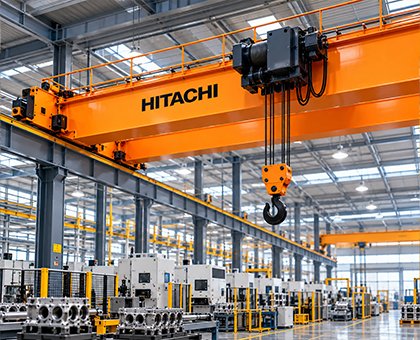
A wall-mounted jib crane allows large factories to install it beneath heavy overhead cranes, handling light and fast lifting operations without waiting for the main crane to become available.
Key Industrial Applications of Jib Cranes
Due to their high-speed handling capability and continuous operation in confined spaces, these cranes have become essential in several industrial applications:
1. Assembly lines and precision inspection stations
In electronics factories, automotive parts production, and motor assembly lines, technicians need to lift and rotate components slowly for inspection or installation. Jib cranes provide smooth and controlled movement that prevents damage to sensitive loads.
2. CNC machining loading and unloading
These cranes are commonly installed next to heavy CNC machines and lathes, allowing operators to load raw materials and remove finished parts independently without requiring additional lifting assistance.
Industrial and Economic Advantages of Wall-Mounted and Compact Cranes
Investing in a wall-mounted jib crane or compact lifting system provides immediate operational benefits that directly improve factory productivity:
Eliminating operational waiting time:
Workers no longer need to wait for the main overhead crane to become available, as each workstation has its own dedicated lifting system.
Maximum space utilization:
Wall-mounted designs utilize otherwise unused vertical surfaces, keeping floor areas clear and safe for daily operations.
Easy installation and low maintenance cost:
The simple mechanical design allows for quick maintenance procedures, reduced downtime, and lower operational expenses compared to larger crane systems.
Frequently Asked Questions About Jib Cranes
What is the maximum load capacity and boom length of a wall-mounted jib crane?
These cranes typically handle loads ranging from 250 kg up to 5 tons, while boom lengths can reach 7–8 meters depending on the structural strength of the supporting wall.
Can the crane arm be rotated manually or electrically?
For light loads and short boom lengths (under 2 tons), manual rotation is easy and practical. For heavier loads or longer arms, electric rotation systems are used to ensure smooth, safe, and low-effort operation.
Conclusion
Ultimately, jib cranes and wall-mounted crane systems demonstrate that operational efficiency is not always dependent on equipment size, but rather on how intelligently the system adapts to spatial challenges. Equipping your facility with these compact lifting solutions reduces downtime caused by worker inefficiency and ensures smooth production flow while maintaining the highest safety standards.
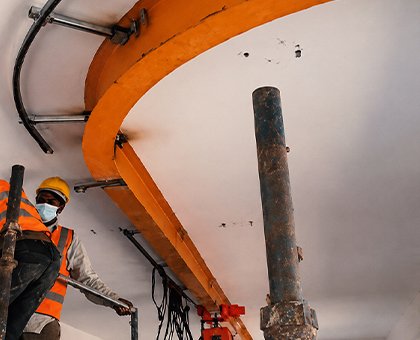
At Al Manarat Al Munira, we always recommend performing a detailed structural assessment of walls and concrete supports before any wall-mounted installation, to ensure a safe and durable lifting system that supports your industrial goals for many years to come.