
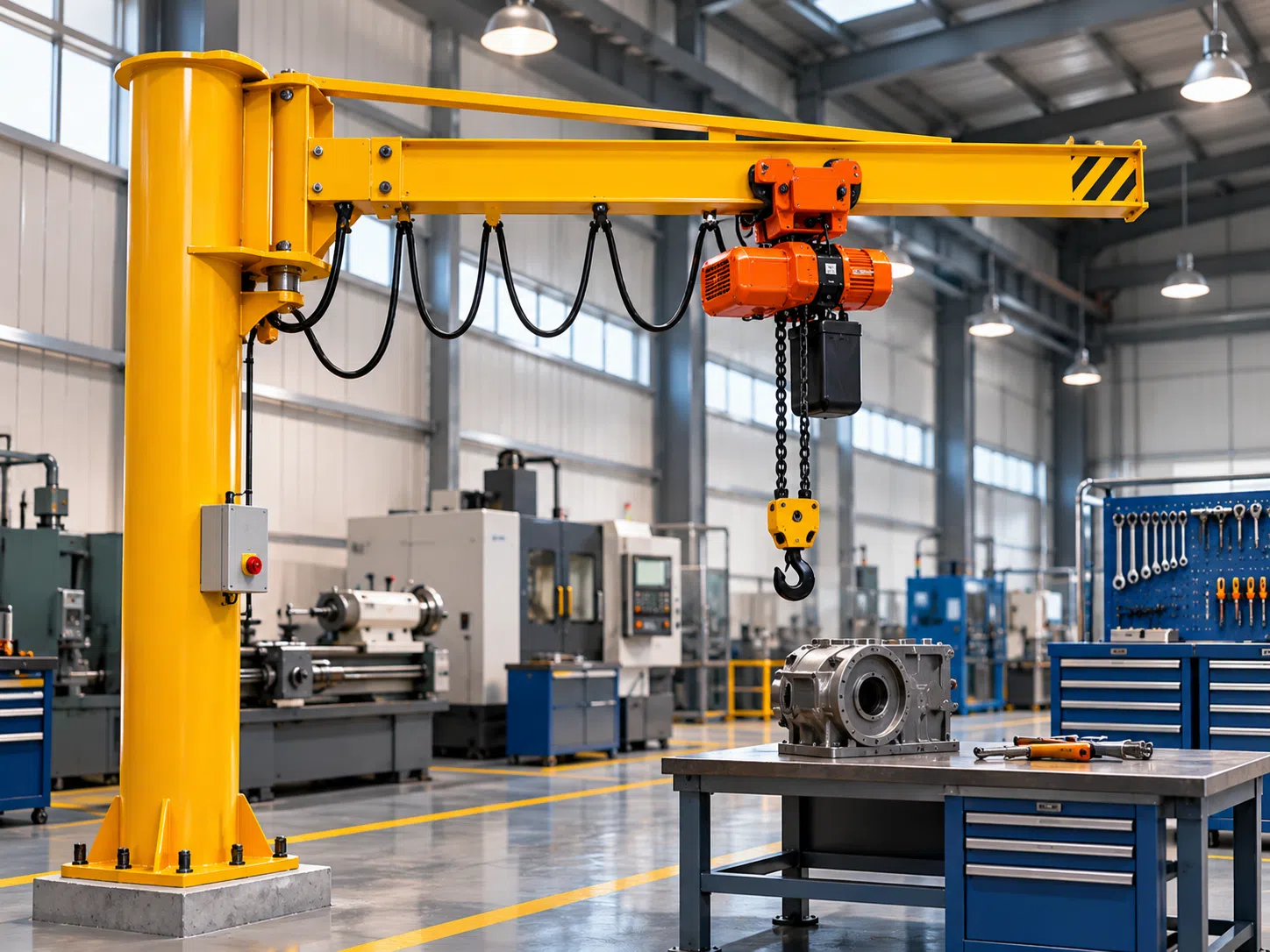
The Jib Crane: Uses and Types in Maintenance Workshops
Work intensity inside maintenance workshops and mechanical service stations reaches critical levels that demand very fast removal and installation of complex parts, without waiting for the large overhead cranes that serve the entire hall. Technicians spend long periods waiting for the bridge crane to become free so they can pull a truck engine or move a heavy pump to the inspection bench. Relying on manual lifting solutions or forklifts in the narrow aisles of a workshop creates stifling congestion and increases the risk of collisions with sensitive machinery. This is where the jib crane stands out as a self-contained mechanical solution that gives each work station its own complete orbital lifting platform, giving the technician full freedom to handle loads within a wide radius without disrupting the rest of the workshop lines or wasting daily working time.
What Is a Jib Crane?
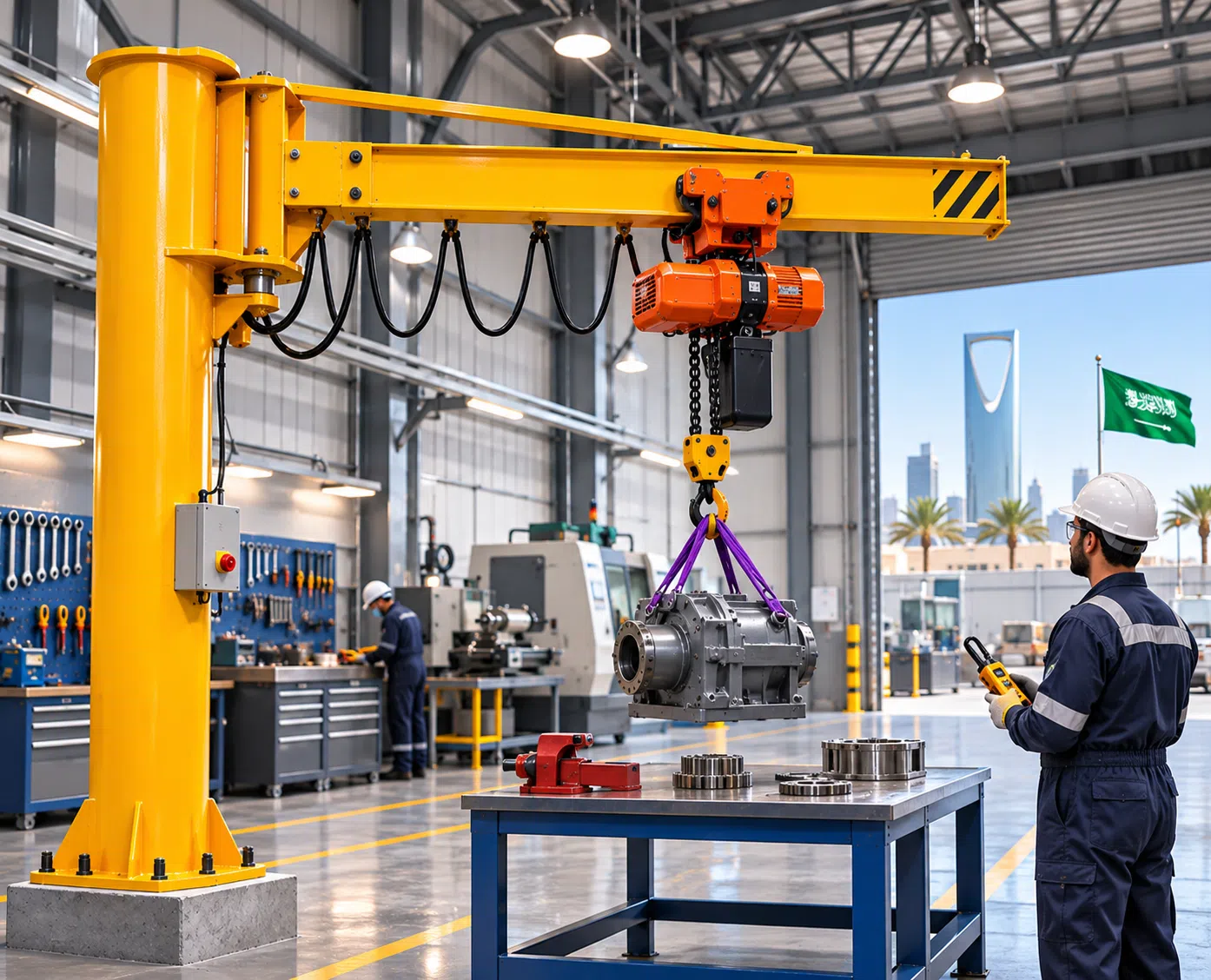
The jib crane (cantilever crane) is a compact industrial lifting system consisting of an extended horizontal arm (boom) fixed at one end, either to an independent vertical steel column resting on the floor, or directly to a concrete wall or one of the building's columns. The hoist and trolley travel along this arm, which can rotate through 180 to 360 degrees to cover a defined circular or semicircular working area.
Integrating this system into maintenance workshops delivers immediate operational gains:
- Complete independence for individual maintenance stations, with no need to call on the main overhead hall crane.
- Flexible floor coverage that allows equipment to be lifted and lowered onto inspection benches and lathes with great precision.
- Lower construction and foundation costs than large crane systems, with easy installation in confined spaces.
The Main Mechanical Components of a Jib Crane System
The efficiency of a jib crane depends on the integration of a group of elements designed to withstand the bending moment produced by the arm extending into open space:
1. The Horizontal Jib Boom
This is the main structural element that carries the weight of the load. It is made either from a rolled steel beam (I-Beam / H-Beam), with the trolley running on its lower flange, or from a closed hollow box section with an internal track for the wheels. The boom length is calculated precisely to resist deflection when the hook is at maximum reach at the free end.
2. Pivot Axis & Slewing Bearing
This is the central pivot point that lets the boom rotate. It relies on ball bearings and heat-treated steel shafts to reduce friction, and operates either by smooth manual rotation for light loads, or by an electric motor connected to a slewing ring (Motorized Slewing Drive) to rotate the boom precisely and safely when handling large loads.
3. Hoist & Trolley Unit
The trolley travels along the boom to cover the horizontal reach. It is fitted with an Electric Chain Hoist for precise tasks and compact spaces, or a wire rope hoist for heavy loads, with mechanical end stops at both ends of the boom to prevent the trolley from leaving the track.
4. Mounting Assembly
This varies by crane type. It is either a wide steel base fixed with pre-tensioned anchor bolts into reinforced concrete foundations in the ground, or a cantilever mounting bracket with fixing plates that wrap around the building's concrete or steel columns.
The Most Common Types of Jib Cranes in Maintenance Workshops
Jib crane designs vary to suit the architectural layout and the space available inside the workshop:
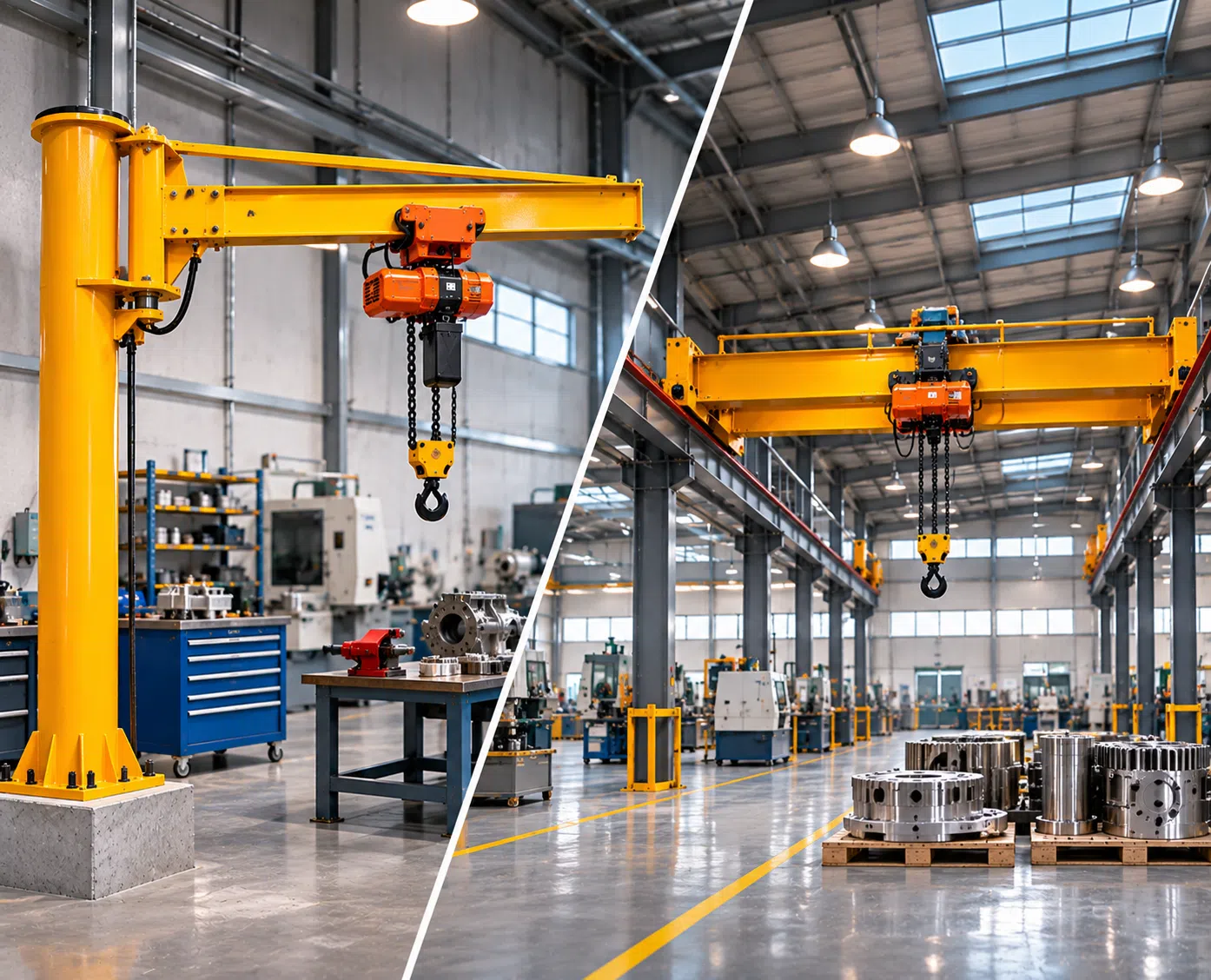
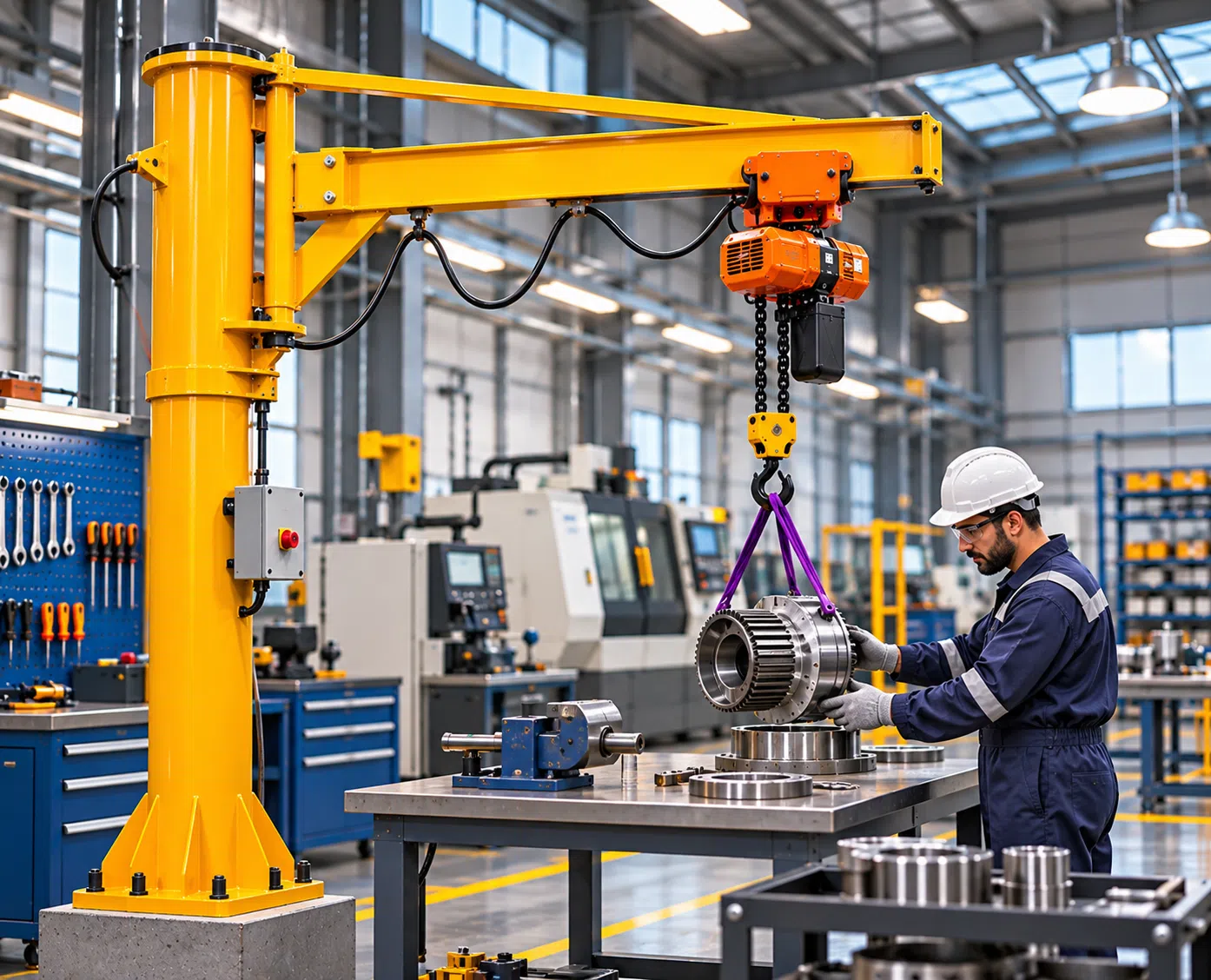
1. Pillar / Free-Standing Jib Crane
This crane rests on a solid cylindrical or thick tubular steel column fixed directly to the concrete floor. It is distinguished by its ability to rotate a full 360 degrees without any obstruction, making it ideal for central workshop stations and for serving two opposite work areas at once, with capacities from 500 kg up to 10 tons.
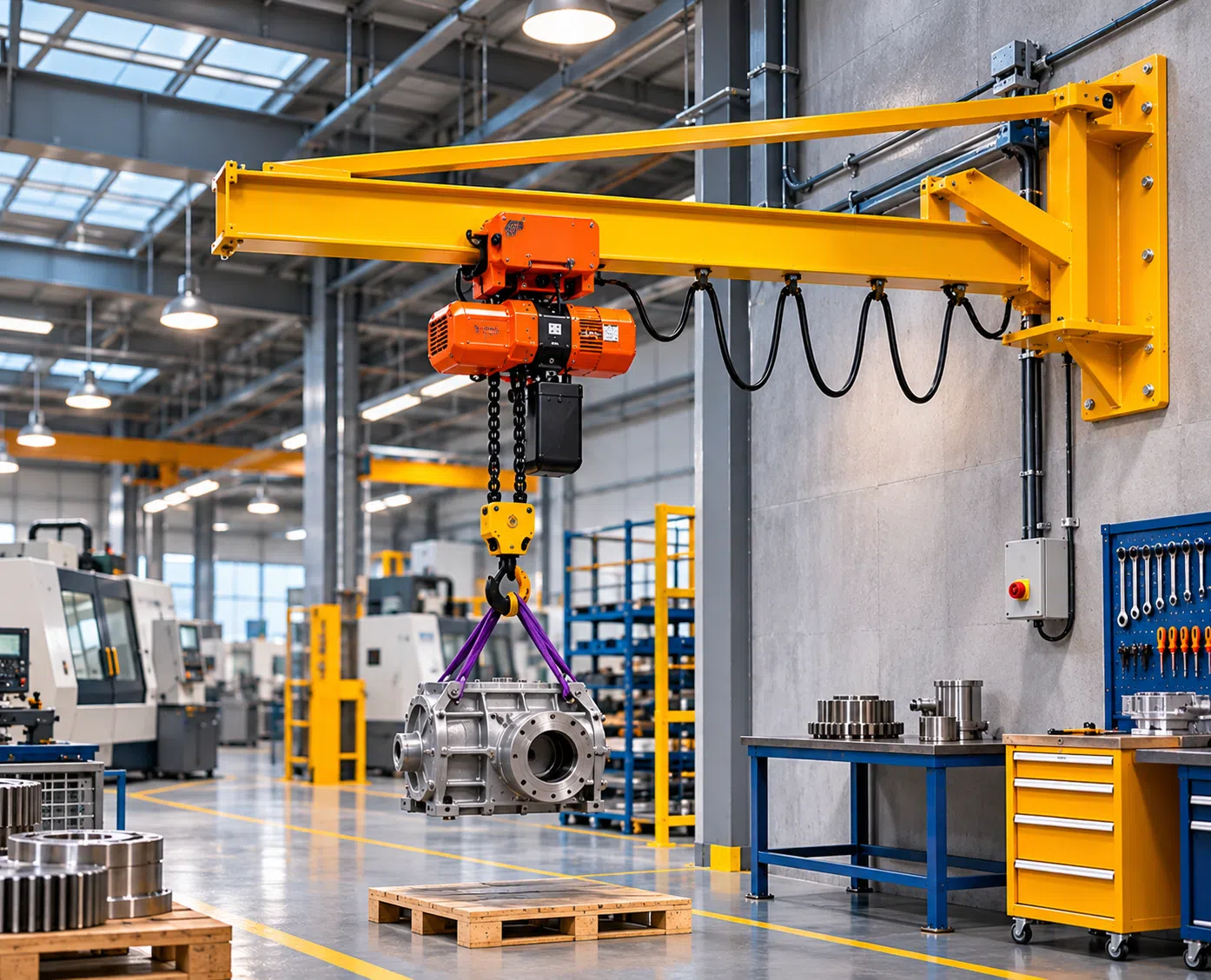
2. Wall-Mounted Jib Crane
The crane's supports and pivot axis are fixed directly to a standing concrete wall or a side building column, providing a semicircular rotation of up to 180 or 200 degrees. This category frees up the entire floor area because no vertical column touches the ground, and it is the standard choice for rows of maintenance stations lined up along the walls.
3. Wall-Traveling Jib Crane
An advanced mechanical solution in which the entire jib arm travels lengthwise on beam tracks and rails fixed to the hall wall below the path of the main overhead crane. It combines the advantage of cantilever reach with the ability to move between several consecutive workshops and maintenance stations along the building's wall.
4. Articulated Jib Crane
In this model the arm has an additional middle joint, similar to a human arm, which allows the crane to bend and reach dead corners, work around columns and enter machine cavities and inspection rooms that straight arms cannot enter.
Comparative Analysis: Free-Standing Jib Crane vs. Wall-Mounted Jib Crane
The points below set out the direct technical and structural differences to help you choose between the two designs and find the best solution for your workshop:
- Coverage and rotation angle: The free-standing crane gives a full 360-degree free rotation that covers a complete working circle around the column, while the wall-mounted crane's rotation is limited to a semicircular range of 180 to 200 degrees at most, because the wall blocks the arm's path of rotation.
- Floor space use and freedom of passage: The wall-mounted crane leaves the workshop floor 100% clear because it has no floor bases, making it easier for tool carts and forklifts to move, whereas the free-standing crane takes up a circular area around its poured concrete base.
- Structural and foundation requirements: The free-standing crane requires a reinforced concrete foundation poured to an engineered depth and thickness to resist the overturning moment, while the wall-mounted crane relies on the strength of the existing wall or building columns, which calls for a prior check of how well the workshop walls can bear lateral stresses.
- Total cost and relocation flexibility: The wall-mounted crane has a lower manufacturing cost because it has no large vertical column, while the free-standing crane offers more freedom in choosing the installation point anywhere in the open hall, without being tied to the locations of the concrete columns.
Key Uses of the Jib Crane Inside Maintenance Workshops
This equipment serves a wide range of complex mechanical operations thanks to its quick response:
Dismantling and Assembling Truck Engines and Heavy Machinery
The crane is positioned next to the engine stand to pick up cylinder heads, turbochargers and heavy engine blocks. It lets the technician rotate the part in the air and position it with millimeter precision on rotating maintenance stands without any muscular effort.
Feeding Lathes & CNC Machines
The system makes it easy to lift steel plates and raw blocks, move them from storage platforms and place them directly between the machine's jaws. This protects the precision machine tables from impacts caused by rough lowering and speeds up set-up between jobs.
Welding and Mechanical Fabrication Stations
Welders use the jib arm to hold and position metal structures at different angles during welding. The workpiece can be moved manually or by motor to follow the weld line smoothly, with no need for expensive auxiliary fixtures.
Pump and Valve Maintenance in Power and Water Plants
Jib cranes are installed next to pipe runs to lift large valves and submersible electric motors, inspect them, replace mechanical seals and return them to their bases accurately and quickly.
Occupational Safety Standards for Operating and Installing Jib Cranes
Loads suspended from an extended arm generate a very large turning moment, which calls for strict preventive measures to keep the workshop safe:
- Engineering verification of foundation strength and anchor bolts: The depth and design of the concrete foundations must not be less than the structural calculations required to resist the overturning moment, using high-strength steel anchor bolts whose tightening is checked with a regularly calibrated torque wrench.
- Mechanical rotation stops: Install adjustable stops on the pivot axis to limit the arm's angle of movement and prevent it from hitting workshop walls, electrical cabinets or neighboring pipelines.
- Overload protection sensors: Fit the crane's hoist with electronic cut-outs that stop upward movement immediately if the weight of the part exceeds the crane's rated capacity, protecting the arm from bending or breaking at maximum reach.
- Slewing brakes and resistance to self-rotation: Fit the pivot axis with adjustable friction brakes that stop the arm from rotating uncontrolled by itself under the effect of floor slope or air currents inside the hall.
How Does Al Manarat Al Monerah Support You in Choosing and Equipping a Jib Crane?
Al Manarat Al Monerah (almanratalmonerah.com) leads the manufacturing and supply of industrial lifting equipment in the Kingdom and the Middle East, offering an integrated range of engineering solutions to raise the efficiency of maintenance workshops:
- Free site inspection and structural calculations: We examine your workshop floors and walls and calculate the moment and bending loads to determine the most suitable type (free-standing or wall-mounted), with an arm length that gives maximum coverage of your work stations.
- Engineered manufacturing to the highest standards (FEM/ISO/CMAA): We build jib arms and columns from high-strength steel plate, with welds treated and checked by non-destructive testing (NDT) to ensure absolute durability under the harshest daily use.
- Equipping the crane with the latest electric hoists and frequency inverters: We fit the arm with reliable European electric chain hoists with variable speed drives (VFD) to give smooth, vibration-free lifting and rotation movements.
- Certified field installation and precise alignment: Specialized engineering crews supervise the anchor bolt installation and laser-level the pivot axis to ensure light, smooth rotation with no physical effort.
- Load testing and calibration certificates for civil defense: We perform on-site static (125%) and dynamic (110%) load tests and provide official inspection reports that prove the equipment is ready for operation and complies with occupational safety requirements.
- Genuine spare parts and fast technical support: Motors, brakes, trolley wheels and control switches are stocked in local warehouses to ensure fast preventive maintenance that protects your workshop from sudden breakdowns.
Al Manarat Al Monerah gives you direct access to its engineering consultants for a detailed study and a tailored technical and financial proposal, putting in your hands a jib crane designed to serve your maintenance stations with efficiency and safety that last for decades.
Frequently Asked Questions About Jib Cranes and Maintenance Workshops
Can a free-standing jib crane be installed on an ordinary concrete floor without excavation?
This is not recommended for medium and heavy loads unless the floor was previously poured as an extra-thick reinforced industrial concrete slab designed to resist the overturning moment. In most workshops, a square reinforced concrete foundation dedicated to the crane base must be excavated and prepared, with dimensions set by the structural engineer to ensure the equipment stays stable and is not pulled out of the ground when lifting at maximum arm reach.
What is the maximum reach available for a jib crane arm in a workshop?
The standard arm length is usually between 2 and 6 meters for medium loads, so that beam deflection stays within safe engineering limits. In special designs the arm can be extended to 8 or 10 meters, with the arm supported by triangular overhead tension ties (Tie-Rod Supported) to reduce the weight of the structure and keep it straight.
How is the jib crane arm rotated while heavy loads are suspended?
For light loads up to one ton and a short arm, the crane is rotated smoothly by hand, pushing on a dedicated handle next to the hook. For loads above two tons, or when long arms are used, an electric motor with a brake and a frequency inverter is fitted, connected to a slewing ring gear, so the operator can rotate the arm left and right at the push of a button using the wireless control, with precision and complete safety.
Read also: Why Does Your Maintenance Workshop in Saudi Arabia Need a Jib Crane?