
The Complete Guide to Choosing Industrial Cranes for Every Application
Material handling and lifting systems are the backbone of logistics flow and process integration inside factories, forming shops and loading terminals. The lifting system you choose is the real difference between a production line that runs smoothly and quickly and one that suffers constant operational bottlenecks and mechanical failures that drain profits. Buying new industrial cranes goes beyond finding a particular tonnage; it is a combined engineering and investment decision that links the architecture of the building, the nature of the materials being moved, the duty classification, and internationally recognized occupational safety standards such as FEM, CMAA and ISO.
How Do You Choose the Right Industrial Crane for Your Application?
The right industrial crane is chosen by analyzing the structural work environment, determining the maximum lifting capacity with a safety margin of at least 20%, defining the required motion pattern and coverage path (three-dimensional, linear, or orbital), matching the duty cycle and heavy-duty classification (Duty Class), selecting the suitable lifting medium (wire rope or chain), and ensuring smart frequency-controlled drives and certified safety sensors are available.
Checking these elements in advance delivers immediate operational returns:
- Capital is invested precisely, without unjustified over-engineering or buying equipment that cannot meet future requirements.
- Long waiting times are eliminated entirely and the flow of raw materials and products is secured.
- Your facility complies with civil defense requirements and industrial inspection bodies, and the work environment is kept free of hazards.
Types of Industrial Lifting Cranes and Their Applications
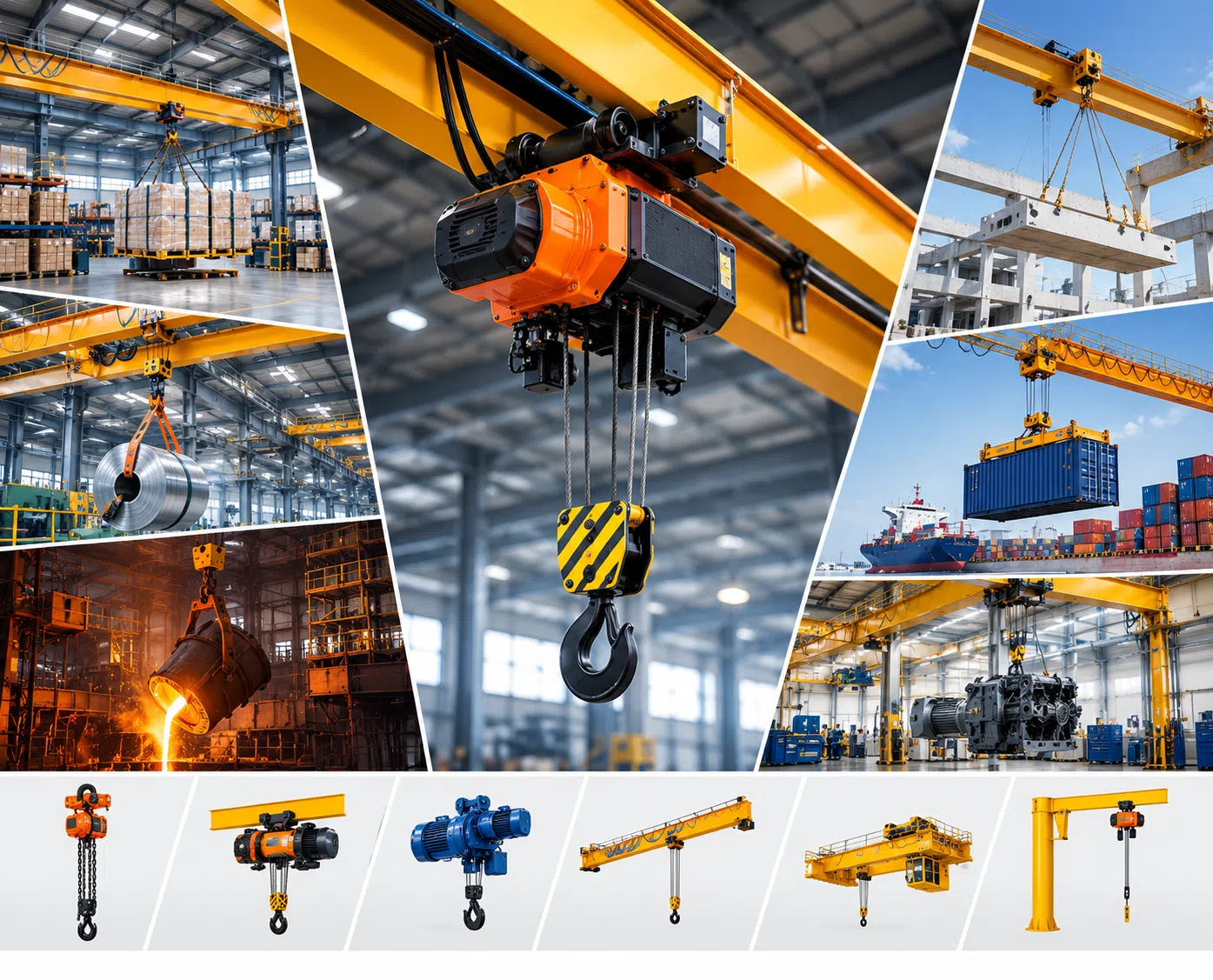
Mechanical lifting systems come in many forms to suit the varied spatial and operational requirements of production halls:
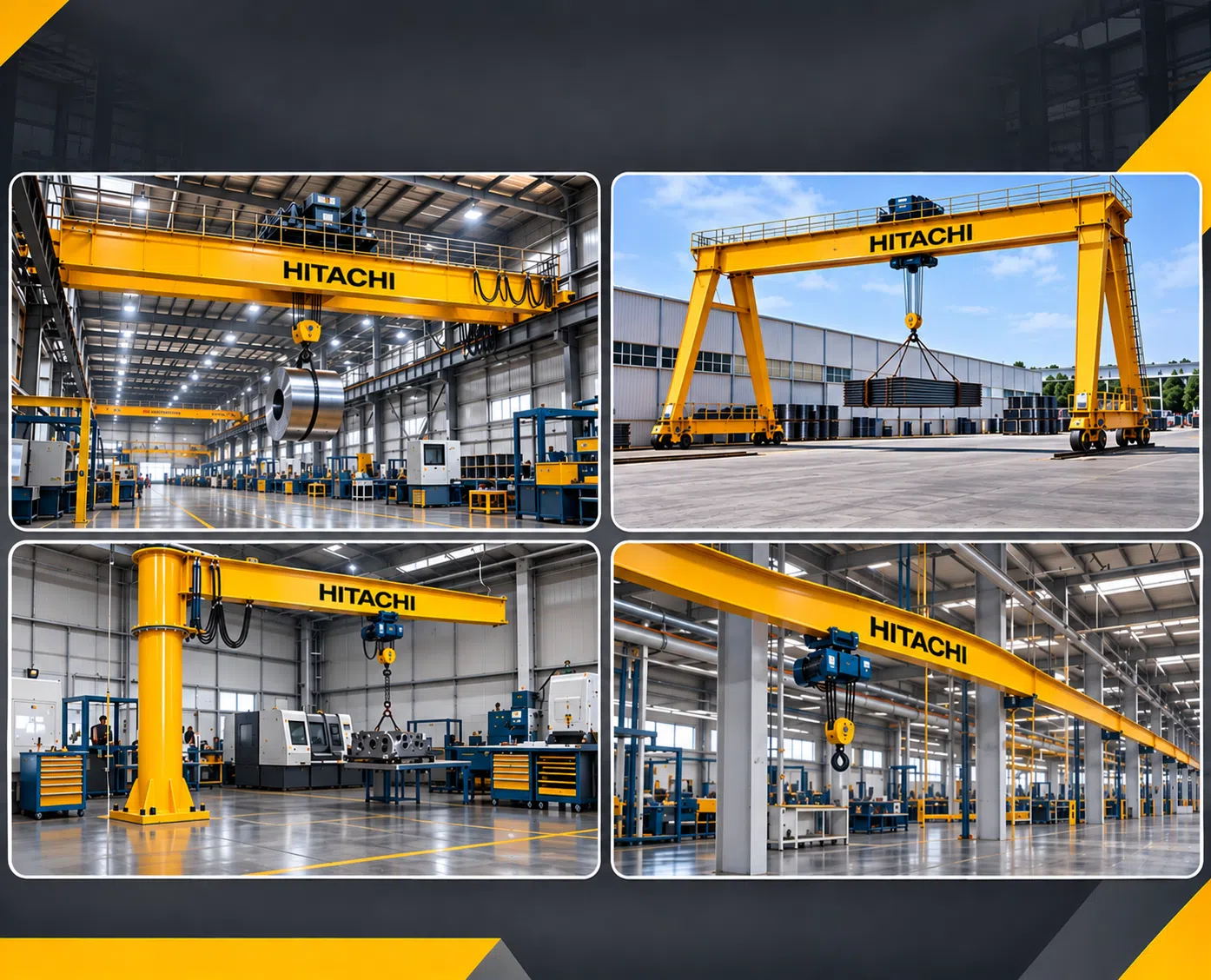
1. Overhead / Bridge Cranes
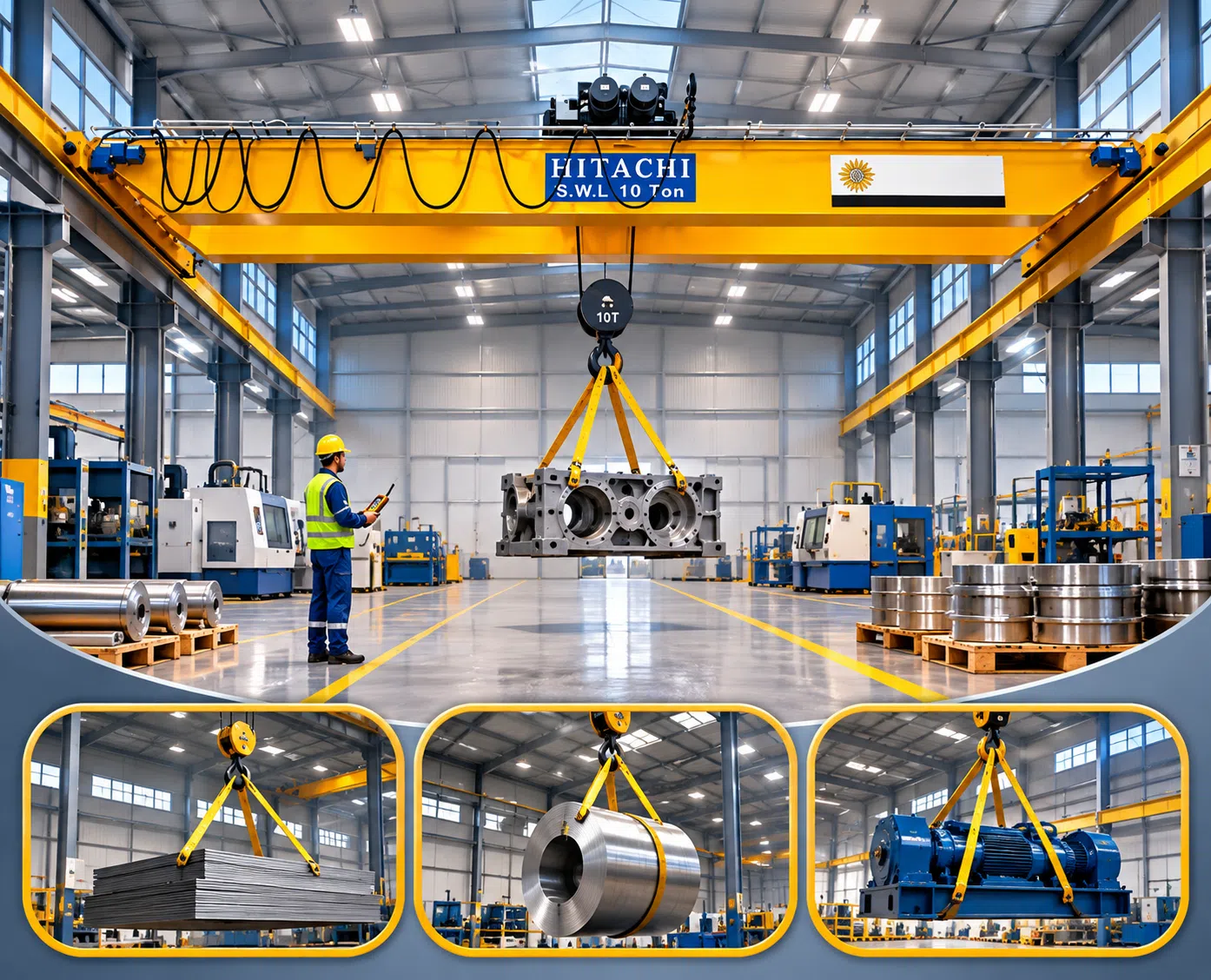
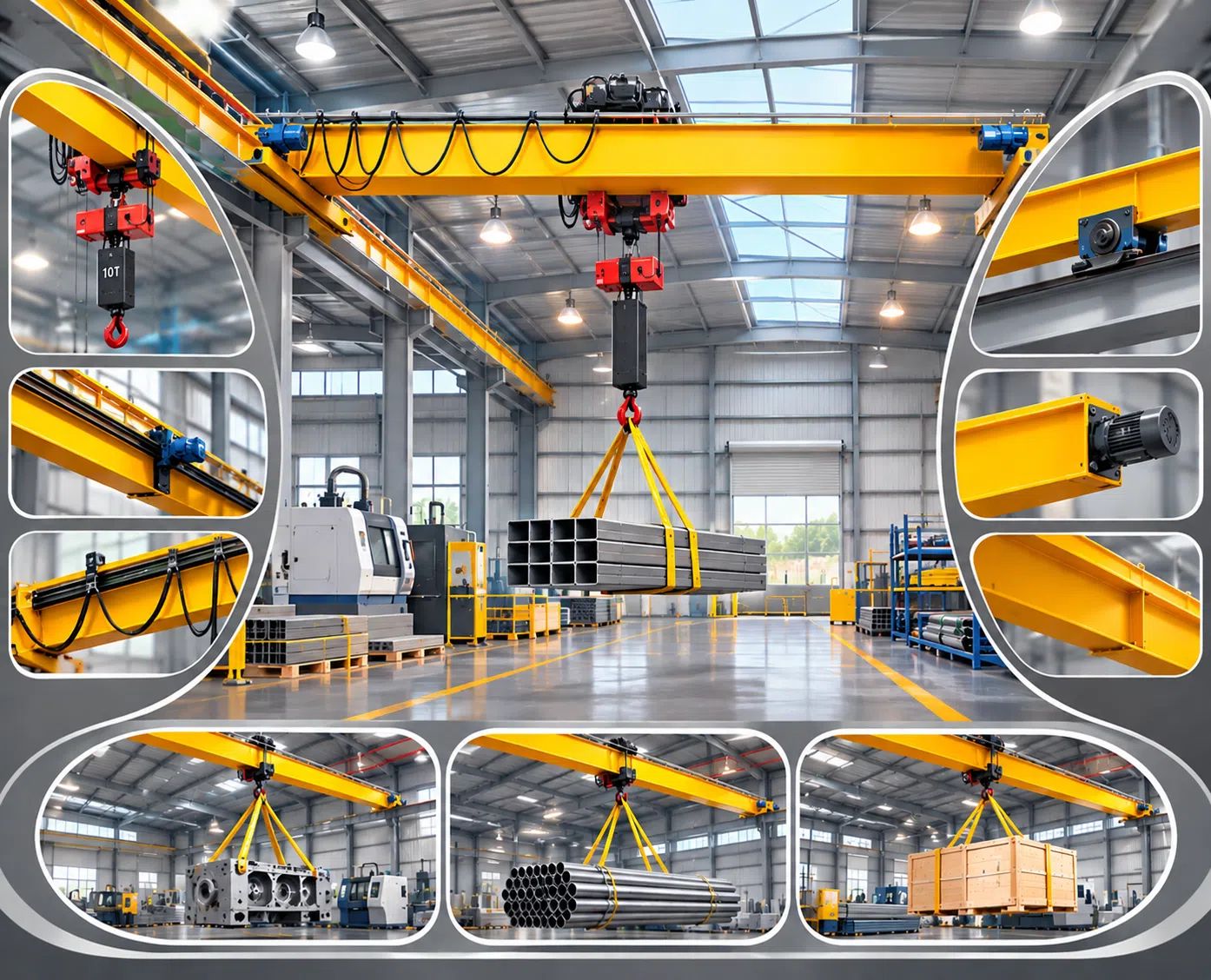
These are the backbone of large factories and open warehouses. They travel on parallel runway beams fixed to the columns of the structural frame. They provide full rectangular (three-dimensional) coverage and are available in a single girder configuration for light and medium loads up to 10-15 tons, or a double girder configuration for heavy loads, wide spans and very high lifting heights.
2. Gantry & Semi-Gantry Cranes
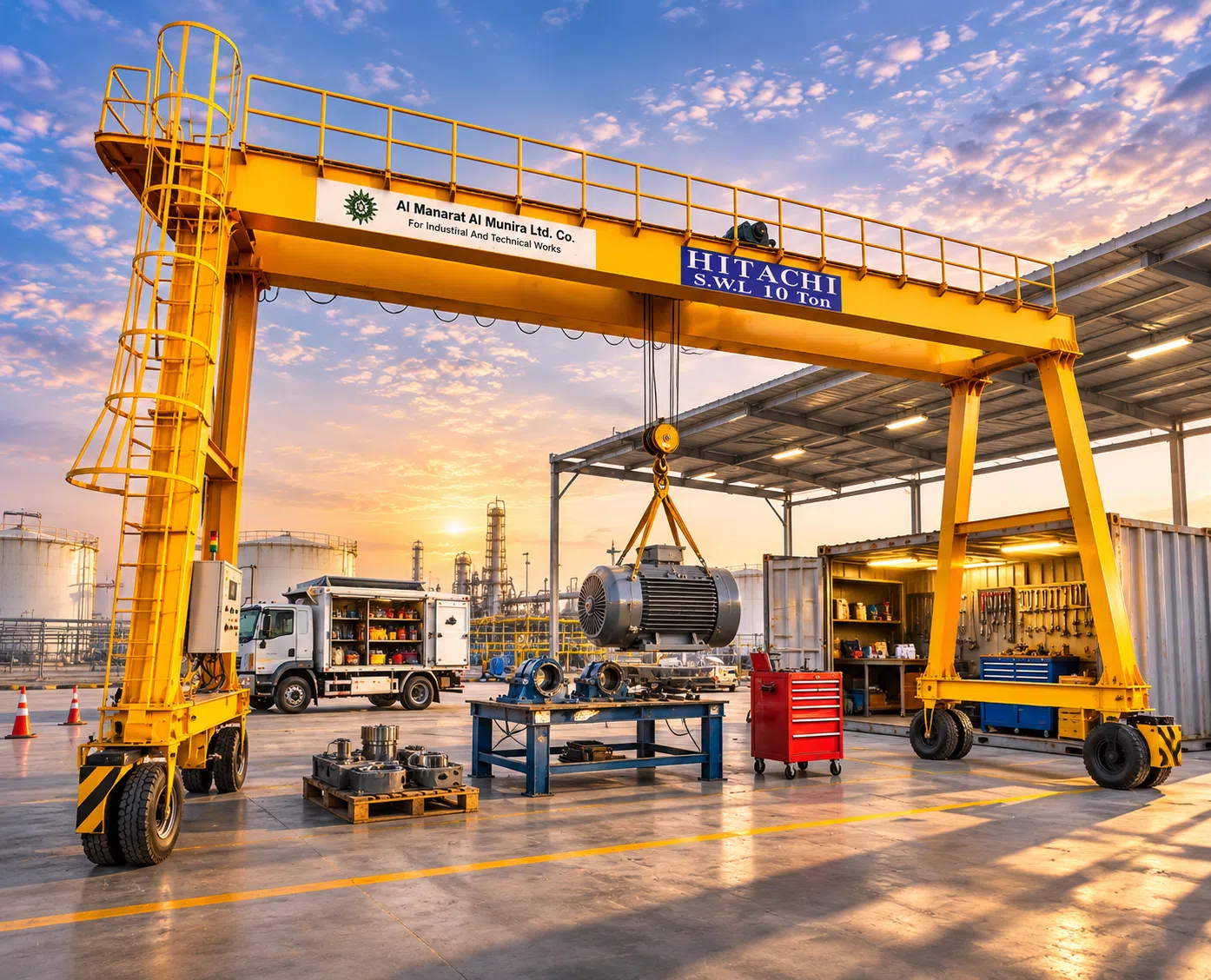
These stand on steel legs that travel on rails fixed in the floor or on the hall wall. They are the ideal solution for open storage yards, container unloading ports and precast concrete plants, offering a self-supporting solution that needs no roof truss structure to carry it.
3. Jib Cranes
These consist of a horizontal cantilever arm that rotates around an independent column fixed in the floor (360 degrees) or mounted on a concrete wall (180 degrees). This category specializes in serving individual work cells, feeding CNC machines and quick-maintenance stations, so the main overhead crane is not tied up.
4. Suspended Monorail Hoists
These rely on a single steel beam track suspended from the ceiling, along which the hoist trolley travels on a fixed, predetermined linear path (straight or curved). They excel in sequential assembly lines, painting and chemical washing tanks, and food and pharmaceutical plants.
Comparative Analysis: Main Crane Types by Application and Space
The points below set out the key differences to help you quickly compare the leading industrial systems:
- Coverage area and range of motion: An overhead crane provides three-dimensional coverage of the entire hall floor, a jib crane offers circular coverage around a single work cell, and a monorail hoist is confined to an overhead linear path defined by a start and end point.
- Infrastructure and structural requirements: An overhead crane requires strong runway beams and columns along the length of the hall, a gantry crane needs level ground rails, while a monorail hoist simply hangs from the existing roof trusses without using any floor space.
- Lifting capacities and load range: Double girder overhead and gantry cranes lead in heavy lifting capacity (from 10 tons up to hundreds of tons), while monorail hoists and jib cranes are designed for fast, light and medium loads (from 250 kg to 10 tons).
- Capital cost and flexibility: Jib cranes and monorails have a low capital cost and are easy to dismantle and relocate, whereas overhead cranes are a major fixed investment that serves the hall for decades.
Critical Engineering Criteria for Choosing a Crane
Specifying a crane requires studying a set of technical parameters to ensure complete compatibility:
1. Determining the Duty Classification
A crane that works 20 minutes a day in a periodic maintenance shop is not comparable to one that runs around the clock in steel foundries and paper mills. FEM standards (such as 1Am, 2m, 3m) and CMAA classes (from Class A for light work to Class F for continuous severe service) determine the motor size, gear thickness, oil cooling rate and metal fatigue resistance.
2. Choosing the Lifting Medium: Wire Rope or Chain?
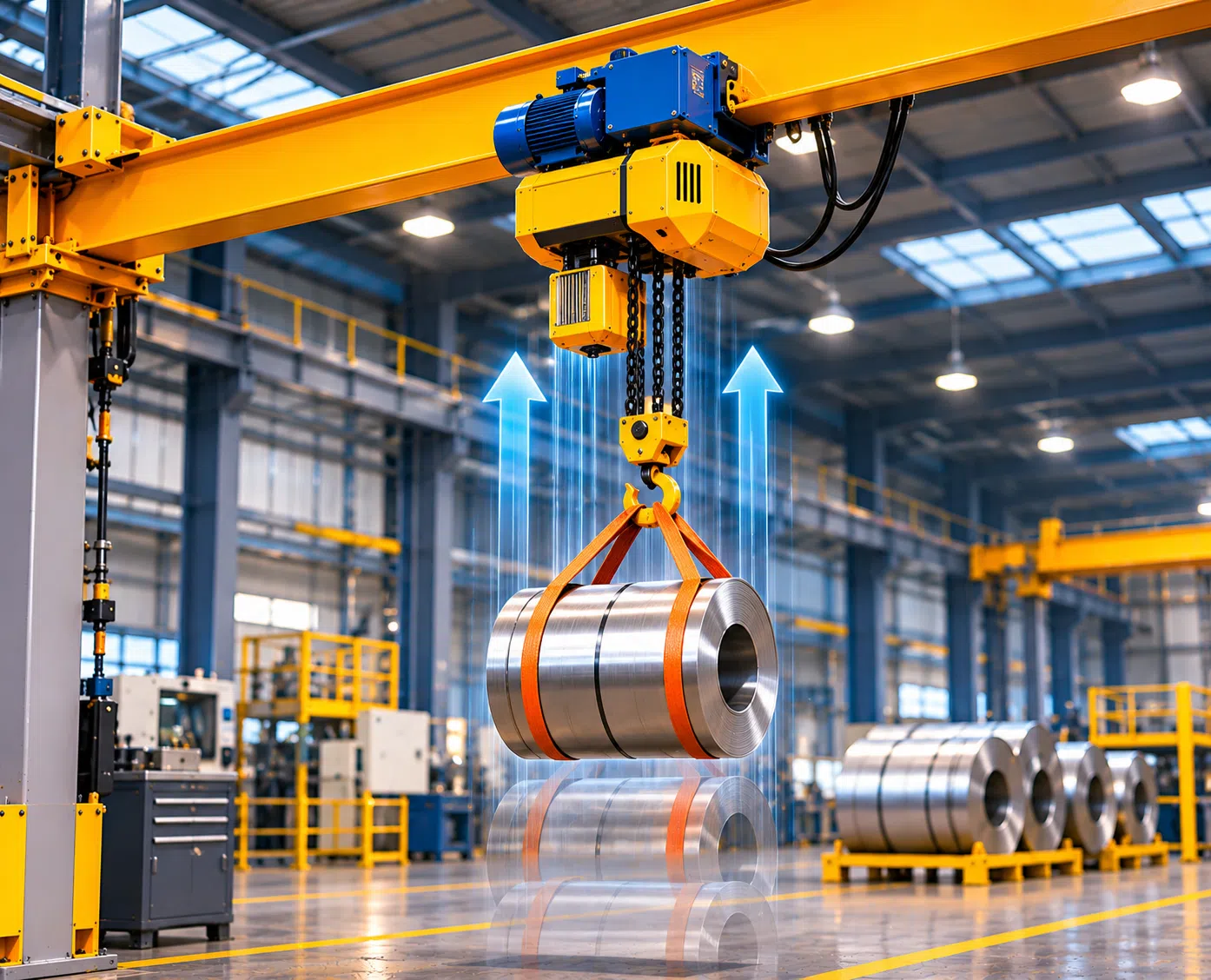
- Electric Chain Hoist: The standard choice for loads from 250 kg to 5 tons. It offers a compact size, perfectly straight vertical lifting without any side deviation, and an economical cost suited to assembly stations and limited lifting heights.
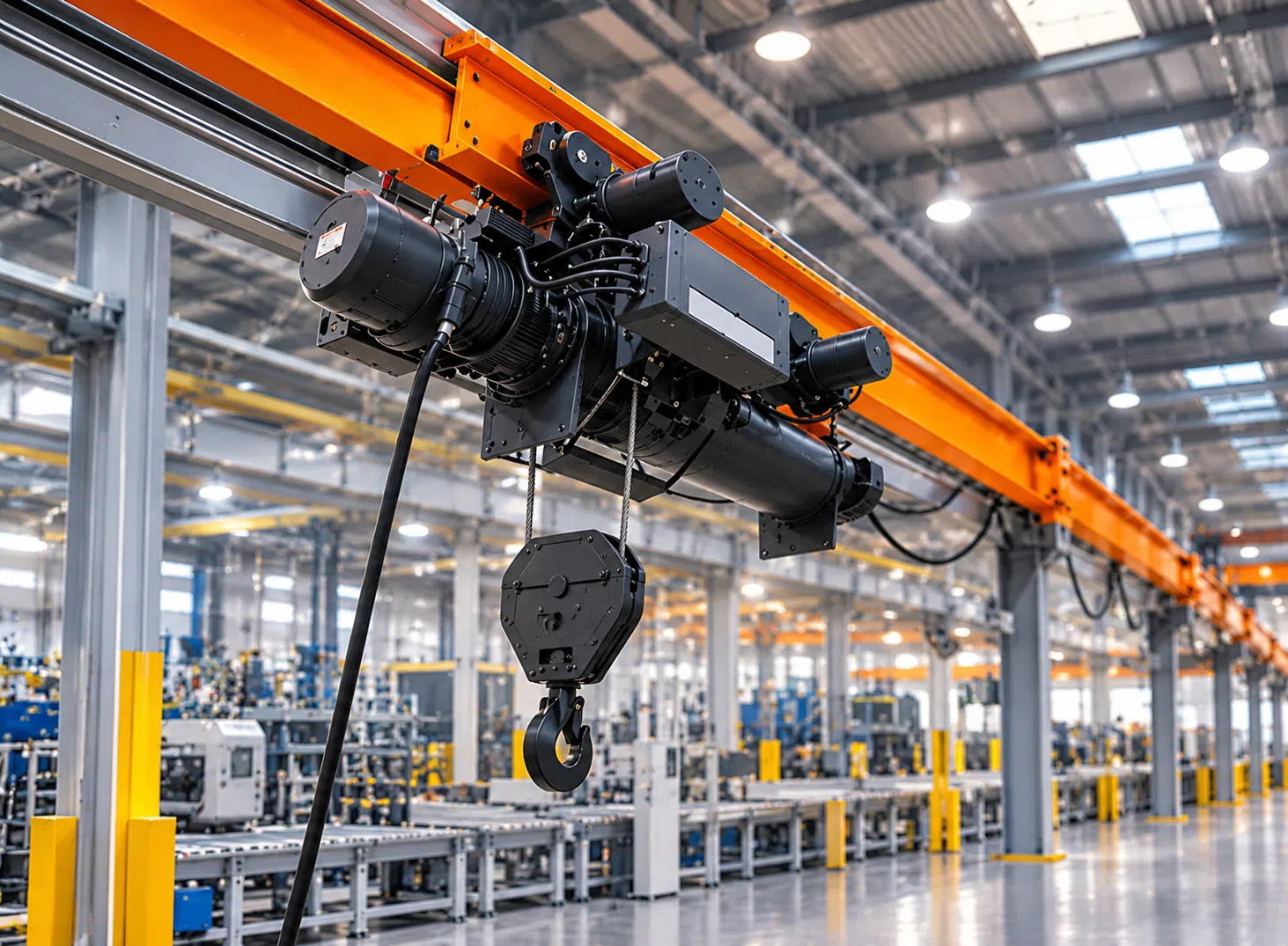
- Electric Wire Rope Hoist: The required choice for heavy loads (3 tons and above), very high lifting heights (above 15 up to 30 meters) and high speeds. It withstands continuous heavy-duty service and absorbs mechanical shocks well.
3. Studying Clear Height and Dead Vertical Distances (Headroom)
If the hall has a low ceiling, choose Low Headroom Trolleys, which allow the hook to rise to the highest point next to the runway beam, gaining extra vertical distance for stacking goods.
4. Electrical Equipment and Environmental Resistance
Choose suitable protection ratings (IP55 for general dust or IP66 for humid environments and food plants), with motor thermal insulation classes of at least Class F/H to suit high summer temperatures, and fit the crane with smart variable frequency drives (VFD) for smooth acceleration and deceleration that prevents load swing.
Mandatory Safety Requirements and Protective Equipment
Workplace safety is closely tied to integrating a package of standard safety devices into the crane:
- Digital Overload Limiter: A safety cut-out that prevents lifting any weight above the crane's rated capacity, protecting the steel wire ropes and the steel structure from structural deformation.
- Dual Limit Switches: These automatically cut off upward travel before the hook reaches the body of the crane, and prevent the rope from running out of the hoisting drum at the lowest point of descent.
- Fail-Safe DC Brakes (self-locking electromagnetic brakes): These close mechanically within fractions of a second as soon as the control buttons are released or if the power supply is suddenly interrupted.
- Encrypted wireless controls and an emergency stop button (E-Stop): These allow the operator to stand at a safe distance with a clear line of sight, outside the fall path of suspended loads.
How Does Al Manarat Al Monerah Help You Choose and Equip Lifting Cranes?
Al Manarat Al Monerah (almanratalmonerah.com) leads the engineering, manufacturing and supply of industrial lifting systems in the Kingdom of Saudi Arabia, Egypt and the Middle East, providing integrated solutions built on the highest engineering standards:
- Free site survey and structural analysis: We inspect your facility's halls, study the engineering drawings and material flow paths, and determine the type, size and capacity of the crane that suits your business with the highest efficiency and lowest cost.
- Manufacturing and supply to international standards (FEM/ISO/CMAA): We supply and manufacture all types of cranes (overhead, gantry, jib and monorail) equipped with European motors and gearboxes and certified genuine components.
- Engineered installation and precision laser alignment: Specialized engineering crews equipped with the latest measuring instruments supervise rail leveling and joint alignment, ensuring smooth, vibration-free travel.
- Load testing and official calibration certificates: We carry out on-site static (125%) and dynamic (110%) load tests and provide the certified inspection reports required to obtain civil defense and industrial inspection body approvals.
- Genuine spare parts and preventive maintenance contracts: Local warehouses stocked with ropes, chains, brakes and electrical panels ensure a fast response that protects your production operations from unexpected stoppages.
Al Manarat Al Monerah gives you direct access to its engineering experts for a detailed study and a tailored technical proposal, ensuring your plant is equipped with the best industrial cranes to support your expansion plans and provide a stable, safe working environment for decades to come.
Frequently Asked Questions About Industrial Lifting Cranes
What is the difference between FEM 1Am and FEM 2m classification in lifting cranes?
The classification relates to the number of daily operating hours and the load spectrum. Class 1Am is intended for medium-duty work running up to 2-4 hours a day with medium loads (such as assembly shops and general maintenance), while class 2m is designed for heavy-duty service running 4 to 8 actual operating hours a day with loads close to maximum capacity (such as steel plants and busy logistics warehouses).
Can two electric hoists operate together on a single overhead crane bridge?
Yes, absolutely. These configurations are used either to provide two different speeds (a main hoist that lifts heavy loads slowly and an auxiliary hoist that lifts light loads quickly), or to lift long pieces through synchronized (tandem) lifting, where the two hoists are linked to a unified electronic control system that ensures perfectly even raising and lowering.
When is a gantry crane more cost-effective than an overhead bridge crane?
A gantry crane is more cost-effective in two main cases: first, when goods must be handled in open outdoor yards that have no roofs or supporting columns; and second, inside leased halls whose columns lack the structural capacity to carry overhead crane runway beams, where installing a gantry crane on ground rails saves the high cost of structural reinforcement.
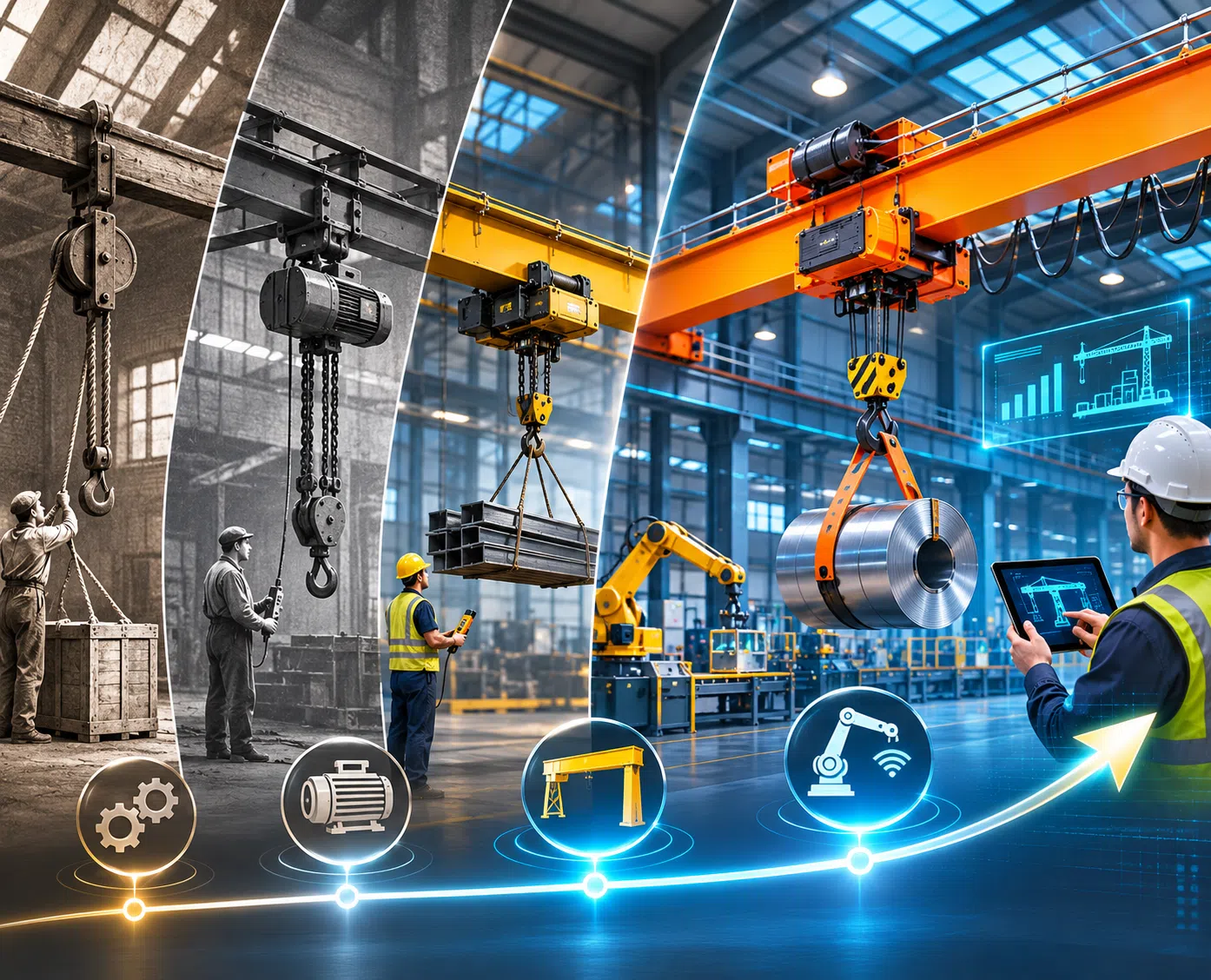
Read also: How Has Lifting and Handling Equipment Evolved to Meet the Demands of the Industrial Revolution?