
The Complete Guide to Monorail Crane Systems in Assembly Lines and Factories
Sequential production lines and industrial processing stations impose strict linear travel paths. They require moving raw materials and mechanical parts from one station to another without interrupting worker movement on the ground or filling the hall with huge lifting equipment that takes up aisle width. Using a full bridge crane to feed a coating line or a car assembly line is unjustified financial and engineering waste when the required movement is confined to a defined linear path. Here the monorail crane stands out as an ingenious mechanical solution that combines engineering simplicity with complete logistical effectiveness. It provides a single-rail overhead transport path that carries products with great smoothness, bypassing all ground obstacles and architectural curves to deliver materials to their final destination with the least energy use and the highest rates of field safety.
What Is a Monorail Crane?
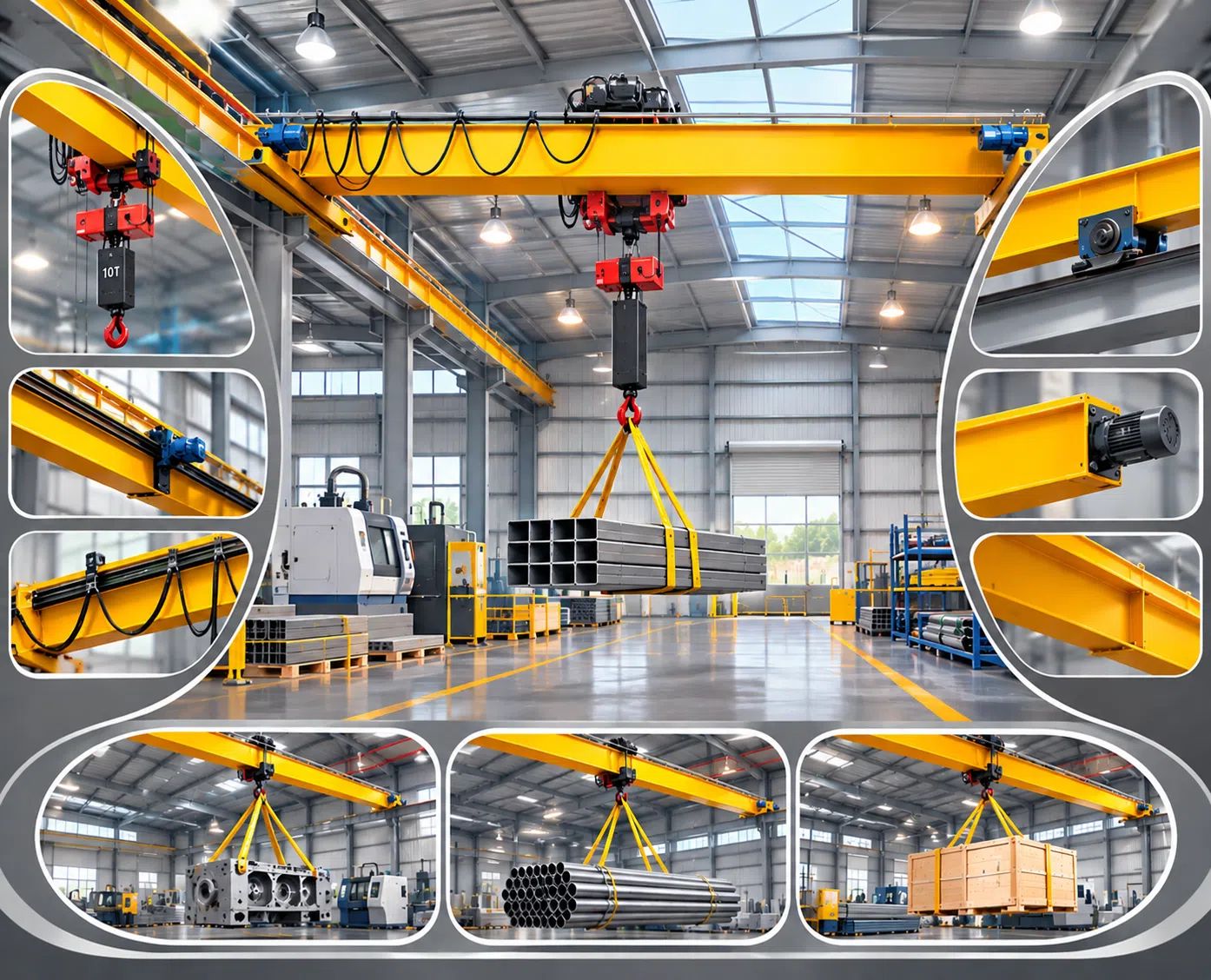
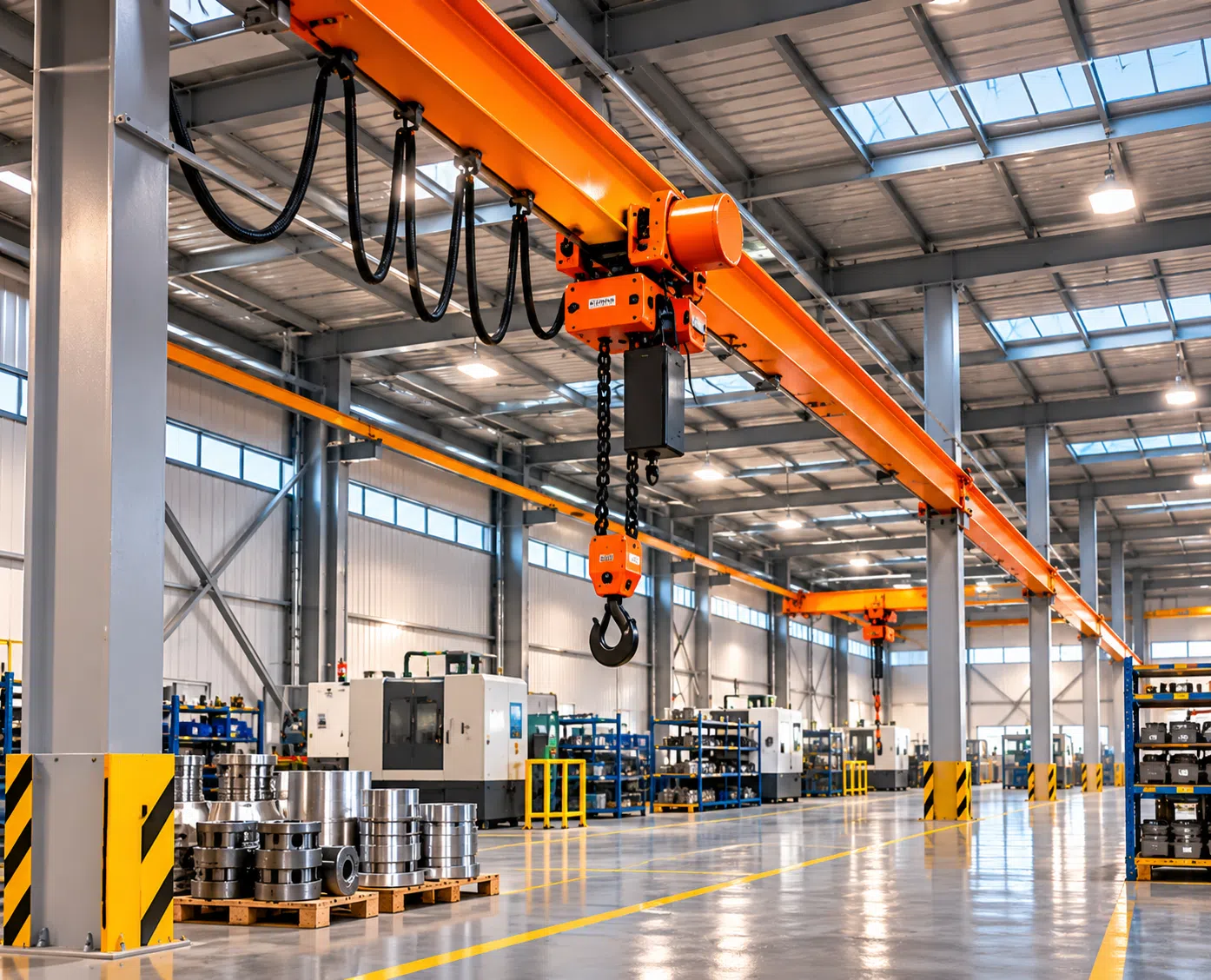
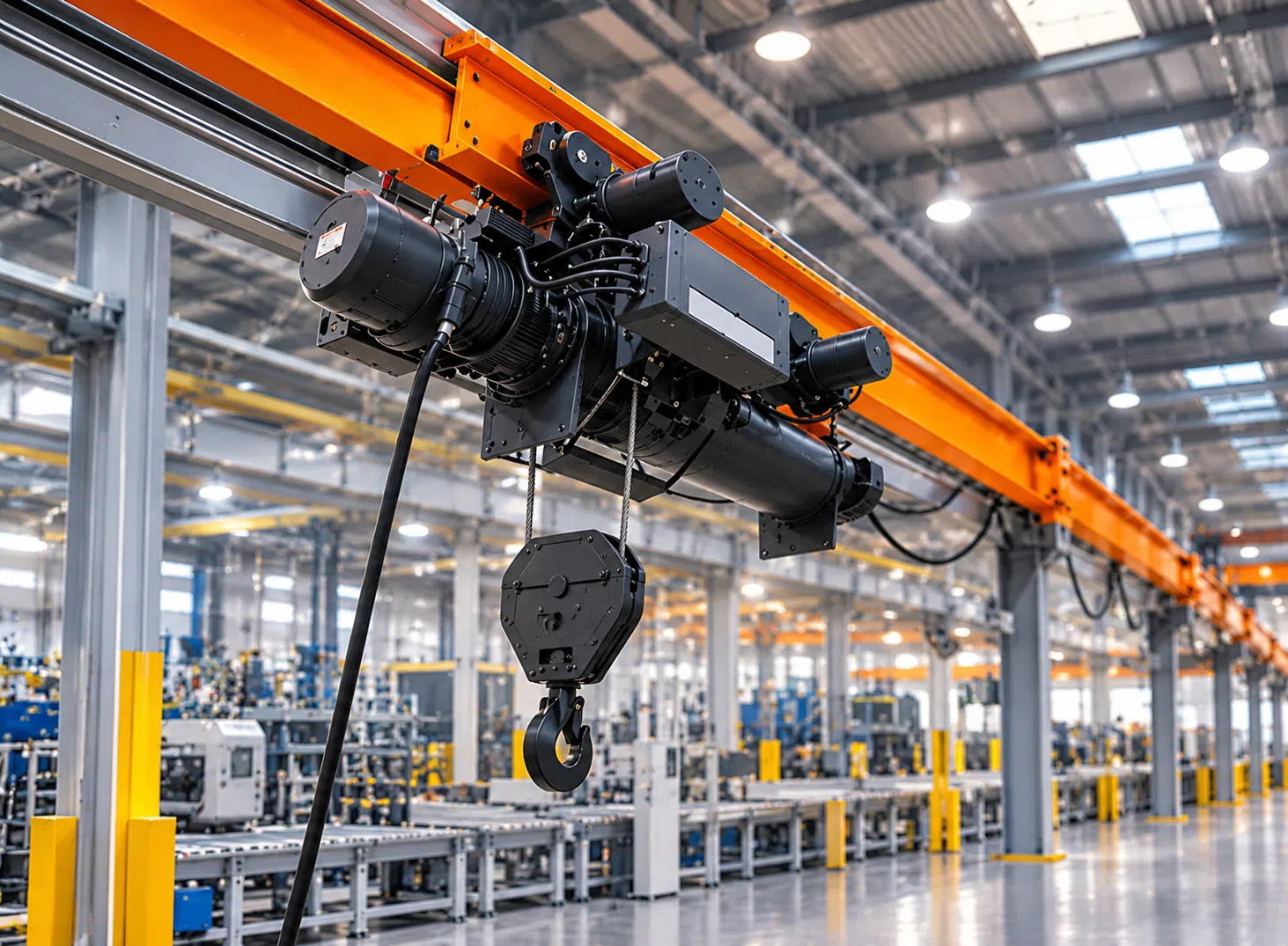
A monorail crane is an industrial lifting and transport system based on a single track made up of one steel beam (straight, or with curves and switches) suspended from the facility's roof or carried on dedicated structural columns. An electric or manual hoist trolley travels over it or along its bottom flange to move loads along a fixed, predefined path.
This specialized system delivers immediate operating returns to factories and assembly lines:
- Providing a continuous overhead travel path linking the successive production stages without any conflict with floor traffic.
- The ability to design the track with engineered curves and smart branches to go around machines and building columns.
- Lower capital and structural cost compared with installing full overhead crane bridges.
The Core Engineering Components of a Monorail Crane System
This system draws its flexibility from the integration of solid mechanical elements designed to deliver smooth, silent movement:
1. The Steel Monorail Track Beam (Monorail Track Beam)
It is the backbone of the system, and is usually made from standard steel sections such as rolled beams (I-Beam / H-Beam) or enclosed box sections with a lower track (Enclosed Track Systems) made of carbon steel or reinforced aluminum alloys. Enclosed sections protect the trolley wheels from the buildup of dirt and industrial dust inside halls.
2. The Hoist and Trolley Unit (Hoist & Trolley Unit)
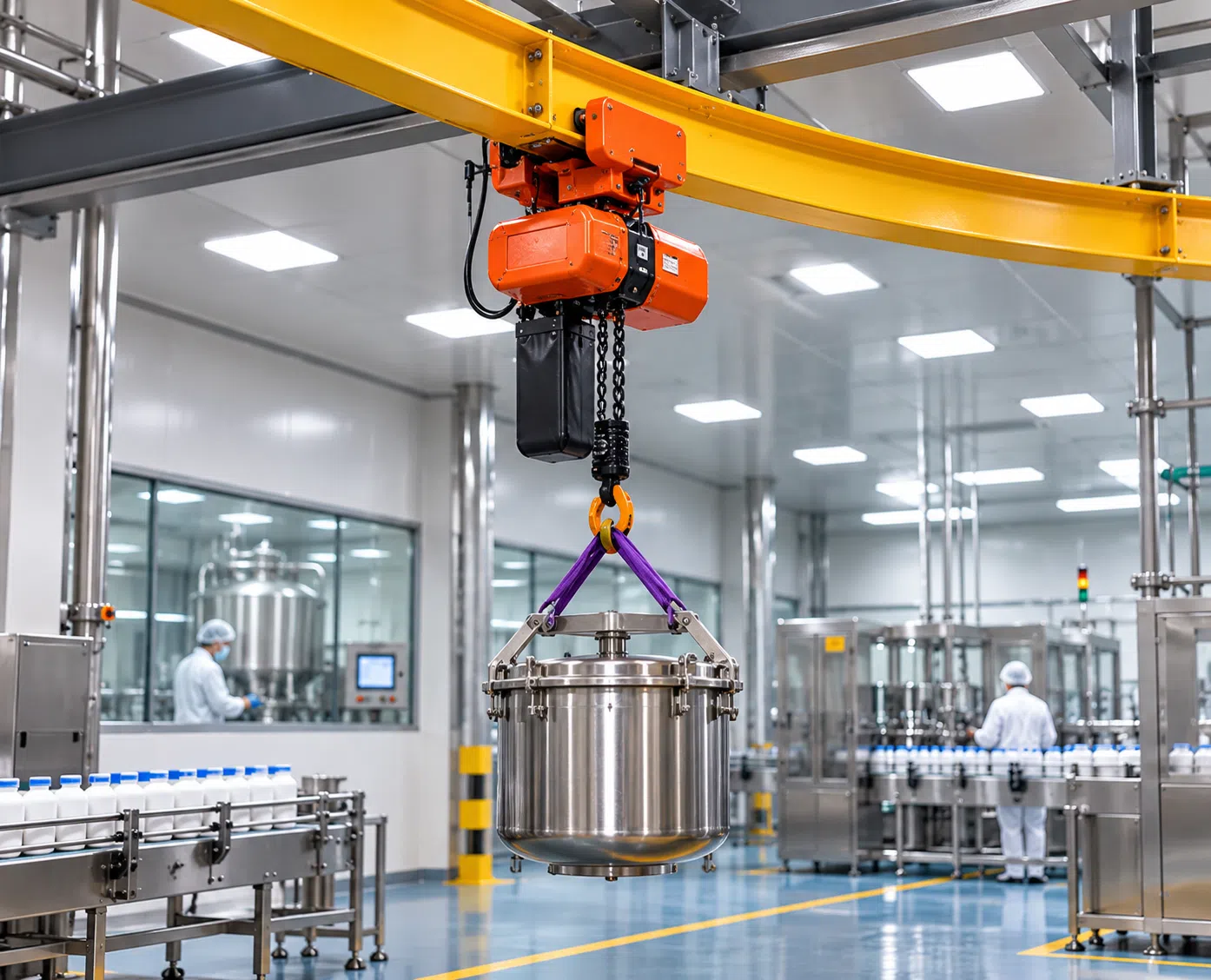
The trolley moves on the bottom flange of the track on wheels of hardened steel or polyurethane. The trolley is fitted either with an electric chain hoist for light and medium loads and compact headroom, or with a wire rope hoist for heavier loads requiring high lifting speeds.
3. Curves and Smart Track Switches (Curves & Switches)
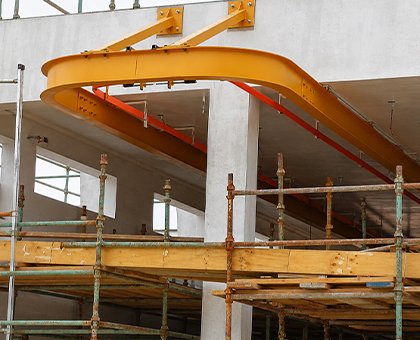
Monorail systems have an outstanding ability to turn through curved sections designed with an engineering-calculated bending radius that prevents the trolley wheels from jamming, with the option of adding rotating or sliding track switches and turntables (Track Switches & Turntables) that let the trolley move from a main line to branch production lines at the push of a single button.
4. Suspended Power Feeding Systems (Power Feeding Systems)
The system is powered either through flexible cables hung from sliding carriers (festoon cable system) for limited straight tracks, or through insulated, protected copper conductor bars (Conductor Bars) for long and curved tracks, to ensure an uninterrupted power supply while turning.
Comparative Analysis: Monorail Crane Versus Overhead Bridge Crane and Conveyors
To determine the best engineering option for your production line, the points below show the direct technical and operational differences between these industrial solutions:
- Nature of the travel path and spatial coverage: The overhead bridge crane provides wide rectangular coverage of the entire hall (three-dimensional X-Y-Z movement), whereas the monorail crane focuses on serving a fixed, defined path with a start and end point (two-dimensional X-Z movement) with the possibility of turning and curving, which makes it more efficient and suitable for sequential lines.
- Floor space use and worker freedom: The monorail crane leaves the factory floor 100% free because its track is suspended entirely from the roof, whereas floor conveyors take up a wide part of the floor and divide the hall into barriers that are hard for forklifts or workers to cross.
- Engineering flexibility and going around obstacles: The bridge crane cannot change its straight path or turn around building corners, whereas the monorail crane has exceptional engineering flexibility that lets it turn at sharp angles, climb and descend on slopes, and shift between separate rooms and multiple stations.
- Foundation cost and steelwork: The bridge crane requires two parallel runway beams and a heavy moving bridge that imposes large loads on the hall columns, whereas the monorail requires only a single beam at a very low steel and fixing cost, saving more than 50% of the capital cost.
The Main Industrial Applications of Monorail Crane Systems
The operating environments in which this equipment excels are many, serving strategic production sectors:
Coating, Dip Tank and Surface Treatment Lines (Electroplating & Dip Tanks)
It is the ideal working environment for the monorail. It carries car or electrical appliance parts and moves them in a loop path that passes them over chemical wash tanks, phosphating, electro-coating and then thermal drying ovens in a non-stop sequential movement.
Automotive and Engine Assembly and Manufacturing Lines
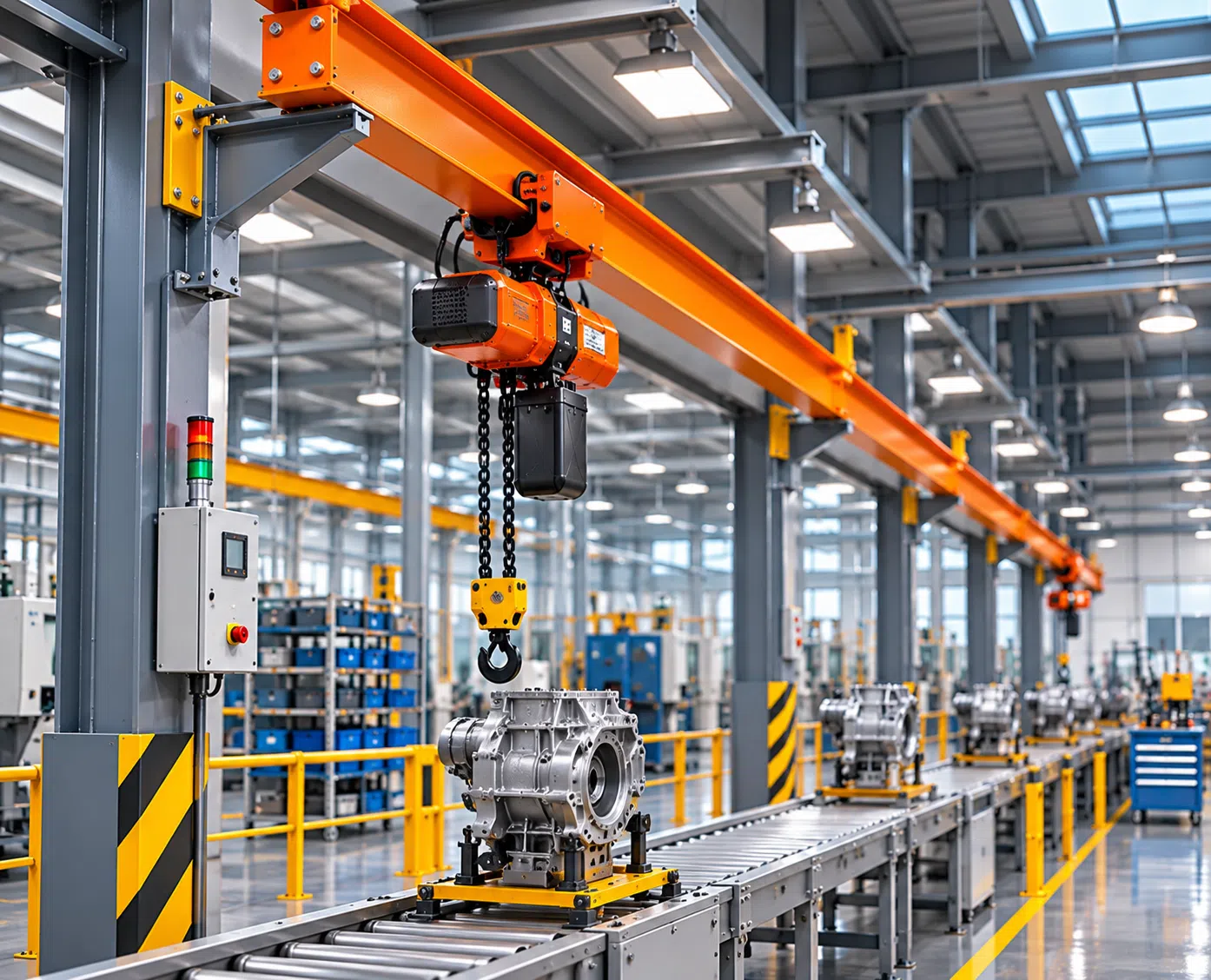
The engine or chassis is carried along the monorail track and stops automatically at each designated assembly station for parts to be fitted, which lets technicians work beneath and around it freely at suitable heights that prevent physical strain and speed up assembly time.
Metal Foundries and Concrete Casting Plants
Monorail systems are used to carry crucibles of molten metal or fresh concrete mixes from central mixing stations and distribute them accurately and quickly over casting molds before they lose their heat or begin to set.
Warehouses and Linking Production Lines to Shipping Areas
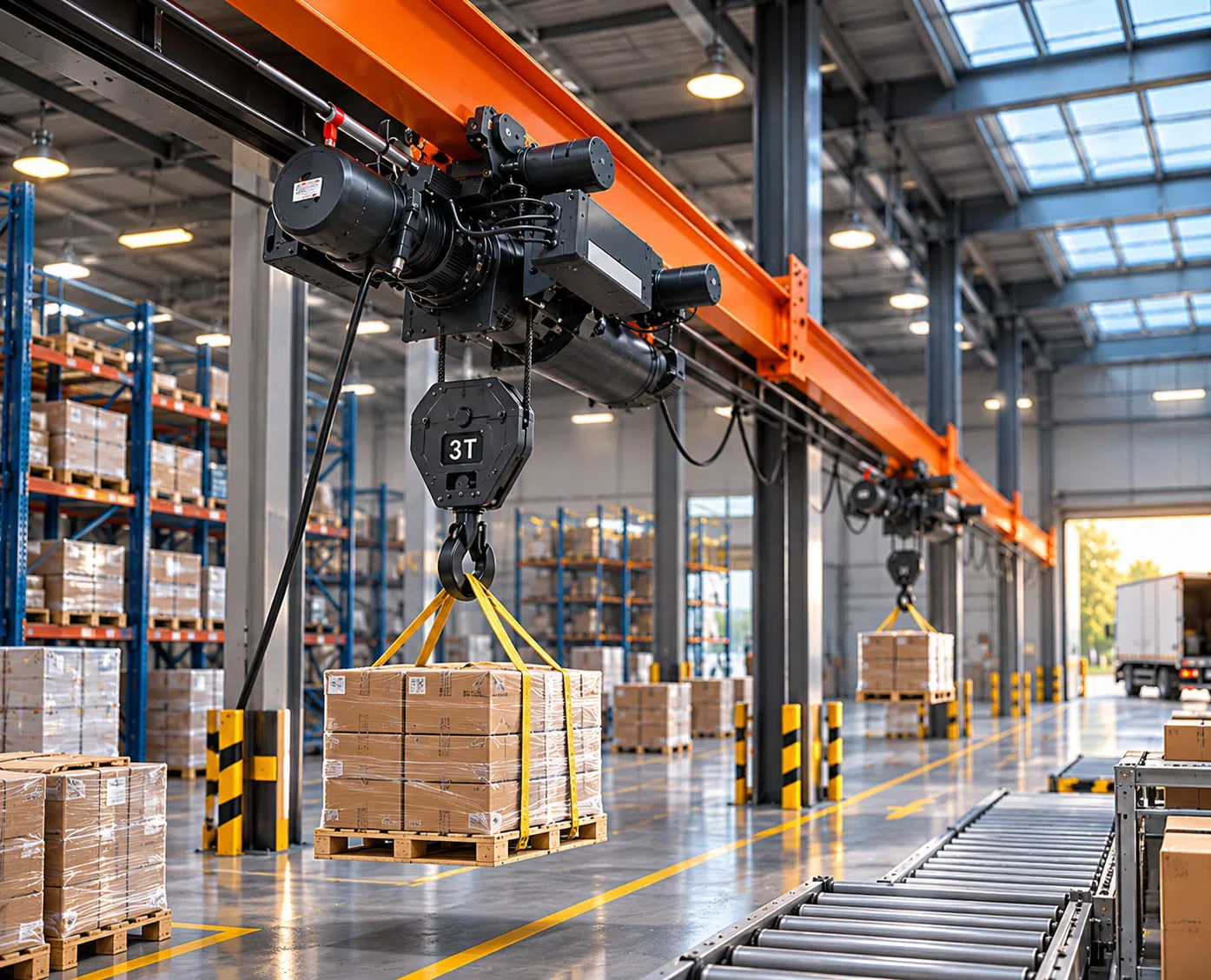
Delivering assembled finished products from the end of the production line straight to the pallet unloading area and container stacking, bypassing narrow aisles and hall walls with no need for ground forklifts.
Safety Standards and Mandatory Equipment in Monorail Systems
Suspended travel along fixed tracks imposes precise safety requirements to protect the technical staff working below the track:
- Reinforced mechanical end stops (End Stops): Solid barriers fitted with rubber pads fixed at the track ends to prevent the hoist trolley from leaving the track if the electrical travel cut-offs fail.
- Switch sensors and interlocks (Switch Interlocks): Mechanical and electrical protection gates that close the track automatically while the switch is changing, and stop the trolley from reaching the air gap until the rail connection is fully and safely complete.
- Photoelectric safety and anti-collision sensors (Anti-Collision Sensors): Where more than one hoist runs on the same monorail track, laser sensors are fitted that stop the trolleys automatically when they come within a set distance of each other to prevent impact.
- Secondary safety suspension cables and chains (Secondary Safety Cables): Secondary steel cables connect the monorail track to the roof's structural frame as a backup system that prevents the beam from falling if the original fixing bolts suffer a sudden failure.
- Encrypted wireless control units and variable frequency drives (VFD): Provide smooth acceleration and deceleration that prevents suspended parts from swinging while entering curves, while allowing the operator remote control from a safe distance with open visibility.
How Does "Al Manarat Al Monerah" Help You Design and Install a Monorail Crane?
Al Manarat Al Monerah (almanratalmonerah.com) leads the engineering and manufacture of industrial lifting systems in the Kingdom and the Middle East, providing integrated solutions for equipping production lines with the latest monorail systems:
- Field engineering study and material flow simulation: Inspecting your factory line paths and studying load distribution on the roof beams, and designing a custom monorail track that accounts for curves and stopping points with minimal loss of movement.
- Manufacture of steel tracks to precise dimensions: Fabricating and forming beams, curves and automatic track switches to the highest mechanical precision standards to prevent wheel friction and secure a quiet, highly reliable travel path.
- Supply and integration of globally certified genuine hoists: Equipping monorail systems with the latest electric chain and wire rope hoists that meet FEM and ISO standards, fitted with energy-saving motors and instant electromagnetic safety brakes.
- Installation and precision laser alignment: Specialized engineering crews supervise track fixing, levelling and joint alignment by laser, with the installation of insulated power supply systems protected against dust and moisture.
- Load tests and calibration certificates: Carrying out static load (125%) and dynamic load (110%) tests on site and issuing certified technical inspection certificates for submission to Civil Defense and the industrial regulatory authorities.
- Preventive maintenance contracts and spare parts readiness: Supplying travel wheels, brake linings, control switches and power feed tracks from local warehouses to secure a fast response that protects your lines from any sudden stoppage.
Al Manarat Al Monerah gives you direct access to its engineering experts to obtain a detailed study and an integrated technical proposal that puts in your hands a monorail crane system designed specifically to multiply the efficiency of your assembly lines and secure smart, sustainable manufacturing paths.
Frequently Asked Questions About Monorail Crane Systems
Can a Monorail Crane Be Installed in a Hall That Lacks Strong Concrete Columns?
Yes, absolutely. This is done either by hanging the monorail track directly from the steel roof trusses after studying their structural capacity to carry the loads, or by building a free-standing structure (Free-standing Structure) on light steel columns fixed with countersunk bolts into the hall floor alongside the production line, without affecting the building walls.
What Is the Minimum Bending Radius in Monorail Tracks?
The bending radius is determined by the trolley wheelbase and the load capacity. The minimum for standard sections usually ranges from 1.0 to 1.5 meters for enclosed box sections and chain hoists, whereas wire rope hoists and heavy steel beams require a radius of no less than 2.0 to 3.0 meters to ensure the wheels turn smoothly without rubbing against the track flanges.
Can More Than One Electric Hoist Operate on a Single Monorail Track?
Yes, several hoists can operate on the same track to serve simultaneous stations, but each trolley must be fitted with electronic optical anti-collision sensors (Optical Anti-Collision Sensors) and mechanical buffers that cut off movement automatically and keep a constant safe distance between the hoists to prevent the loads from hitting one another.
Read also: What Is a Monorail Crane and How Does It Use Your Factory's Ceiling Space?