
How Has Lifting and Handling Equipment Evolved to Meet the Demands of the Industrial Revolution?
Industrial facilities and global supply chains have been transformed by the rapid shift toward Industry 4.0 applications. In smart manufacturing environments it is no longer acceptable to rely on isolated, slow-moving lifting machinery that depends on pure human judgment and wastes time and disrupts material flow. At the start of the industrial age, moving raw materials, pouring metal and handling heavy forming dies relied on steam power and then on simple electromechanical gearing with fixed speeds, which made them a constant source of vibration, drop hazards and heavy maintenance costs. With the requirements of automated digital production, mechanical engineering has reinvented lifting and handling equipment, turning it from a rigid steel structure that merely raises weight into smart industrial assets connected through the Industrial Internet of Things (IIoT) and fitted with synchronized braking systems and self-correcting anti-sway algorithms, ensuring extreme precision and record speed in line with the latest global safety standards such as ISO, FEM and CMAA.
How Has Lifting and Handling Equipment Kept Pace with the Industrial Revolution?
Lifting and handling equipment has evolved by integrating smart variable frequency drives (VFDs), embedding IIoT sensors that predictively monitor stresses and working hours, applying automatic anti-sway algorithms, and connecting fully to warehouse management systems (WMS) and encrypted wireless control solutions, moving it from purely mechanical lifting tools to automated handling stations that deliver the highest levels of safety and productivity.
This technical and structural evolution has produced strategic results for modern factories:
- Reducing unplanned downtime by more than 65% thanks to predictive maintenance based on real-time data analysis.
- Millimeter-accurate positioning of loads inside machining centers and assembly cells without manual intervention.
- Cutting energy consumption by up to 30% through efficient hoisting motors and regenerative braking systems.
Historical Milestones in the Evolution of Industrial Lifting Systems
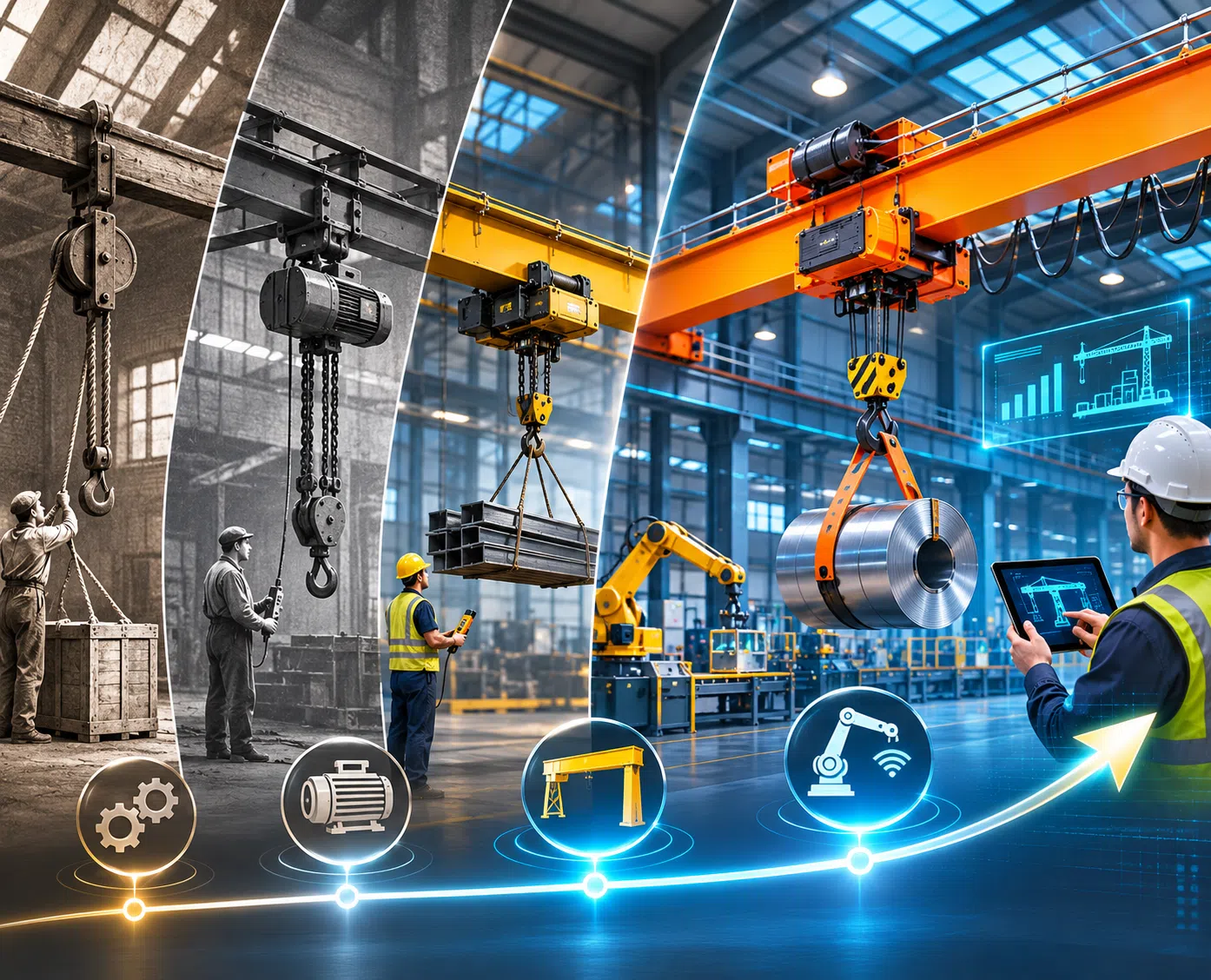
The timeline of lifting technology shows how industrial technology has driven radical changes in the way heavy masses and loads are moved:
1. The Mechanical and Steam Era (First and Second Industrial Revolutions)
Lifting equipment began as wooden and iron cranes operated with manual pulleys, then evolved with steam engines and open gears. Although they could lift unprecedented weights, they lacked precise control, were extremely noisy and required physical effort to monitor the ropes, with no safety mechanisms to protect against wire breakage.
2. The Electromechanical Era and Automatic Brakes (Third Industrial Revolution)
With the spread of three-phase industrial power grids, electric overhead cranes appeared, fitted with induction motors, self-locking electromagnetic brakes and precisely stranded steel wire rope as the lifting medium. Standard safety codes (such as FEM and CMAA) began to define exact calculations for bending moments and cyclic fatigue, laying the foundation for the era of safe cranes inside factories.
3. The Era of Digitization and Smart Automation (Fourth Industrial Revolution)
In this era, systems reached an unprecedented level of autonomy. Modern cranes are fitted with scanning cameras, 3D laser sensors and programmable logic controllers (PLCs), allowing the crane to carry out complex lifting and transfer cycles in a nearly self-directed manner and with the highest precision, with no scope for human error.
Technical Advantages of the Modern Generation of Lifting and Handling Equipment
Today's smart systems rest on a package of engineering innovations that have made them the cornerstone of advanced supply chains:
Predictive Maintenance and Remote Monitoring (Predictive Maintenance & IIoT)
The equipment is fitted with digital load cells and temperature and vibration sensors mounted on gearboxes and motors. These sensors send performance data in real time to the cloud or the plant's operating platforms, making it possible to predict brake lining wear or elongation of the lifting medium and to schedule replacement before an actual failure occurs.
Smart Anti-Sway Systems (Electronic Anti-Sway Control)
A suspended load swinging like a pendulum is one of the biggest safety threats and an obstacle to transfer speed. The algorithms built into modern frequency drives adjust the acceleration and deceleration of the bridge and trolley motors dynamically in extremely small increments, absorbing the load's inertia so that it stays vertically stable in place even at the highest horizontal travel speeds.
Smart Energy Recovery (Regenerative Braking Systems)
When heavy steel masses are lowered, the hoisting motors turn into electrical generators. Modern systems capture this kinetic energy and feed it back into the plant's electrical grid instead of wasting it as heat through braking resistors, which reduces the carbon footprint and lowers operating bills.
Precise Synchronization of Multiple Cranes (Tandem Operation)
On aircraft assembly lines or long steel structures that require two adjacent cranes to lift together, encrypted wireless synchronization technologies unify the speeds of the crane motors to within fractions of a millimeter, preventing the structures from slipping or being subjected to damaging torsional moments.
Comparative Analysis: Traditional Lifting and Handling Equipment vs. Modern Smart Systems
The following points show the direct technical and operational differences between earlier generations and the current technology generation, to help you gauge the investment feasibility for your facility:
- Speed control and smoothness of motion: Traditional systems rely on one- or two-speed fixed motors that generate violent mechanical jolts at start and stop, whereas modern equipment uses variable frequency drives (VFDs) that deliver ultra-smooth, flowing motion with precise micro-speeds to protect delicate workpieces.
- Maintenance management and fault detection: Older equipment relies on corrective maintenance after a fault occurs or on estimated periodic maintenance, while smart equipment uses IIoT sensors to monitor vibration and thermal stress predictively and schedule repair work before any unplanned stoppage occurs.
- Safety level and safe-distance control: Traditional cranes were operated from suspended cabins or wired controllers that forced the operator to stay close to the load path, whereas modern systems provide encrypted digital wireless controllers and laser anti-collision sensors that keep the operator and technical staff completely out of the danger zone.
- Energy consumption and motor efficiency: Old motors consume a lot of energy and give off excessive heat during braking, whereas modern cranes use high-efficiency motors (IE3/IE4) integrated with braking energy recovery units that recycle it into the plant's network.
The Role of Modern Systems in Improving the Work Environment and Occupational Safety
Upgrading handling equipment is no longer just about speeding up production. It has extended to redefining human safety on the shop floor:
- Eliminating muscle strain and musculoskeletal disorders: Strenuous manual tasks become smooth mechanical movements controlled at the push of a button, protecting technical staff from spinal injuries and torn tendons.
- Protection from free-falling loads: Thanks to dual self-locking (fail-safe) electromagnetic brakes, the brakes close automatically within fractions of a second as soon as power is lost, holding the suspended load with complete safety.
- Protecting facilities from impacts: Dual photoelectric anti-collision sensors and mechanical limit switches ensure an immediate stop before the crane touches the end trucks or before bridges collide with each other inside the same bay.
How Does "Al Manarat Al Monerah" Lead the Modernization of Lifting Equipment in the Region?
Al Manarat Al Monerah (almanratalmonerah.com) is a leading engineering partner for industrial facilities and installations in the Kingdom of Saudi Arabia, Egypt and the Middle East, harnessing the latest global innovations to develop the lifting sector:
- Engineering study and field analysis for smart environments: A precise assessment of production lines and warehouses to determine the lifting systems best suited to modern automation requirements and bay dimensions.
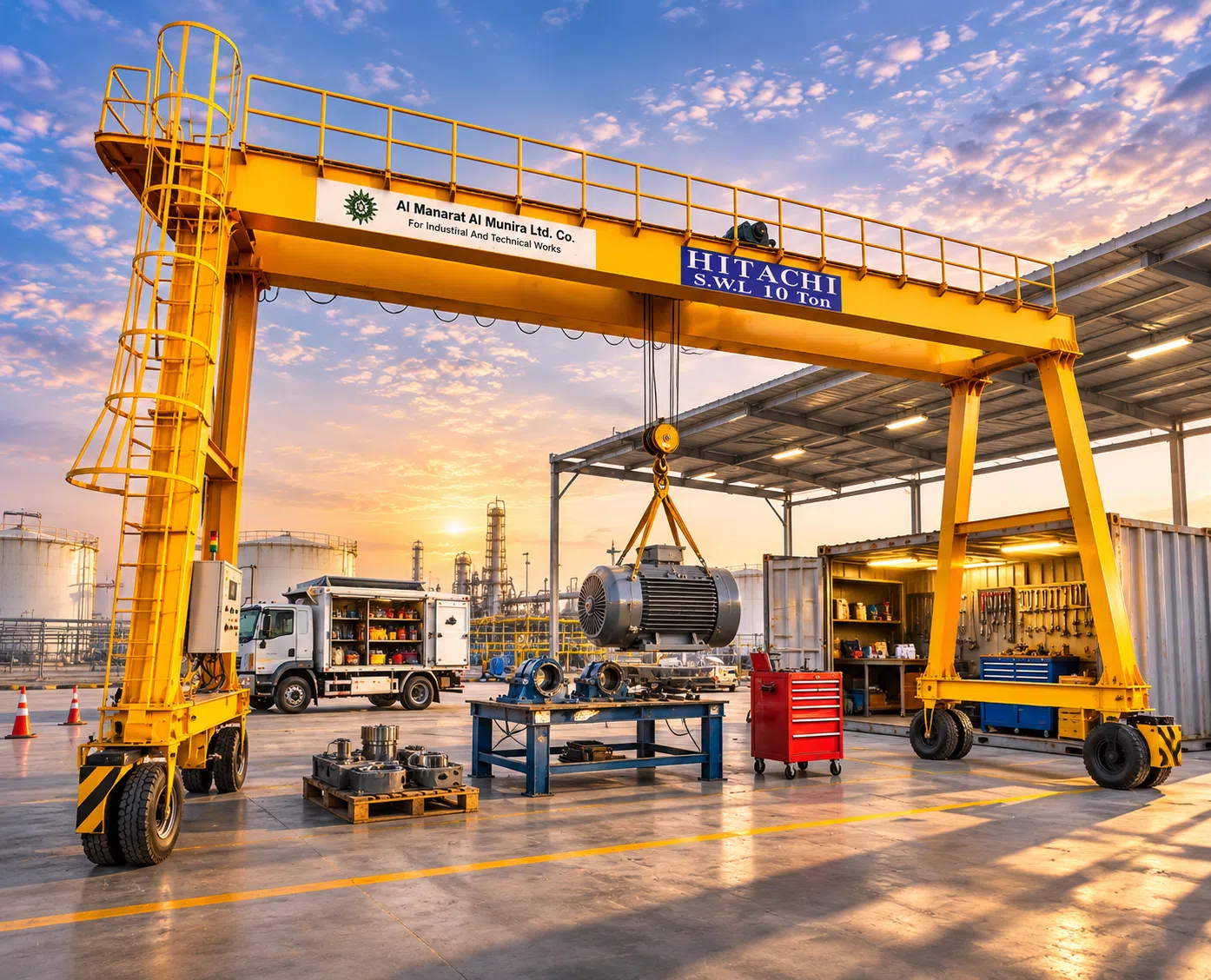
- Supply and manufacture of equipment compliant with international standards (FEM/ISO/CMAA): Building overhead, gantry, jib (cantilever) cranes and monorails using high-strength steel sections and reliable European components suited to the region's harsh climate.
- Upgrading and modernizing existing cranes (retrofitting): Converting old cranes into smart equipment by adding variable frequency drives (VFDs), digital load cells and performance-monitoring sensors, without having to replace the entire steel structure.
- On-site installation and precision laser alignment: Specialized engineering crews, equipped with the latest optical and laser measuring tools, supervise rail leveling and joint alignment to prevent vibration and wheel wear.
- Load testing and official calibration certificates: Carrying out static (125%) and dynamic (110%) load tests on site and issuing certified inspection certificates and reports for submission directly to regulatory bodies and civil defense authorities.
- Genuine spare parts readiness and preventive and predictive maintenance contracts: Fully stocked local warehouses holding motors, brakes, lifting media and electronic boards to provide a fast response that protects your investment from any unexpected breakdown.
Al Manarat Al Monerah gives you direct access to its engineering experts for a detailed study and tailored technical consultation to take the lifting and handling equipment in your facility to a new level of efficiency and reliability that matches modern industrial revolution standards.
Frequently Asked Questions About the Evolution of Lifting and Handling Equipment
What is the difference between preventive and predictive maintenance in modern lifting equipment?
Preventive maintenance relies on fixed, pre-set intervals (such as changing the oil every 6 months or inspecting the brakes monthly) regardless of the machine's actual condition. Predictive maintenance relies on IIoT sensors that measure temperature, vibration and actual loading hours moment by moment, and it triggers a maintenance alert only when the data shows a component approaching real wear, saving the cost of premature replacement.
Can an old traditional industrial crane be converted to run with smart anti-sway technology?
Yes, through engineering retrofitting. The old control panel is replaced with one fitted with advanced smart VFDs containing anti-sway software algorithms, linked to acceleration sensors, and the travel motors are updated, all without touching the crane's basic steel structure.
How do IE3 and IE4 rated hoisting motors help reduce plant operating costs?
These motors offer superior electrical efficiency that reduces heat losses and internal vibration. They draw between 5% and 12% less electrical current than older motors under the same lifting loads, delivering major financial savings in plants that run continuous shifts around the clock, 24 hours a day.
Read also: What Is a Crane and How Has It Revolutionized Manufacturing and Logistics?