
How to Choose an Electric Hoist That Meets Your Factory's Cargo Lifting Needs
Choosing unsuitable lifting equipment leads to cascading operational losses. They start with a slowdown in the pace of material handling and do not end with electric motor windings burning out from overloading or from misjudging the daily working hours inside the industrial facility. A snapped hoisting cable or a hoist breakdown in the middle of a critical manufacturing shift is a real production crisis that disrupts delivery commitments and costs thousands of dollars within a few hours. Moving to buy a new electric hoist requires deep technical study that goes beyond reading the figure on the external load label. It demands a precise match between the hoist's mechanical characteristics, the nature of the goods being moved and the workshop's environmental conditions, to ensure maximum operating efficiency and the highest levels of field safety.
How Do You Choose the Electric Hoist Best Suited to Your Factory?
Choosing the right electric hoist is determined by an engineering assessment of five operating criteria: maximum load capacity with a future safety margin, the type of pulling mechanism (steel wire rope for large loads or chain for compact spaces), duty cycle classification and daily working hours (FEM/ISO), the required lifting speeds and the frequency control system, plus the motor insulation class and its resistance to heat, dust and humidity.
Engineering scrutiny of these criteria delivers immediate benefits for your facility:
- Avoiding thermal stress on motors and extending the service life of gearboxes and mechanical brakes.
- Achieving balanced, smooth lifting motion that protects sensitive products and dies from shocks and impact.
- Lowering periodic maintenance costs and securing the safety of technical staff on the assembly lines.
The Decisive Engineering Criteria for Specifying an Electric Hoist
Successful technical matching requires breaking the work requirements down into precise specifications that are translated into purchasing documents:
1. Net Load Capacity and Safety Margin (Working Load Limit)
Calculate the maximum weight that can be lifted in the workshop, including the weight of rigging accessories such as steel slings, shackles or electromagnets, and add a safety margin of 20% to 25% over the nominal capacity to make sure the motor is not continuously run at its full maximum capacity, which prevents early gear wear.
2. Duty Cycle Classification and Daily Workload (Duty Cycle Classification)
International codes such as FEM (from 1Bm to 5m) or ISO (from M3 to M8) define how long the hoist can work without stopping in a single hour. Choosing a hoist designated for light workshops (Class M3) to work in a steel plant running three shifts a day will inevitably burn out the motor insulation within a few months.
3. Lifting Speed and Precise Deceleration Rates (Dual Speeds & VFD)
Some operations need very high lifting speed to cut truck unloading times, while others, such as fitting dies into injection machines, require extremely precise, slow motion (Micro-Speed) to avoid damaging machined surfaces. This is where dual-speed motors, or motors fitted with smart inverters (Inverters), prove their importance.
4. Net Vertical Height and Available Clearance (Lift Height & Headroom)
The truss height and the distance between the ceiling and the production machines determine the required design of the hoist body. Low ceilings call for low headroom hoists (Low Headroom Hoists) in which the lifting drum is wound alongside the runway beam to gain the maximum free vertical distance below the hook.
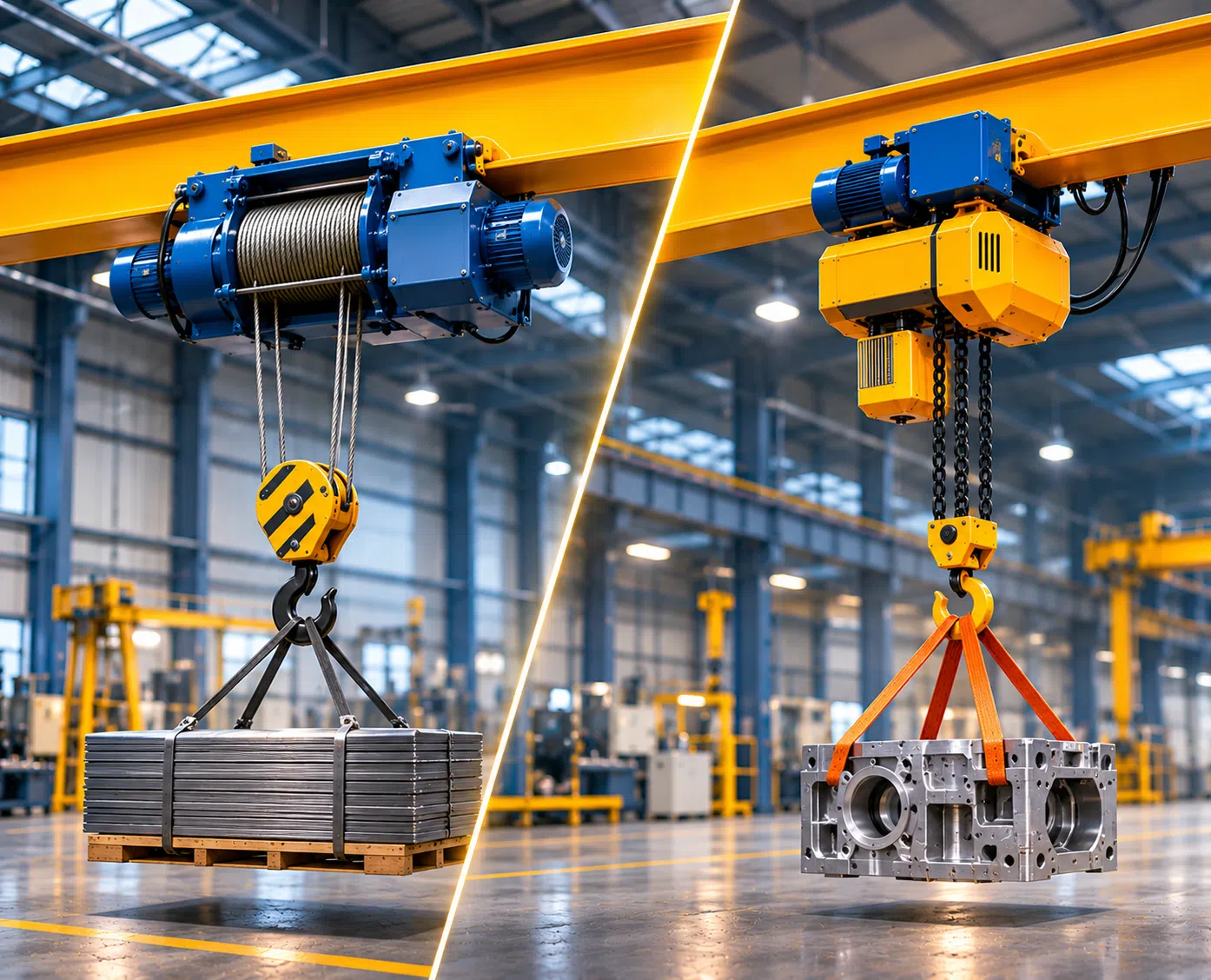
Comparative Analysis: Wire Rope Hoist vs. Electric Chain Hoist
The first technical choice when buying an electric hoist is between two different mechanical types of pulling mechanism. The following points show the fundamental differences to help you make the right decision for your work environment:
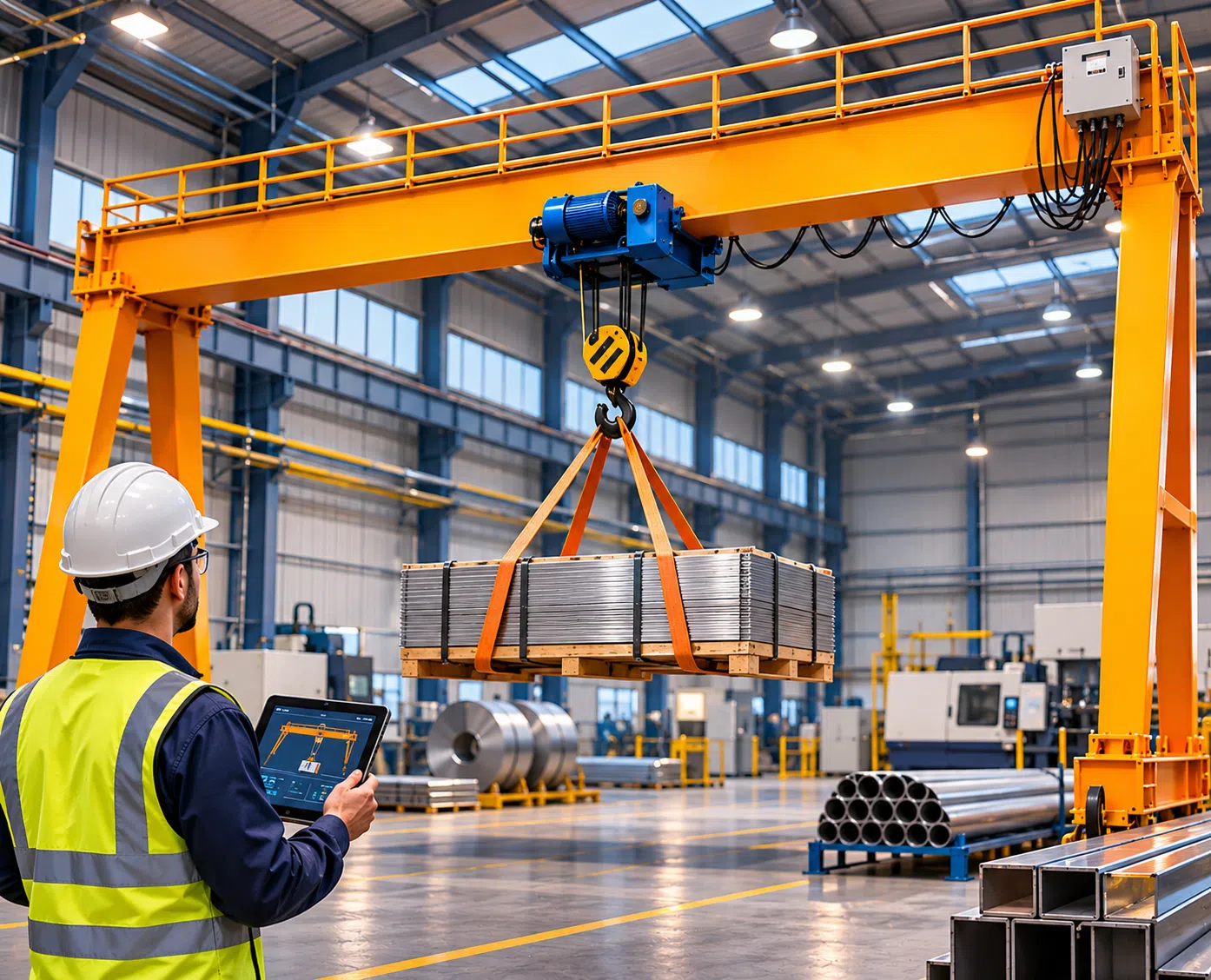
- Load capacity and typical lifting range: Electric wire rope hoists (Electric Wire Rope Hoists) excel at very heavy loads starting from 3 tonnes and exceeding 100 tonnes, thanks to the weight being spread over steel strands, whereas electric chain hoists (Electric Chain Hoists) excel in the light and medium load range from 250 kg to 5 tonnes.
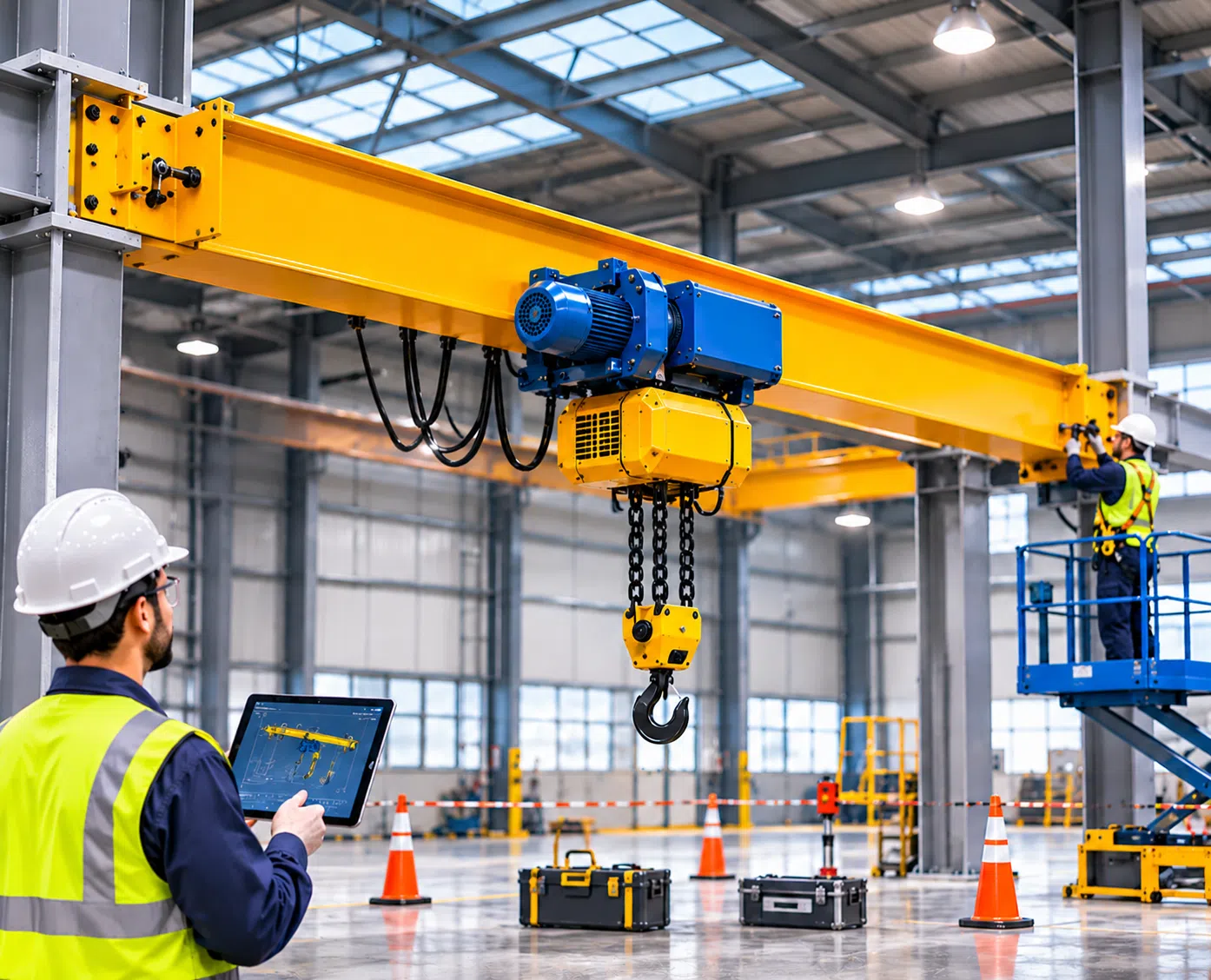
- Structural dimensions and space consumed: A chain hoist is compact with a light overall weight that makes it easy to install in turning workshops and tight assembly stations, whereas a wire rope hoist needs a larger installation space to accommodate the long cable winding drum and its parallel motor.
- Lift heights and wear resistance: A wire rope hoist provides very high lifts of tens of metres in tall warehouses with perfectly straight vertical lifting motion, whereas steel chains are an excellent choice for limited vertical distances thanks to the ease of replacing the hardened chain and its low sensitivity to surface dust.
- Capital cost and maintenance expenses: Electric chain hoists have a low initial investment cost that suits limited budgets, with easy mechanical inspection, whereas wire rope hoists require a higher initial investment but offer a longer service life and superior reliability under heavy, continuous industrial use.
Safety Requirements and Mandatory Equipment in Modern Electric Hoists
There can be no compromise on electrical and mechanical safety equipment when handling heavy cargo. The standards to verify include:
- Electronic overload limiter (Overload Limiter): A protection system that instantly cuts the control circuit of the lifting motor when an attempt is made to pick up an object exceeding the permitted weight, to prevent the steel cable from snapping or the load from falling.
- Dual limit switches (Limit Switches): Mechanical and electrical cut-outs that stop the maximum upward motion before the hook strikes the hoist body, and stop the downward motion before the cable wraps on the drum run out.
- Self-locking electromagnetic brakes (Fail-Safe Brakes): They work on an automatic closing system that applies the mechanical brake as soon as power is cut or the stop button is pressed, ensuring the goods stay suspended with complete stability.
- Encrypted radio remote controls (Radio Remote Controls): Allow the operator to stand at a safe distance away from the path of the lifted goods with a clear panoramic line of sight, and ensure the device is free of any radio frequency interference.
How Does "Al Manarat Al Monerah" Support You in Choosing and Equipping an Electric Hoist?
Al Manarat Al Monerah (almanratalmonerah.com) has a prominent engineering presence in supplying and installing the latest lifting equipment in the Kingdom and the Middle East, providing integrated solutions that focus on the sustainability of your facility:
- On-site engineering study: Visiting your site and analyzing material flow and the nature of the goods to determine the most suitable capacity and classification (chain or steel wire rope), which prevents wasting capital on unused specifications.
- Supplying components that comply with international specifications (FEM/ISO): Providing European- and internationally-certified electric hoists, equipped with motors of superior thermal insulation and frequency speed drives that prevent goods from swinging in the air.
- Precise installation and fine alignment: Specialist engineers and technicians supervise the fixing of travel trolleys and power feed tracks and accurately set the safety brakes to ensure quiet, smooth operation.
- Genuine spare parts readiness and fast technical support: Local warehouses stocked with cables, brakes, lifting sheaves and load sensors to cut waiting times and prevent production line stoppages.
- Upgrading and modernizing existing cranes (Retrofitting): Replacing old hoist units with modern energy-saving models and equipping them with smart control systems without needing to change the existing steel bridges.
Al Manarat Al Monerah gives you the opportunity to request a preliminary technical consultation and a survey of your factory by contacting its experts directly, to get an electric hoist designed to meet your cargo lifting requirements with the highest efficiency and the lowest possible operating cost.
Frequently Asked Questions About Choosing an Electric Hoist for Factories
What is the difference between a single-speed hoist motor and a variable frequency drive (VFD) motor?
A single-speed motor works by starting and stopping abruptly, which generates mechanical shocks and swinging of the suspended load, whereas a variable frequency drive (VFD) system provides smooth, gradual acceleration and deceleration that lets the operator control precise micro speeds, preventing the goods from swaying and protecting the gears from wear.
What is the service life of the steel hoisting rope in an electric hoist?
Service life ranges from two to 5 years depending on daily operating hours and the regularity of lubrication. The rope must be replaced immediately if its diameter has decreased by more than 7% from the nominal diameter, or when any broken wires or unrepairable kinks appear, in accordance with the ISO 4309 standard.
Can an electric hoist be used in industrial environments exposed to fumes and fire hazards?
Yes, but you must order an electric hoist designed to special explosion-proof specifications (Explosion-Proof / ATEX). All electrical components, motors and switchgear are enclosed in gas-tight housings, and the hook and wheels are made of bronze alloys that cannot generate any mechanical sparks on friction.
Read also: Benefits of Using Electric Chain Hoists in Daily Operations