
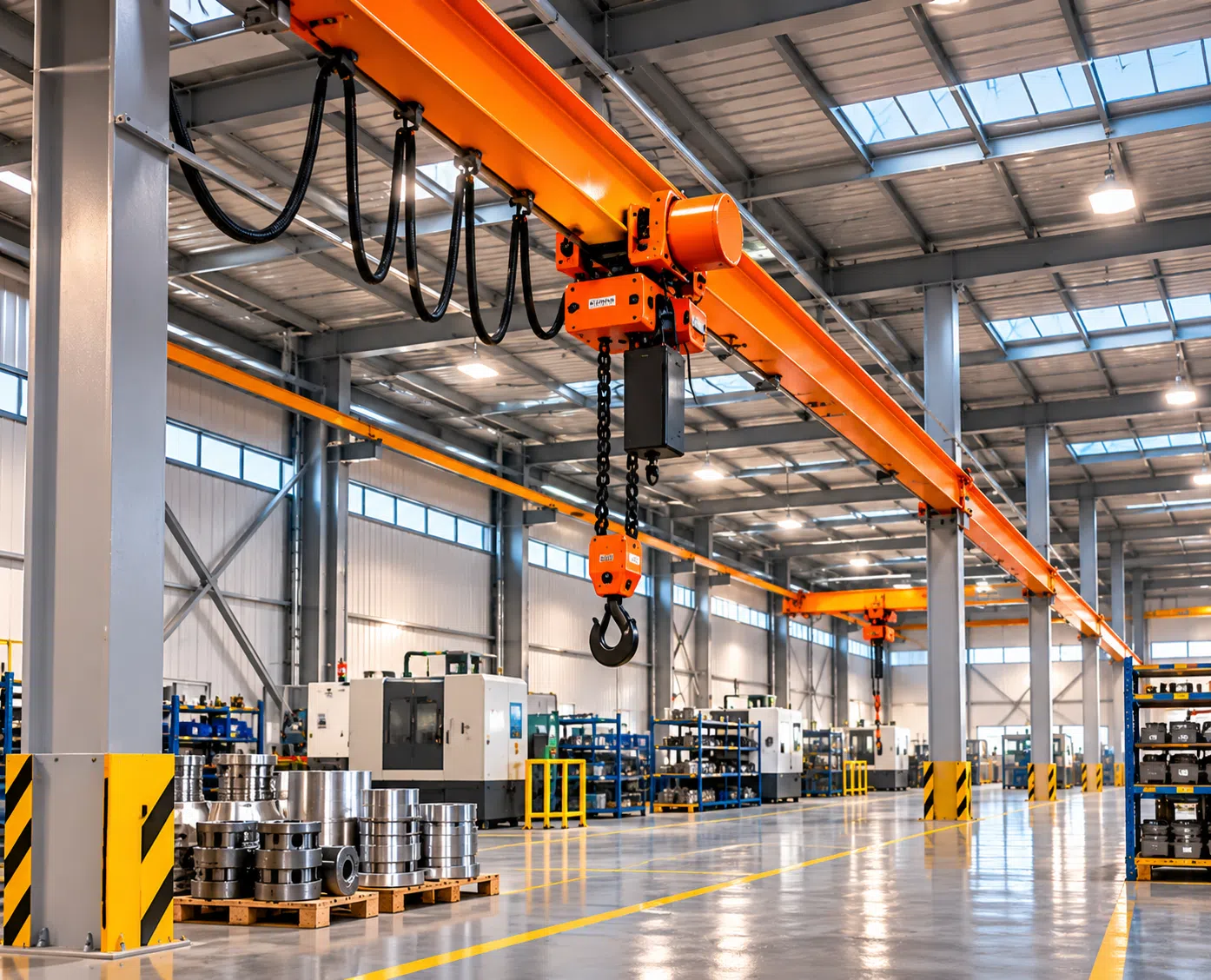
What Is a Monorail Crane and How Does It Use Your Factory's Ceiling Space?
Congestion on the floor of factories and production warehouses peaks when the paths of assembly lines cross the travel aisles of trucks and forklifts. A huge part of the facility floor is wasted on turning lanes and raw material transport aisles that swallow space which could have been used to install new production lines or extra storage racking that raises the facility's investment return. This complexity grows in buildings with long, narrow layouts or workshops that lack wall columns able to carry heavy bridge cranes weighing tons of steel above the roof. This is where the monorail crane comes in as an innovative mechanical solution to free factory floors completely, by shifting the handling burden to the dead overhead air space beneath the roof and turning it into highly flexible, highly efficient logistics arteries.
What Is a Monorail Crane?
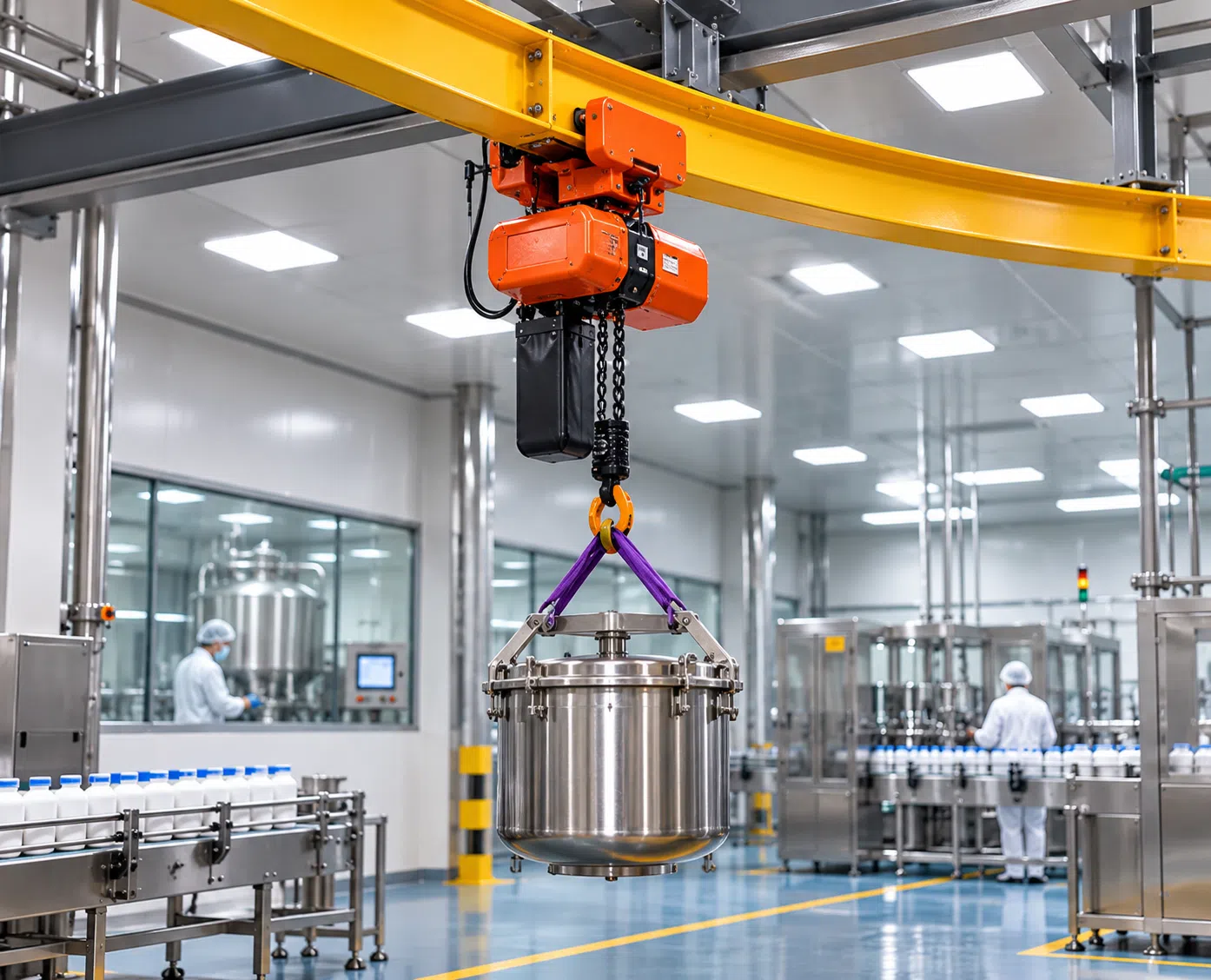
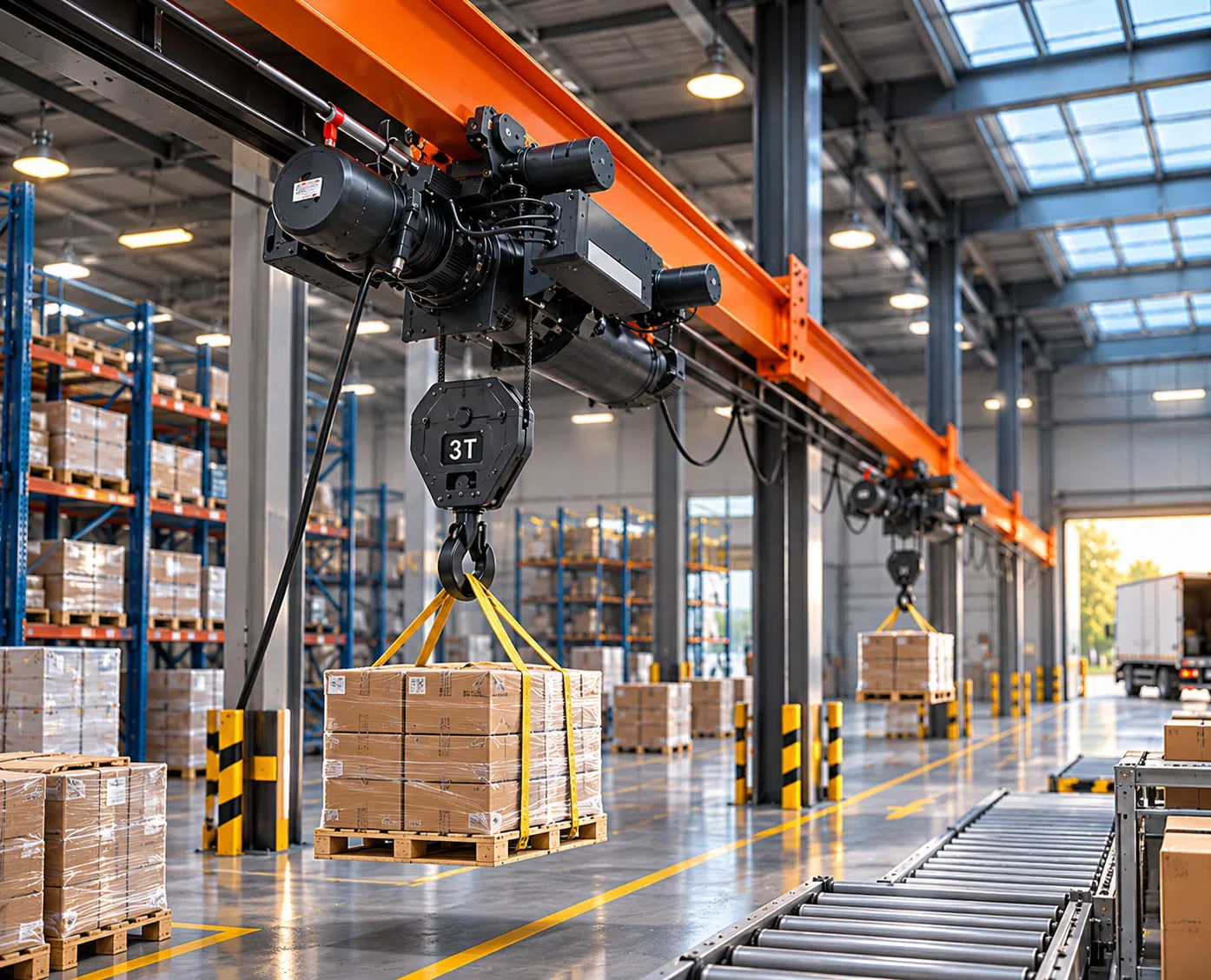
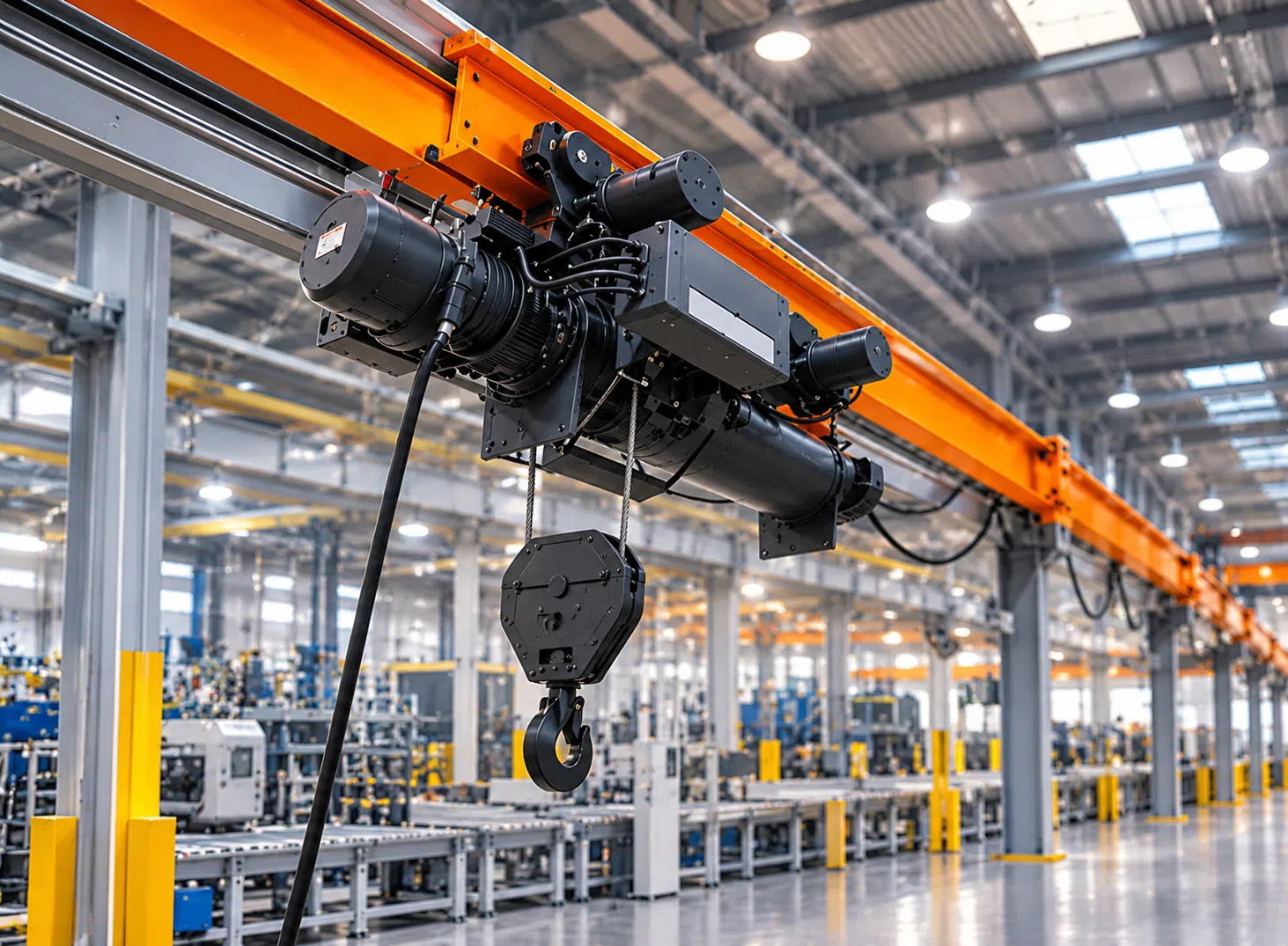
A monorail crane is a suspended industrial lifting system based on a single track made up of a single steel beam fixed in the facility's roof or on light cantilever structures. An electromechanical travel trolley carrying an integrated hoist moves over it or on its lower flange, to move goods and components between pre-set points along a linear or curved path without consuming any floor space.
This compact structural configuration gives industrial facilities immediate operational gains:
- Recovering 100% of the factory floor previously assigned to transport aisles for direct production operations.
- Exceptional engineering flexibility to run the track in straight lines, circular bends, or branches that bypass existing machines.
- Major savings in construction cost compared with the cost of full bridge cranes, which require double beams and huge support columns.
How Does a Monorail Crane Use Unused Ceiling Space?
Neglected roofs and steel trusses are turned by this system into active handling platforms that support production flow through integrated engineering mechanisms:
1. Direct Suspension from the Roof Structure (Ceiling-Mounted Design)
The crane does not need concrete columns or steel bases fixed to the floor to stand on. Instead, the steel beam tracks are hung directly from the existing roof trusses (Roof Trusses) with articulated, mechanically calibrated steel hangers. This engineering lets the trolley and hook move in the vertical space between the hall ceilings and the machines without any obstruction.
2. Bypassing Floor Obstacles and Designing Curved Tracks (Bypassing Floor Obstacles)
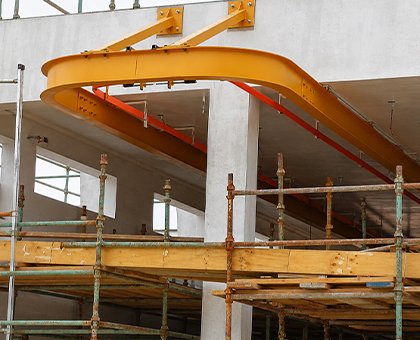
If the production hall contains huge heat treatment furnaces, plastic injection machines, or administrative offices that are hard to remove, the monorail crane track can wrap around these architectural obstacles through curved sections with engineering-calculated radii, linking the manufacturing stations to one another through the air without having to rearrange the hall.
3. Linking Separate Rooms and Serving Narrow Aisles
The monorail beam can pass through narrow wall openings to connect the main production hall with painting rooms or adjacent dry storage warehouses. This feature removes the need to open huge doors or demolish building partitions and ensures continuous movement of metal parts between the different departments.
The Mechanical Components of a Ceiling Monorail Crane System
The system's smooth performance rests on the integration of a set of precise mechanical parts:
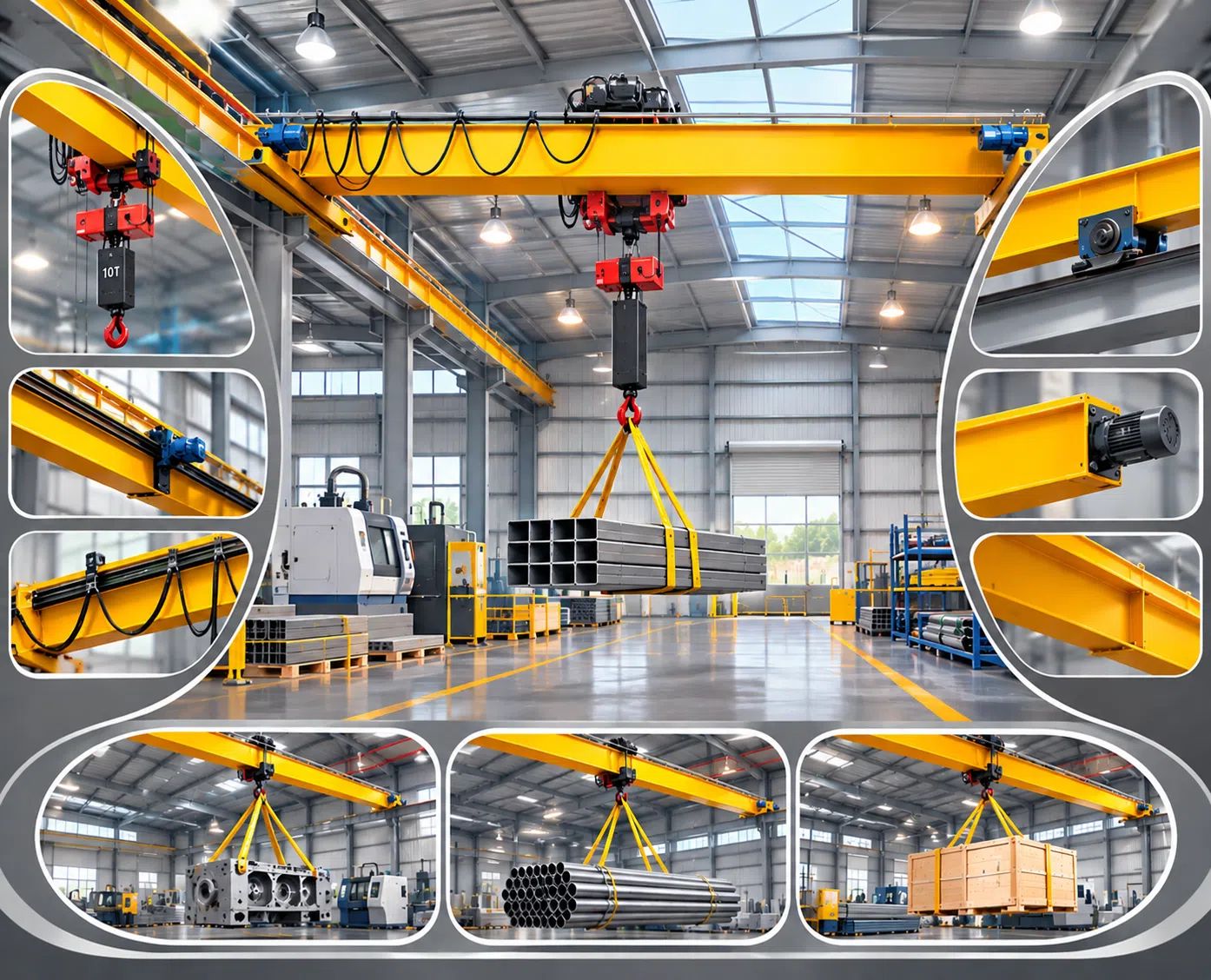
- The suspended track beam (Track Profile): Standard rolled steel beams (I-Beam / H-Beam) are used for heavy duty, or enclosed hollow box sections (Enclosed Rail Systems) of carbon steel or reinforced aluminum alloy for light loads to protect the trolley wheels from dust.
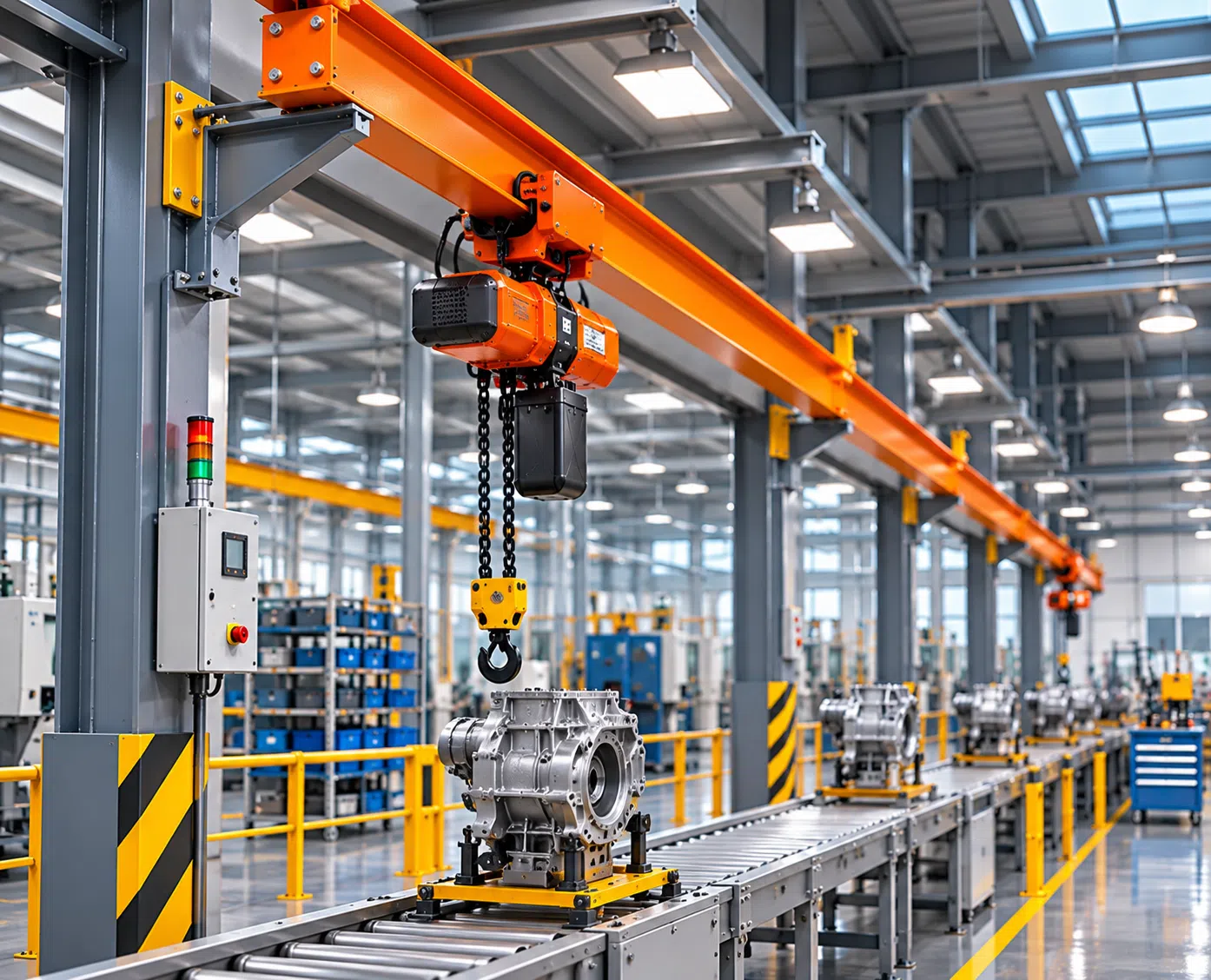
- Travel trolley and electric hoist (Hoist & Trolley Unit): A moving trolley resting on steel or polyurethane wheels fitted with electric chain hoists (Electric Chain Hoists) for medium loads and compact distances, or wire rope hoists for tasks that require high speeds and larger loads.
- Switches and track changers (Switches & Turntables): Rotating or sliding mechanical systems installed in the ceiling to allow the crane to move from a main travel line to multiple branch tracks to feed parallel assembly platforms.
- Insulated electrical conductor tracks (Conductor Busbars): Copper conductor lines protected by an insulating plastic sheath running along the ceiling beam, providing stable electric current to the motor with no need for dangling wires that may obstruct movement or tangle with machines.
Comparative Analysis: Monorail Crane vs. Bridge Crane and Floor Conveyors
Engineering departments weigh up material transport methods to determine the solution that saves the most space. The following points summarize the fundamental and direct operational differences between these systems:
- Use of floor space and freedom of passage: The monorail crane leaves the factory floor 100% clean and clear because its track is fully suspended from the roof, while floor conveyors eat up wide areas and divide the hall with continuous barriers, and forklifts require wide turning aisles that disrupt storage.
- Nature of the path and adaptation to the building: Overhead bridge cranes are limited to moving along a straight rectangular path only and do not wrap around corners, while the monorail crane gives complete freedom to design curved paths, closed loops, and rising and falling paths that suit the most detailed architectural layouts.
- Loads imposed on the factory roof: Bridge cranes require parallel runway beams and a huge moving bridge that throws dead weight and huge reaction forces onto the building's columns, whereas the monorail crane has a light self-weight that distributes the load to scattered points in the roof truss without excessive structural stress.
- Capital cost and installation work: The monorail crane has supply and installation costs lower by more than 40% to 60% compared with bridge cranes, because it dispenses with wide girders and dual travel motors and settles for a single track that serves the workstations precisely.
Key Practical Applications of Monorail Cranes in Modern Factories
The efficiency of these ceiling cranes stands out in many industries that require sequential product transfer:
Surface Treatment and Chemical Coating Lines (Dip Tanks)
The monorail crane carries metal frames and car parts and passes them vertically and horizontally over degreasing tanks, acid wash and phosphating baths, then feeds them directly into thermal drying ovens in a non-stop suspended loop.
CNC Machining Loading and Unloading Stations (CNC Machining)
The crane moves over rows of closely spaced machines to pick up steel blocks and casting dies and lower them with millimeter accuracy onto the machining tables, preventing shocks that could hit the machine axes and saving part setup time between shifts.
Engine and Heavy Equipment Assembly Plants
The engine or mechanical part is hung from the crane hook so it moves alongside the technicians at each assembly station, providing a comfortable working height for workers and eliminating the physical strain caused by carrying parts by hand.
Logistics Linking Production Halls and Storage Warehouses
Moving finished and consolidated goods from the end of the manufacturing line to the shipping platforms and pallet unloading in the adjacent warehouse, passing over barriers and sorting walls with no involvement from ground handling equipment.
Mandatory Safety Standards for Operating Monorail Cranes
Systems suspended from ceilings require strict safety requirements that ensure track stability and the safety of workers below:
- Secondary safety suspension cables (Secondary Safety Cables): Fixing secondary steel cables that connect the monorail beam directly to the main roof truss to act as immediate emergency support that prevents the track from falling if the primary fixing bolts suffer any breakage or unexpected stress.
- Mechanical track end stops (Mechanical End Stops): Steel stops backed by rubber pads or polyurethane dampers fixed at the rail ends to prevent the hoist trolley from leaving the track if the electrical motion cutouts fail.
- Track switch interlock systems (Track Switch Interlocks): Mechanical and electrical protection gates that automatically close the track and cut power to the trolley if the switch has not settled 100% in its correct position, to prevent the crane from dropping into the air gap.
- Digital overload limiters and variable frequency drives (VFD): Automatically cutting hoisting motion as soon as the rated weight is exceeded to prevent stress on the roof, with the use of frequency inverters to give smooth start and deceleration that prevents suspended loads from swinging as they turn through curves.
How Does "Al Manarat Al Monerah" Help You Equip Your Factory with Monorail Cranes?
Al Manarat Al Monerah (almanratalmonerah.com) leads the supply and design of advanced industrial lifting systems in the Kingdom and the Middle East, providing integrated engineering solutions to use ceiling space with the highest efficiency:
- Structural survey and roof load study: Inspecting your facility's trusses and roofs and confirming their ability to carry the monorail's dynamic loads, and designing custom tracks that wrap precisely around your existing machines by the shortest possible route.
- Manufacture and forming of certified tracks and curves: Forming steel beams and track switches with mechanical precision that ensures smooth wheel movement free of any vibration or friction noise during operation.
- Supply and integration of genuine global hoists (FEM/ISO): Equipping the system with electric chain or wire rope hoists fitted with motors with superior thermal insulation and instant electromagnetic safety brakes that lock automatically when power is lost.
- Installation and precision laser alignment: Specialized engineering crews supervise fixing the tracks and adjusting their complete levelness by laser, and run insulated electrical feed networks protected against dust and heat.
- Load testing and calibration certificates: Carrying out static (125%) and dynamic (110%) load tests on site and providing certified engineering inspection reports for submission to civil defense and industrial inspection bodies.
- Genuine spare parts readiness and preventive maintenance contracts: Providing travel wheels, brake linings and electrical panels in local warehouses to secure fast preventive maintenance that protects your lines from any sudden stoppage.
Al Manarat Al Monerah gives you direct access to its engineering experts for an on-site consultation and a tailored technical proposal that puts the best monorail crane solutions in your hands to use your factory's vertical space and achieve the highest productivity rates with complete safety.
Frequently Asked Questions About Monorail Cranes and Using Ceiling Space
Does installing a monorail crane require costly modifications to the existing factory roof?
In most cases, no costly modifications are needed. The monorail hangers are fixed directly to the existing steel roof beams or trusses after their load capacity is verified by engineering calculation, and light reinforcing connections are added only if the distances between suspension points are wide or the transported loads exceed 5 tons.
What is the difference between a straight monorail crane and a closed loop system?
In a straight monorail the hoist travels back and forth between two set points to serve a simple production line. In a closed loop system (Closed Loop System), several cranes move in a continuous circular direction to serve successive processing stages such as coating and drying tanks, without the crane having to return to the starting point.
How is the movement of a ceiling-mounted monorail crane controlled?
Control is either through wired pendant control units hanging from the trolley, which the worker carries alongside the line, or through encrypted digital wireless control devices (Radio Remote Controls) that give the operator the freedom to stand at a safe distance and watch the suspended load's movement with complete clarity, up to fully automated control systems (PLC) that move loads automatically between stations without human intervention.
Read also: Advantages of Monorail Hoists for Moving Products in Food and Pharmaceutical Plants