
In many industrial facilities and warehouses, the nature of the work does not require covering the entire workshop area with massive overhead cranes. Instead, there is a need to transport goods, raw materials, or semi-finished products along a specific, fixed linear path (from point A to point B). In such cases, the "Monorail System" emerges as the most efficient and cost-effective engineering solution.
If you are looking for a way to accelerate production lines and reduce reliance on manual labor or forklifts in narrow aisles, monorail cranes are the ideal choice. In this guide—brought to you by Al-Manarat Al-Munira for Industrial and Technical Works Ltd.—we will explore what these systems are, their advantages, and how to install and operate them for maximum benefit.
What Are Monorail Cranes?
The term "monorail" literally means "single rail." Consequently, monorail cranes are lifting and material-handling systems consisting of a single steel track (rail) suspended from the building's ceiling or supported by columns. An electric or manual hoist travels along this track to transport loads.
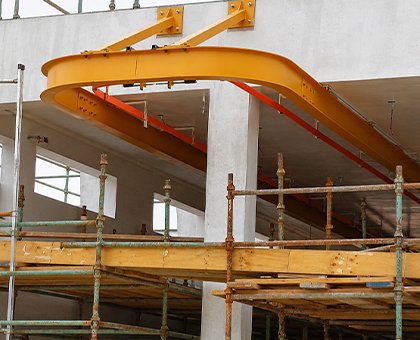
The track can be perfectly straight, curved, or even a branched system featuring switches to direct the load to various side tracks, making it a highly flexible system.
Key Industrial Applications of Monorail Cranes
Their linear design makes them ideal for sequential production lines. Some of their most common applications include:
Painting and coating lines: Transporting metal parts sequentially through paint booths and drying ovens.
Automotive industry: Moving car bodies or engines between various assembly stations.
Meat processing plants: Monorail hoists are the standard system used to transport meat through various processing stages.
Long warehouses: Rapidly moving goods in a straight line from the receiving area to storage or shipping zones.
Features that make monorail cranes a profitable investment:
1. Cost-effectiveness
Unlike overhead cranes—which require massive double girders and longitudinal rails along the building's sides—monorail cranes require significantly less steel and structural support, making them highly economical to manufacture and install.
2. Optimal use of tight spaces
These cranes do not require floor space; their compact design allows them to operate in very narrow aisles, between machines, and in areas inaccessible to forklifts.
3. Flexibility and expandability
A monorail system functions much like a train track; you can easily add new routes or branch lines, or even integrate the monorail with another overhead crane to create a comprehensive material handling network that covers the entire factory.
Steps for the safe installation and operation of monorail cranes
Installing these overhead systems requires precise engineering expertise. Here is how the process works at Al-Manarat Al-Munira Company:
First: Structural Assessment and Track Design
Our engineers visit the site to assess the load-bearing capacity of the building's roof or steel structure. Based on this, the track layout (straight or curved) is designed, and the appropriate steel section—typically an I-beam or H-beam—is selected to support the combined weight of the hoist and the load without deformation.
Second: Fabrication and Installation
The tracks are fabricated and the hangers prepared at our factory. During installation, the track is mounted with extreme precision to ensure perfect alignment; any tilt in the rail could cause the hoist to slide or lead to rapid wheel wear.
Third: Hoist Installation and Operation
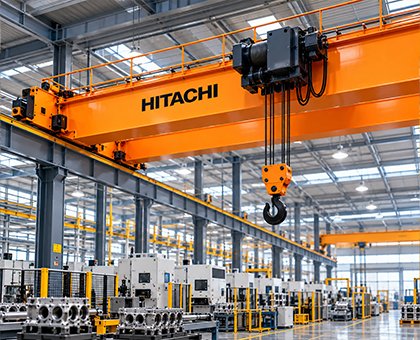
The electric hoist (featuring a trolley and either wire rope or chain) is installed on the rail. At Al-Manarat Al-Munira, we exclusively recommend and use Japanese-made Hitachi hoists to ensure smooth, silent operation and heavy-duty load-bearing capability.
Fourth: Safety Testing
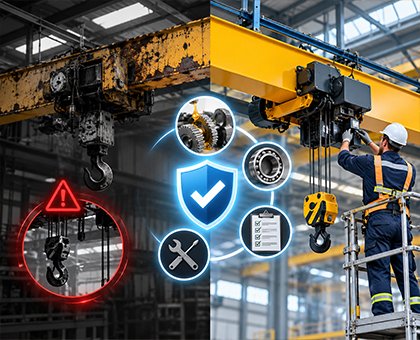
Before actual operation, the monorail cranes undergo load testing. We verify the functionality of the end stops—which prevent the hoist from running off the track—and inspect the electrical control panels.
Why choose Al-Manarat Al-Munira for monorail systems?
With over 10 years of experience and our state-of-the-art factory in Al-Mashael, we provide more than just a steel rail; we deliver a comprehensive, expertly engineered material handling system. As the exclusive agent for Hitachi hoists in the Kingdom, we ensure that the heart of your monorail system beats with the highest standards of Japanese technology. This guarantees years of reliable, heavy-duty performance, backed by the full availability of spare parts and maintenance services.
Conclusion
If your operations require a fixed, rapid path for material transport, monorail cranes offer the ideal solution—combining simplicity and cost-effectiveness with high efficiency.
Don't hesitate to upgrade your production lines. Contact Al-Manarat Al-Munira Industrial & Technical Services Co. Ltd. today to request an engineering consultation and begin your journey toward faster, safer material handling.