
Gantry cranes are a cornerstone for heavy industries, the construction sector, and logistics ports when handling massive loads. Given the demanding nature of the tasks these machines perform, their manufacturing process is far more than a simple assembly of metal parts and motors; it is a precise engineering system requiring strict adherence to global quality and industrial safety standards.
If you have ever wondered how tons of raw steel are transformed into a powerful lifting machine that operates with extreme precision, this article is for you. Brought to you by Al-Manarat Al-Munira Industrial and Technical Works Co. Ltd., we will take you on a detailed tour of the precise stages involved in manufacturing gantry cranes to standard specifications—ensuring the highest levels of performance and safety.
The Importance of Precision in Gantry Crane Manufacturing
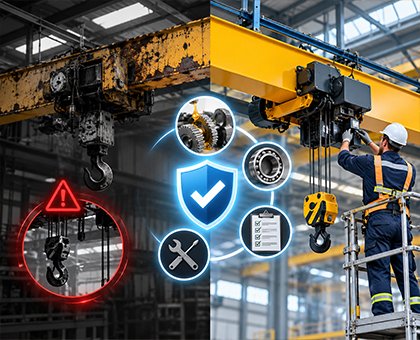
A gantry crane is a machine that moves independently along ground-level rails, consisting of robust legs and a massive horizontal girder. Even a minor error in structural calculations or weld quality could lead to a catastrophe—such as the structure collapsing under heavy loads or strong winds (in outdoor operations). Therefore, absolute precision throughout every stage of manufacturing is the only guarantee for ensuring human safety and project success. Engineering Steps in the Gantry Crane Manufacturing Process
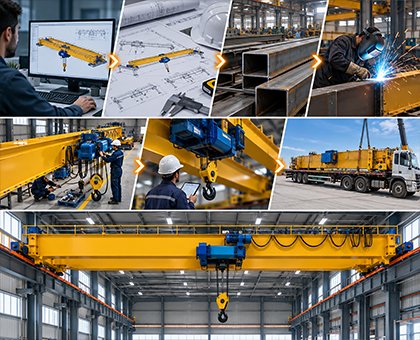
The production process at our advanced facilities follows a series of systematic steps supervised by a team of expert engineers, including the following:
1. Site Assessment and Requirement Analysis
The process begins with a precise understanding of the client's needs. Engineers assess the site (whether an indoor factory or an open yard) and determine the required maximum lifting capacity, the span between the legs, and the necessary lifting height, while also analyzing the operating environment (e.g., wind speed, humidity levels, and temperature). Based on this data, a preliminary concept for the equipment is developed.
2. Engineering Design and Simulation
This is the most critical stage in gantry crane manufacturing. Using state-of-the-art Computer-Aided Design (CAD) and structural analysis software (such as Finite Element Analysis - FEA), the design team drafts the crane's complete structure. Virtual simulations are conducted to subject the design to maximum loads and test stress points, ensuring the durability of the beams and legs and guaranteeing they will not buckle or fracture.
3. Steel Material Selection
Once the design is approved, the appropriate type of steel is selected. At Al-Manarat Al-Munira Company, we use high-quality steel plates that comply with international standards. Raw materials undergo careful inspection to ensure they are free from manufacturing defects before the cutting process begins. 4. Fabrication, Cutting, and Welding
This is where the actual manufacturing of the gantry cranes takes place on the factory floor:
Precision Cutting: Steel plates are cut using CNC plasma or laser cutting technologies to ensure dimensions match the engineering design exactly.
Assembly and Welding: Certified welders assemble the girders and legs (often utilizing a "box girder" design for maximum durability). Welding is a critical stage; therefore, automatic welding machines are used to produce uniform, void-free weld seams.
Non-Destructive Testing (NDT): All welded joints undergo X-ray or ultrasonic inspection to verify their structural integrity with 100% certainty.
5. Surface Treatment and Painting
Since gantry cranes often operate outdoors, protection against rust and corrosion is paramount. Metal structures are cleaned via sandblasting to remove impurities, followed by the application of multiple layers of industrial coating—resistant to weather and chemicals—and heavy-duty epoxy.
6. Electrical Assembly and Hoist Installation
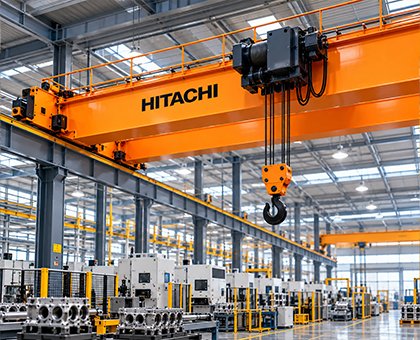
Motors, travel wheels, electrical systems, and control panels are installed. At this stage, the crane's "heart"—the hoist—is fitted. We take pride in equipping our cranes with genuine Japanese Hitachi hoists to ensure exceptional performance. 7. Final Testing and Commissioning
Before the crane is handed over to the client, it undergoes rigorous factory testing. It is then transported to and installed at the client's site. There, actual load testing is conducted—involving lifting weights that exceed the crane's rated capacity by a specific margin (e.g., 125%)—to verify structural stability and the efficiency of the braking and safety systems.
Al-Manarat Al-Munira Factory: A Leader in Gantry Crane Manufacturing
Since expanding our operations in 2015 and opening our state-of-the-art factory in the Al-Masha'el Industrial Area in Riyadh, Al-Manarat Al-Munira Industrial & Technical Works Co. Ltd. has established itself as a formidable player in the metal structures and lifting systems sector. Our massive production capabilities, reliance on modern technology, and highly skilled team of engineers and technicians enable us to handle the largest projects, ensuring on-time delivery and adherence to the highest quality standards certified by major authorities.
Conclusion
Manufacturing gantry cranes is a complex engineering journey requiring expertise, precision, and advanced technology. Investing in a crane built to rigorous standards is a direct investment in the success and sustainability of your industrial and commercial projects.
If you seek strength and reliability for your next project, do not compromise on quality. Contact Al-Manarat Al-Munira Industrial & Technical Works Co. Ltd. today. Discuss your requirements with our experts, and let us design and manufacture the ideal gantry crane to propel your business to new heights with complete safety.