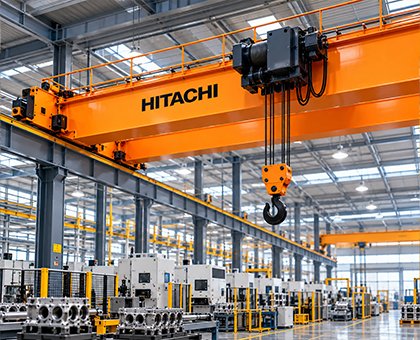

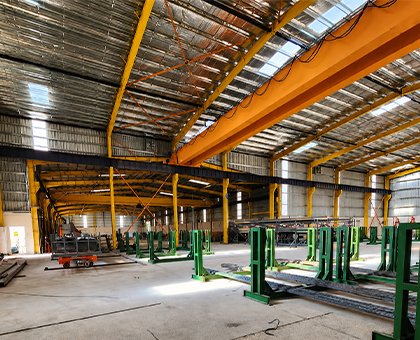
Heavy-duty cranes and industrial lifting systems form the backbone of production lines in large factories, logistics hubs, and cargo handling terminals. Behind every crane capable of lifting dozens of tons with a single command lies a highly engineered and strictly controlled manufacturing process that combines structural engineering, mechanical design, and advanced automation technologies.
Building an industrial crane is not a simple assembly operation. It is a complete engineering cycle that ensures the final system can withstand dynamic loads, continuous operation cycles, and strict safety requirements while protecting human lives and industrial assets.
In this technical guide from Al Manarat Al Munira, we explore the full engineering workflow used in manufacturing overhead cranes and gantry cranes from initial concept to final commissioning.
1. Site Survey and 3D Engineering Design
The manufacturing journey begins long before any steel is cut.
Structural Assessment and Site Survey
Engineers visit the installation site to:
- Measure building dimensions with high precision
- Inspect concrete or steel support structures
- Evaluate runway beam alignment and load-bearing capacity
- Identify operational requirements and lifting routes
3D Modeling and Simulation (FEA Analysis)
Using advanced CAD systems, the crane is digitally designed and tested:
- Finite Element Analysis (FEA): Simulates stress distribution across girders and joints
- Load path optimization: Ensures uniform stress handling under maximum load
- Duty classification (FEM/CMAA): Defines crane class based on operational intensity and working cycles
This phase ensures that the crane structure is optimized before manufacturing begins.
2. CNC Cutting and Steel Fabrication
Once the design is approved, production begins with high-grade steel processing.
Precision CNC Cutting
Steel plates are processed using:
- CNC plasma cutting systems
- Laser cutting machines for high-precision parts
This ensures millimeter-level accuracy in:
- Main girders
- End carriages
- Reinforcement plates
Box Girder Construction
The main crane beam is typically fabricated as a box structure:
- Internal stiffeners are installed
- Welded reinforcement sections increase rigidity
- Structural geometry is optimized to resist bending and torsion
3. Automated Welding and Non-Destructive Testing (NDT)
Welding quality is one of the most critical safety factors in crane manufacturing.
Automated Welding Process
- Submerged Arc Welding (SAW) is used for deep penetration and uniform strength
- Robotic welding systems ensure consistency and eliminate human error
- Continuous weld lines increase structural integrity
Non-Destructive Testing (NDT)
After welding, the structure undergoes strict inspection:
- Ultrasonic testing (UT)
- X-ray inspection
- Magnetic particle testing (MPI)
These methods detect microscopic cracks or internal defects without damaging the structure.
4. Surface Treatment and Anti-Corrosion Coating
Industrial cranes often operate in harsh environments such as coastal areas, steel plants, and chemical factories.
Surface Preparation
- Sandblasting removes rust, scale, and impurities
- Creates a clean surface for coating adhesion
Protective Coating Systems
Multi-layer coating systems are applied:
- Epoxy primer coating
- Polyurethane top coat
- Marine-grade anti-corrosion protection for coastal environments
This significantly extends the crane’s operational lifespan.
5. Mechanical Assembly and Electrical Integration
At this stage, the crane becomes a fully functional system.
Hoist and Trolley Installation
- Electric hoists (wire rope or chain type) are mounted on the main girder
- Trolley systems are aligned for smooth horizontal movement
Electrical Systems and VFD Integration
Modern cranes are equipped with intelligent control systems:
- Variable Frequency Drives (VFD) ensure smooth acceleration and deceleration (Soft Start / Soft Stop)
- Overload limiters prevent lifting beyond rated capacity
- Limit switches control travel boundaries and prevent mechanical collision
- Remote control systems enhance operator safety and visibility
Frequently Asked Questions
What load testing is required after crane installation?
Every crane must undergo two mandatory tests before commissioning:
- Static Load Test (125%):
- The crane is tested with 125% of its rated capacity to verify structural integrity and weld strength.
- Dynamic Load Test (110%):
- The crane is operated under 110% load across all movements to validate braking systems, controls, and mechanical stability.
How are cranes adapted for hazardous or explosive environments?
For petrochemical plants and hazardous zones, additional engineering modifications are applied:
- Flameproof electrical enclosures
- Explosion-proof motors and components
- Non-sparking materials for hooks and wheels
- Enhanced sealing and insulation systems
These measures ensure safe operation in high-risk industrial environments.
Conclusion
The manufacturing of overhead and gantry cranes is a highly specialized engineering process that integrates digital design, precision fabrication, advanced welding technologies, and strict safety validation protocols.
From 3D modeling and structural simulation to final assembly and load testing, every stage is designed to ensure maximum durability, safety, and performance under extreme industrial conditions.
At Al Manarat Al Munira, we apply these engineering principles to deliver customized lifting solutions that meet international standards and support long-term industrial reliability.