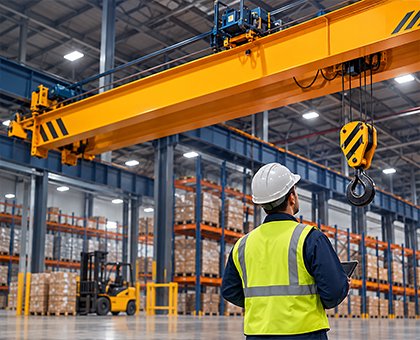

At the heart of every industrial lifting system—whether overhead, bridge, or jib—lies a critical piece of engineering that bears the brunt of the workload: the electric hoist. This device is directly responsible for lifting and lowering heavy loads; consequently, its efficiency dictates the speed and safety of material handling operations within your facility.
Given the wide range of options available on the market, selecting the right electric hoist for heavy-duty, intensive tasks can be a daunting challenge. A poor choice can lead to frequent breakdowns, production delays, and serious risks to worker safety. In this guide, presented by Al-Manarat Al-Munira for Industrial and Technical Works Ltd., we will walk you through the crucial factors that enable you to select the best hoist to meet heavy-duty requirements with efficiency and reliability.
What is an electric hoist, and why is it vital for heavy industries?
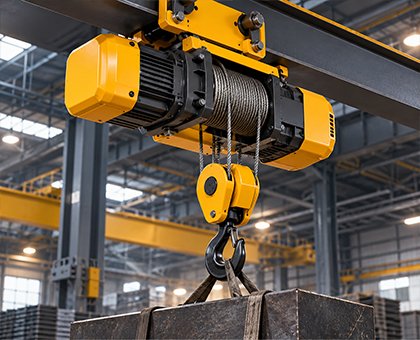
An electric hoist is a motor-driven mechanical device that lifts heavy objects vertically by winding a wire rope or pulling a metal chain. In heavy industries—such as steel mills, metal foundries, and large-scale machinery assembly plants—hoists operate under harsh conditions characterized by extreme heat, heavy dust, and continuous, round-the-clock usage.
Therefore, a hoist designed for these demanding applications (a heavy-duty hoist) must feature ultra-durable components and advanced protection systems to ensure uninterrupted operation and prevent sudden equipment failure. Factors for Selecting the Best Electric Hoist for Factories
To avoid purchasing equipment unsuited to the rigorous demands of your facility, the following technical criteria must be carefully evaluated:
1. Maximum Lifting Capacity
The first and most important rule: what is the maximum weight you need to lift? Hoists are available with capacities ranging from half a ton to over 100 tons. When selecting an electric hoist, experts recommend choosing equipment with a capacity 20–25% higher than the maximum weight expected in your factory. This prevents overloading and preserves the lifespan of the motor and brakes.
2. Lift Height
You must determine the distance from the hoist's suspension point to the lowest point the load needs to reach. Based on this, the length of the wire rope or chain and the capacity of the winding drum are determined to ensure the cable does not run short during operation.
3. Lifting Speed
Demanding tasks require time efficiency. Do you need high-speed lifting to handle large volumes? Or do you require slow, precise speeds for installing delicate components (such as positioning injection molds or assembling engines)? The best solution for demanding tasks is to select an electric hoist equipped with dual speeds or a variable frequency drive (VFD/Inverter). This ensures precise control and smooth movement, free from the violent vibrations that could damage goods or strain the hoist's structure. 4. Duty Cycle and Service Classification
The fundamental difference between a low-cost commercial hoist and a heavy-duty hoist lies in its "service classification." Heavy-duty hoists are designed to operate for extended hours daily and handle a high frequency of start/stop cycles per hour without the motor overheating dangerously. Ensure the hoist’s classification (e.g., M5, M6 or FEM 2m, 3m) matches the actual operational intensity of your production lines.
5. Advanced Safety Systems
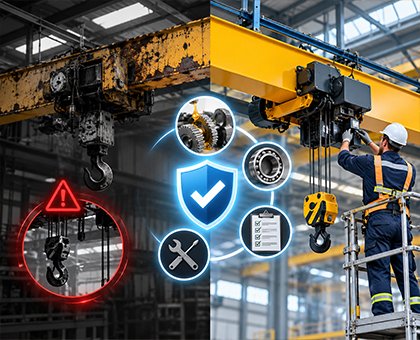
Heavy-duty operations leave no room for error. Ensure the electric hoist is equipped with: responsive dual electromagnetic brakes, overload limiters, and upper and lower limit switches to prevent the lifting hook from colliding with the hoist structure.
Types of Electric Hoists: Wire Rope or Chain?
The choice depends on the nature of the task:
Chain Hoists: Excellent for light-to-medium loads (typically up to 5 tons) and limited lifting heights. They are compact, easy to maintain, and cost-effective.
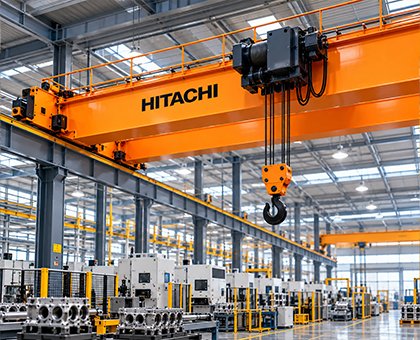
Wire Rope Hoists: The undisputed champion of heavy-duty tasks. Used for very heavy loads (5 tons and up), significant lifting heights, and high lifting speeds. They offer smoother, safer movement when handling massive loads. Hitachi: The Best Electric Hoist on the Market – Brought to You by Al-Manarat Al-Munira
If you are seeking ultimate power and unwavering reliability, Japanese engineering is the answer. At Al-Manarat Al-Munira Industrial & Technical Works Co. Ltd., we are proud to be the exclusive distributor of Hitachi electric hoists in the Kingdom of Saudi Arabia.
Using a Hitachi electric hoist ensures the following for your facility:
Unprecedented service life, thanks to superior Japanese metals and gears.
Powerful, consistent performance under the harshest operating conditions and temperatures.
Remarkably efficient energy consumption and ultra-quiet operation.
Maximum worker protection, thanks to dual braking systems and advanced safety technologies.
Conclusion
Selecting an electric hoist for heavy-duty tasks is a critical technical and economic decision that determines your facility's efficiency and productivity. Focusing on lifting capacity, duty cycle, component quality, and safety systems will inevitably lead you to the right choice.
Do not let your facility's heavy-duty operations rely on unreliable equipment. Contact the expert engineers at Al-Manarat Al-Munira Industrial & Technical Works Co. Ltd. today; we will help you select and install the ideal Hitachi electric hoist to ensure your operations continue with unmatched Japanese strength, safety, and efficiency.