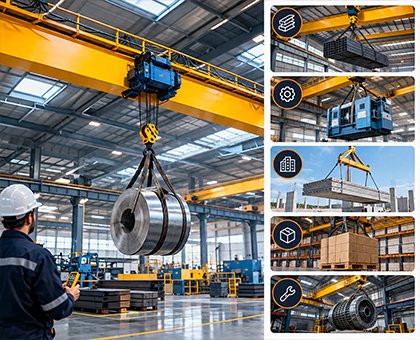

Production lines in any industrial facility serve as the vital artery ensuring the continuous flow of products to the market. To keep this artery functioning efficiently and without interruption, integrating the right material handling technologies is crucial. This is where advanced factory cranes come into play; they are no longer merely lifting machines but have become an integral part of modern production systems.
Haphazard selection of lifting equipment can lead to production line bottlenecks, delivery delays, and serious risks to worker safety. In this article—sponsored by Al-Manarat Al-Munira Industrial and Technical Works Co. Ltd.—we provide a detailed guide on the engineering and operational standards required to select factory cranes that align perfectly with your production lines and boost your facility's efficiency.
What are factory cranes, and why are they important for production lines?
Factory cranes refer to the various overhead, bridge, and jib crane systems specifically designed for industrial environments to handle heavy materials, semi-finished components, and finished products. Their importance to production lines is evident in the following ways:
Accelerating workflow: Moving heavy parts between assembly stations with high precision in mere seconds.
Reducing physical strain: Protecting workers from occupational injuries associated with manual lifting.
Optimizing space utilization: Since most of these cranes operate overhead, they leave valuable floor space available for assembly lines and machinery.
Supporting continuous production: Heavy-duty cranes are capable of operating around the clock to serve non-stop manufacturing operations. Types of Factory Cranes Available to Meet Your Needs
To select the most suitable system, you should first familiarize yourself with the options available—all designed and manufactured by Al-Manarat Al-Munira Company to the highest quality standards:
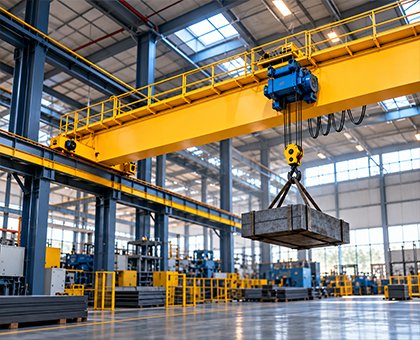
Overhead Cranes
These are the most common choice for factories with long production lines. Installed on longitudinal tracks parallel to the factory ceiling, they provide extensive rectangular coverage. They are a standard choice for automotive plants, steel mills, and heavy machinery assembly facilities.
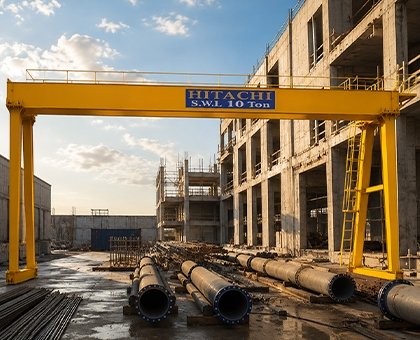
Gantry Cranes
These are used when the building structure cannot support the weight of overhead cranes. They rely on their own legs, which move along floor-mounted tracks. They play a vital role in transporting materials from outside the factory to the start of the production line.
Jib Cranes (Wall-Mounted and Pillar-Mounted)
If a production line is divided into independent workstations, the jib crane is the ideal solution. It can be mounted on a column or wall, providing rotational movement within a specific area; this allows workers to lift and assemble heavy components at their station without waiting for the main overhead crane.
Monorail Systems
These consist of a single track (straight or curved) that carries a hoist. This system is best suited for sequential production lines where a component moves from Station A to Station B, then to Station C, along a fixed, unchanging path—such as in painting or packaging lines. 5 Key Criteria for Selecting the Ideal Factory Crane
To select a crane that integrates seamlessly with your production line, carefully consider these five criteria:
1. Material Nature and Lifting Capacity
Calculate the maximum weight of the heaviest item passing through the production line and add a safety margin (approximately 20% to 25%). The crane must be capable of handling this maximum load without straining the motors.
2. Work Frequency and Operating Hours (Duty Cycle)
This is the most critical factor for production lines. If the line operates on a single shift, a crane with a moderate service rating will suffice. However, if the factory operates 24 hours a day with a very high handling rate, you need heavy-duty class cranes to prevent unexpected downtime.
3. Lifting and Movement Speed
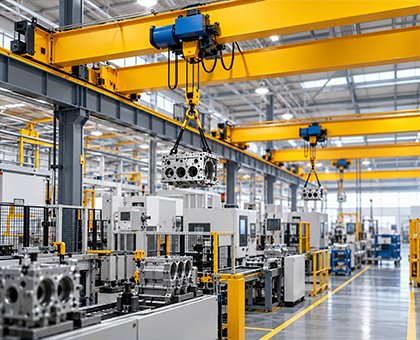
For precision assembly lines (such as automotive engines), you need hoists capable of very slow speeds—known as "creep speed"—to position components with micrometer-level accuracy. At Al-Manarat Al-Munira, we offer speed control systems using VFD technology to ensure smooth, vibration-free movement.
4. Operating Environment
Does the production line involve chemicals, smelting furnaces, or a dusty atmosphere? The crane must be equipped with specialized insulation and heat- or explosion-resistant motors tailored to the factory environment to ensure the safety of both equipment and personnel.
5. Compatibility with Future Expansion
Choose a scalable system. You might decide to extend the production line or increase its capacity in the future. Establishing a robust foundation and a flexible lifting system from the start will save you replacement costs down the line. Why is "Al-Manarat Al-Munira Company" the best partner for supplying factory cranes?
Investing in your factory's infrastructure requires a partner with both expertise and reliability. At Al-Manarat Al-Munira Company for Industrial and Technical Works Ltd., we offer you:
Extensive Engineering Expertise: Over 10 years of experience analyzing production lines and delivering engineering solutions that boost productivity.
Local Manufacturing to Global Standards: We operate our own facility in the Al-Masha'el Industrial Area in Riyadh, enabling us to design and manufacture factory cranes fully customized to your facility's dimensions and specific needs.
Japanese Hitachi Technology: We guarantee flawless performance through our exclusive use of Hitachi hoists in the Kingdom of Saudi Arabia.
Government and Private Sector Accreditations: The trust placed in us by public sector entities—such as the National Water Company—stands as a testament to the quality of our products and the rigor of our testing processes.
After-Sales Services: We provide periodic maintenance, rapid breakdown response, and a constant supply of spare parts to ensure your production lines never come to a halt.
Conclusion
Carefully selecting factory cranes is not merely about adding new equipment; it is about re-engineering your production line for greater speed, safety, and efficiency. Analyzing load requirements, the working environment, and operational intensity are the first steps toward a successful investment.
If you are planning to upgrade your production line or build a new factory...