
Modern factories and production workshops rely on efficiency and speed as two fundamental pillars for achieving competitiveness and profitability in the market. At the heart of this dynamic system lies the process of transporting materials and heavy components, which is one of the most critical tasks that determines the overall speed of the production line or causes delays and disruptions if not managed properly. Integrating smart, lightweight, and automated solutions into workstations is no longer a technological luxury—it has become a necessity to eliminate operational waste and protect human labor.
Here, the electric hoist plays the role of an unsung hero behind the scenes of advanced industries, providing production lines with exceptional flexibility and instant lifting power at the push of a button. In this article from Al Manarat Al Muneera Company, we will explore in detail the key technical and economic advantages that make the adoption of modern electric cranes a real turning point in your facility’s productivity.
What is an Electric Hoist and What Are Its Main Types?
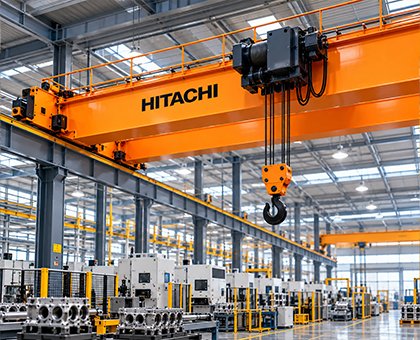
The lifting unit or electric hoist is the mechanical device directly responsible for lifting, lowering, and vertically moving loads. It can be used as a standalone unit or integrated as a core component of overhead and bridge cranes.
Electric hoists are mainly divided into two types based on the lifting medium, each serving a specific industrial need:
Electric Chain Hoists:
These rely on a solid metal chain for lifting loads. They are compact in size and cost-effective, making them ideal for light to medium loads (up to 5 tons) in maintenance workshops and small assembly lines.
Wire Rope Electric Hoists:
These use high-strength braided steel cables and are designed for heavy-duty applications and large loads (exceeding 10 tons and reaching hundreds of tons). They offer high lifting speeds and great lifting heights, making them suitable for large factories and ports.
Modern wire rope hoists ensure perfectly vertical lifting without any lateral deviation of the load, which is extremely important when handling precision machinery or sensitive casting molds.
Key Benefits of Integrating Electric Hoists into Production Lines
Investing in advanced electric hoists at workstations directly and immediately improves your facility’s key performance indicators (KPIs) through several strategic advantages:
1. Time Efficiency and Increased Production Rates
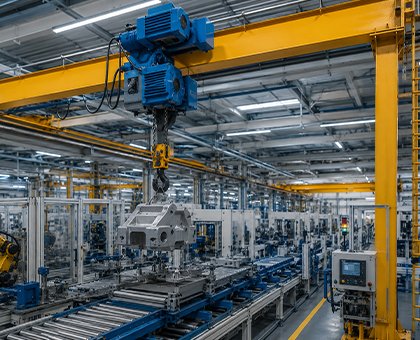
These hoists enable fast and smooth transportation of heavy components between workers and manufacturing stages. This logistical optimization eliminates idle waiting time and allows the production line to operate at full capacity around the clock.
2. High Precision and Smooth Control
Modern hoists feature speed control systems (inverters) that allow ultra-smooth starting and stopping (micro-speed control). This protects loads from sudden vibration and enables millimeter-level positioning inside machines.
Enhancing Workplace Safety and Reducing Indirect Costs
Providing a safe working environment is essential for retaining skilled labor and reducing financial waste. Al Manarat Al Muneera explains that relying on electric hoists contributes to this in several ways:
Elimination of physical injuries:
It completely removes work-related injuries such as muscle strain and back injuries caused by manual lifting.
Reduced material damage:
Advanced electromagnetic brakes ensure load stability in mid-air even during sudden power outages, protecting products and ground equipment from falling hazards.
Space-efficient design:
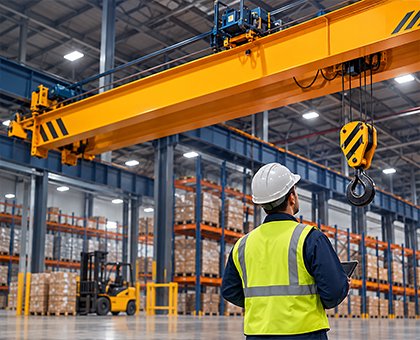
Hoists can be installed on ceilings or narrow overhead rails, keeping floor pathways clear and improving workplace organization and safety.
Frequently Asked Questions About Electric Hoists
What is the recommended duty cycle for an electric hoist?
The duty cycle depends on the equipment classification (such as FEM or ISO standards). Light-duty hoists operate intermittently (around 20% of the time), while heavy-duty hoists used in steel factories are designed to operate continuously at 60% or more without overheating.
How can electric hoists be protected in harsh environments?
Hoists used in humid or chemical environments are equipped with epoxy anti-corrosion coatings, fully sealed motors with IP55 or IP66 protection ratings, and sometimes stainless-steel wire ropes to prevent corrosion.
Conclusion
Ultimately, the electric hoist and modern electric cranes are not just auxiliary tools—they are the intelligent driving force that ensures smooth, efficient, and continuous production flow in modern industries. Choosing the correct technical specifications that match your operational needs protects you from unexpected losses and guarantees a sustainable return on investment.
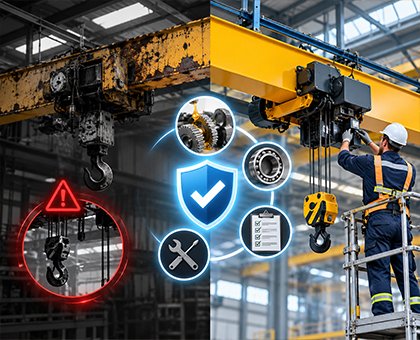
At Al Manarat Al Muneera Company, we always recommend following preventive maintenance schedules and properly training operators on safety fundamentals, ensuring that your lifting system remains a safety shield for workers and a strong pillar supporting your business growth in the industrial world.
Crane Installation and Spare Parts Province