
In the realm of heavy industry and material handling, there is no room for error. Overhead cranes are massive structures capable of lifting loads weighing hundreds of tons while operating above workers and sensitive equipment. Consequently, the quality and safety of these cranes are inextricably linked to the manufacturer's commitment to adhering to global standards during design and production. A lack of such standards essentially means creating a "ticking time bomb" within the facility.
What are these standards, and how do leading companies ensure the safety of their products? In this article—sponsored by Al-Manarat Al-Munira Industrial and Technical Works Co. Ltd.—we highlight the rigorous engineering standards governing the crane industry and explain why adherence to them should be your top priority when purchasing a new crane.
Why Are Global Standards for Overhead Crane Design and Manufacturing Essential?
The primary objective of global standards in the design and manufacture of overhead cranes is to establish a unified engineering language among designers, manufacturers, and end-users worldwide, ensuring three key elements:
Absolute Safety: Preventing catastrophic accidents caused by structural collapse or the failure of lifting systems.
Reliability: Ensuring the equipment operates effectively under harsh conditions for extended periods without frequent breakdowns.
Interchangeability: Ensuring that components and parts are standardized, allowing for easy replacement or maintenance anywhere. Key Global Standard-Setting Bodies
The crane manufacturing process is governed by a set of standard codes established by prestigious international engineering bodies, most notably:
1. CMAA Standards (Crane Manufacturers Association of America)
CMAA specifications (such as CMAA 70 for double-girder cranes and CMAA 74 for single-girder cranes) are among the most important references for structural design calculations and the determination of duty classifications based on usage intensity.
2. FEM Standards (European Materials Handling Federation)
European FEM standards define requirements for mechanical performance, motor selection, and the service life of gears and hoist ropes; these are rigorous standards applied by major manufacturers worldwide.
3. ISO Standards (International Organization for Standardization)
ISO standards (such as ISO 4301) establish comprehensive classifications for all types of cranes and material handling equipment, serving as a global reference that ensures quality.
How are these standards applied during manufacturing?
Applying global standards to the design and manufacture of overhead cranes is not merely a matter of obtaining a certificate; it is a practical process that accompanies the equipment from the initial concept stage through to field operation:
Engineering Design Phase
Engineers begin by inputting data regarding load capacity, span, and wind speed (for outdoor cranes) into structural analysis software to apply the requirements of the selected code (such as CMAA or FEM). Stresses on the girders and legs are calculated, and the allowable deflection limit is determined to ensure it does not exceed standard thresholds (typically 1/888 of the span length).
Material Selection Phase
International standards mandate the use of specific steel grades (such as ASTM A36 carbon steel or higher). The use of steel of unknown origin or high impurity content is strictly prohibited to ensure the structure's durability and resistance to fracture.
Welding Process
Welding represents a potential weak point in any crane. Standards (such as those from the AWS—American Welding Society) require that welding be performed by certified technicians using automated machinery. Furthermore, welds undergo Non-Destructive Testing (NDT), such as X-ray inspection, to ensure they are free from microscopic defects.
Assembly and Testing Phase
In accordance with standards, the crane is not handed over until it has undergone both dynamic and static load tests. The static test involves a load up to 125% of the crane's rated capacity to verify brake performance and the structural integrity of the assembly.
Al-Manarat Al-Munira’s Commitment to International Standards
At Al-Manarat Al-Munira Industrial and Technical Works Co. Ltd., quality and safety are our top priorities. Adhering to international standards in the design and manufacture of overhead cranes is the fundamental approach we employ at our state-of-the-art facility in the Al-Masha'el district of Riyadh. We distinguish ourselves through the following:
All our structural designs are created using advanced software and undergo rigorous engineering reviews in compliance with CMAA and FEM codes.
We use certified, high-quality steel for all structures manufactured locally.
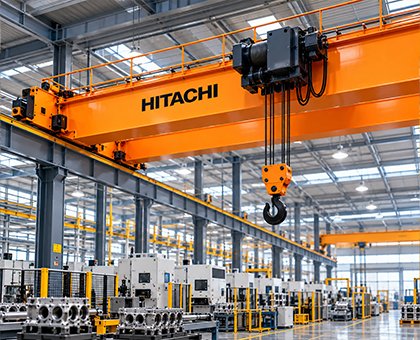
Our hoists are imported exclusively from Hitachi (Japan)—a global icon of quality—and comply with the highest industrial safety standards (such as Japanese JIS and ISO standards).
We issue certified test and safety certificates for every crane we install, ensuring our clients pass all government and industrial inspections (including Civil Defense and the requirements of Aramco or SABIC).
Conclusion
Purchasing a non-compliant overhead crane is a risk with unacceptable consequences. Adhering to global standards in the design and manufacture of overhead cranes is the only way to ensure the safety of your facility and workforce, as well as the continuity of production without unexpected downtime.
Choose safety and world-class quality crafted by local experts. Contact Al-Manarat Al-Munira Industrial & Technical Works Co. Ltd. today to acquire an overhead crane designed and executed to the highest engineering standards, equipped with the most robust Japanese hoists on the market.