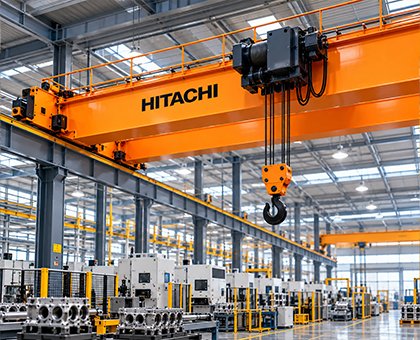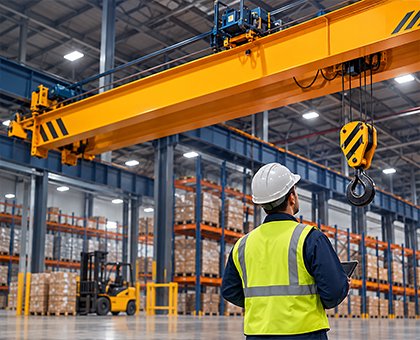

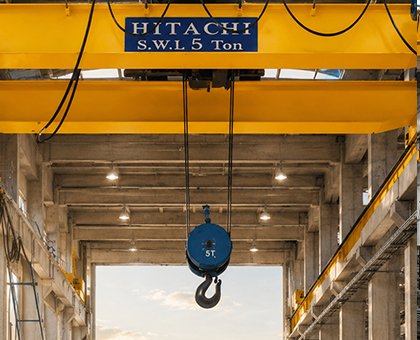
Production lines and industrial workshops operate like nonstop beehives, where raw materials and finished goods are constantly moved in heavy loads around the clock. In such a dynamic environment, selecting the right material handling equipment becomes the backbone of operational safety and uninterrupted productivity. A wrong specification for lifting machinery may lead to complete production shutdown—or worse, serious risks to worker safety.
When it comes to equipping modern industrial facilities, choosing the best factory cranes requires an engineering-driven approach that goes far beyond price or appearance. In this technical guide from Al Manarat Al Muneera Company, we explore the key engineering principles and standards that must be considered when selecting an overhead crane for factories to ensure maximum operational efficiency.
How to Determine the Correct Crane Duty Classification for Your Factory
One of the most common mistakes in the industrial sector is selecting a crane based only on maximum lifting capacity, without considering daily usage frequency. International standards such as CMAA classify overhead cranes into duty groups ranging from light to heavy continuous service:
Classes A & B (Light / Intermittent Duty):
Used in maintenance workshops and engine rooms where lifting occurs occasionally and at low speeds.
Classes C & D (Medium / Heavy Duty):
Ideal for general industrial workshops and manufacturing plants where cranes operate regularly and handle loads close to their rated capacity.
Classes E & F (Very Heavy / Continuous Duty):
Designed for steel plants and container terminals where cranes operate 24/7 under extreme environmental and load conditions.
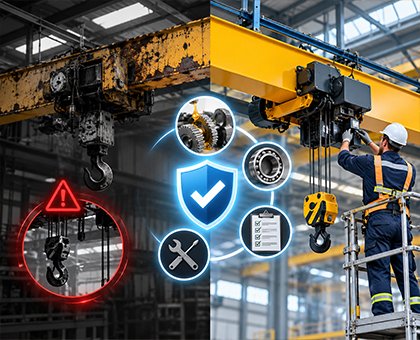
⚠️ Engineering Warning:
Using a light-duty crane (Class B) in a heavy-duty environment (Class E) will significantly accelerate motor failure and gear wear—even if the lifting load remains within rated capacity.
Key Technical Specifications for Selecting an Overhead Factory Crane
To ensure a successful investment in an overhead crane system, three main engineering dimensions must be precisely evaluated:
1. Crane Span
The crane span is the horizontal distance between the center lines of the runway rails. This dimension directly affects the structural design of the main girder, determining whether a single girder or double girder configuration is required.
2. Effective Lifting Height
This refers to the distance from the floor level to the maximum hook position. It is critical to ensure that lifted loads do not collide with machinery or structural elements within the facility.
Working Environment: The Hidden Factor in Crane Specification
Overhead cranes do not always operate in controlled environments. In many cases, they face harsh industrial conditions that directly impact their lifespan and performance. Therefore, crane specifications must always be adapted to the operating environment:
High Humidity & Corrosive Environments:
Require epoxy coatings and electrical protection with at least IP65 rating to prevent moisture and salt intrusion.
Explosion-Prone Areas:
Used in chemical and gas industries, requiring explosion-proof motors and control systems to eliminate ignition risks.
High-Temperature Environments:
Such as steel melting workshops, where operator cabins, cables, and electrical components must be equipped with thermal protection and heavy-duty cooling systems.
Frequently Asked Questions
What is the difference between single girder and double girder overhead cranes?
Single girder cranes are lighter, more cost-effective, and suitable for loads under 15 tons with shorter spans. Double girder cranes are designed for heavy loads and large spans, and they allow the installation of maintenance platforms and operator walkways.
How does starting torque affect crane efficiency?
Using smart motor control technologies reduces high starting current, protecting the factory’s electrical network from voltage drops and ensuring smooth, vibration-free load handling.
Conclusion
Ultimately, selecting the right industrial crane is not a luxury—it is a strategic engineering decision directly tied to productivity and workforce safety. Investing in a properly specified overhead crane protects your operation from costly downtime and unexpected failures.
At Al Manarat Al Muneera Company, we believe that proper engineering starts with understanding your real operational needs. That is why we always recommend involving mechanical engineering experts during the planning phase to ensure a durable, safe, and highly efficient lifting system that performs reliably for years.