
Why You Need Specialist Experts When Installing Factory Cranes
Heavy lifting equipment is the vital artery that links production lines and storage stations inside large industrial facilities. However, relying on it to move and handle loads weighing tens of tons puts a heavy engineering responsibility on project managers and safety officers. The risks of lifting equipment do not stop at the manufacturing quality of the steel girders or the durability of the motors. The most sensitive and dangerous point lies in the field execution stage. Any negligence, or the use of unqualified labor, during factory crane installation inevitably leads to millimeter deviations in rail levelness or poorly secured structural connections. That turns this massive equipment into ticking time bombs that threaten the safety of the entire facility, and causes accelerated mechanical wear that eats up maintenance budgets and disrupts the flow of production lines.
Why Is Using Specialist Companies Mandatory When Installing Cranes?
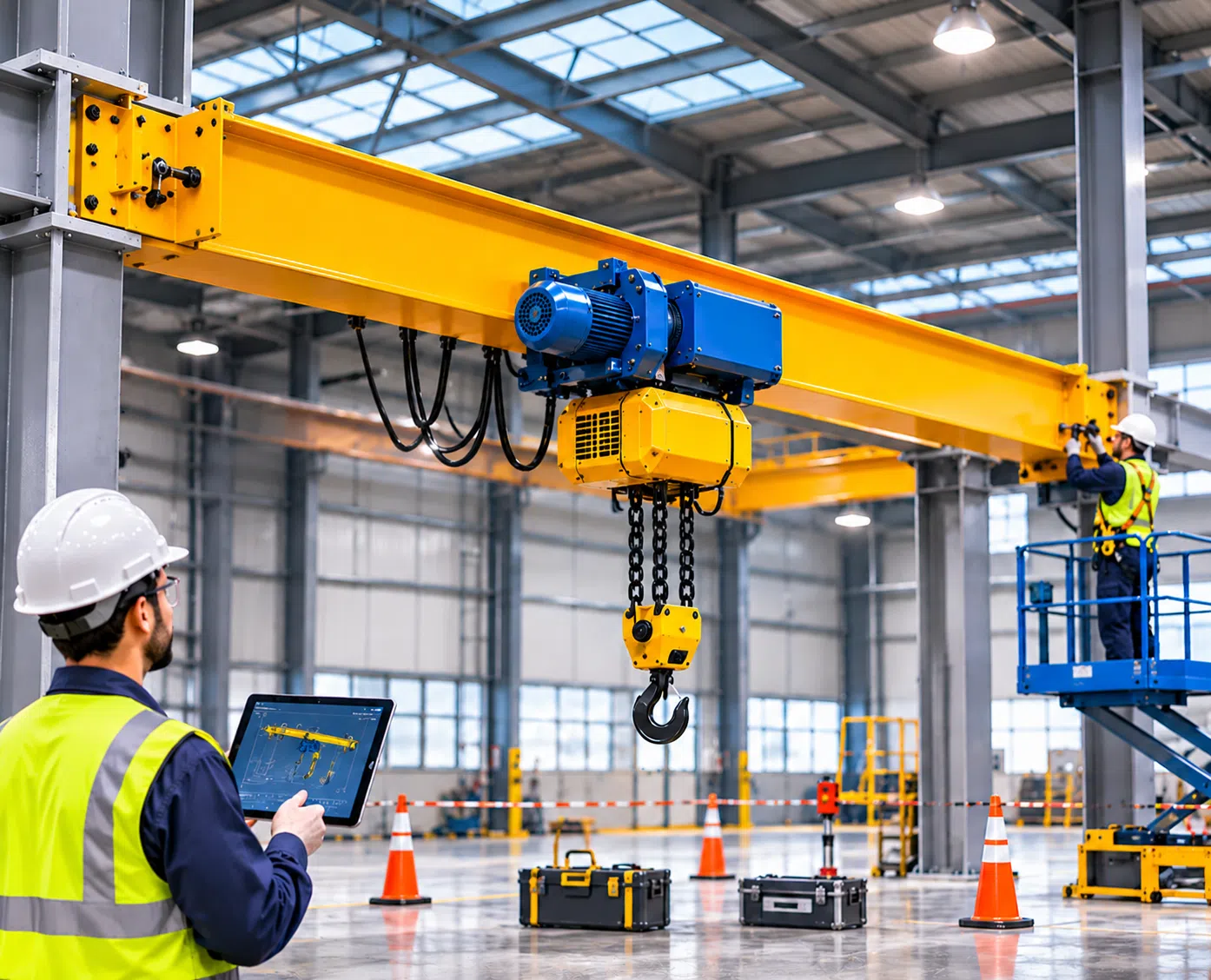
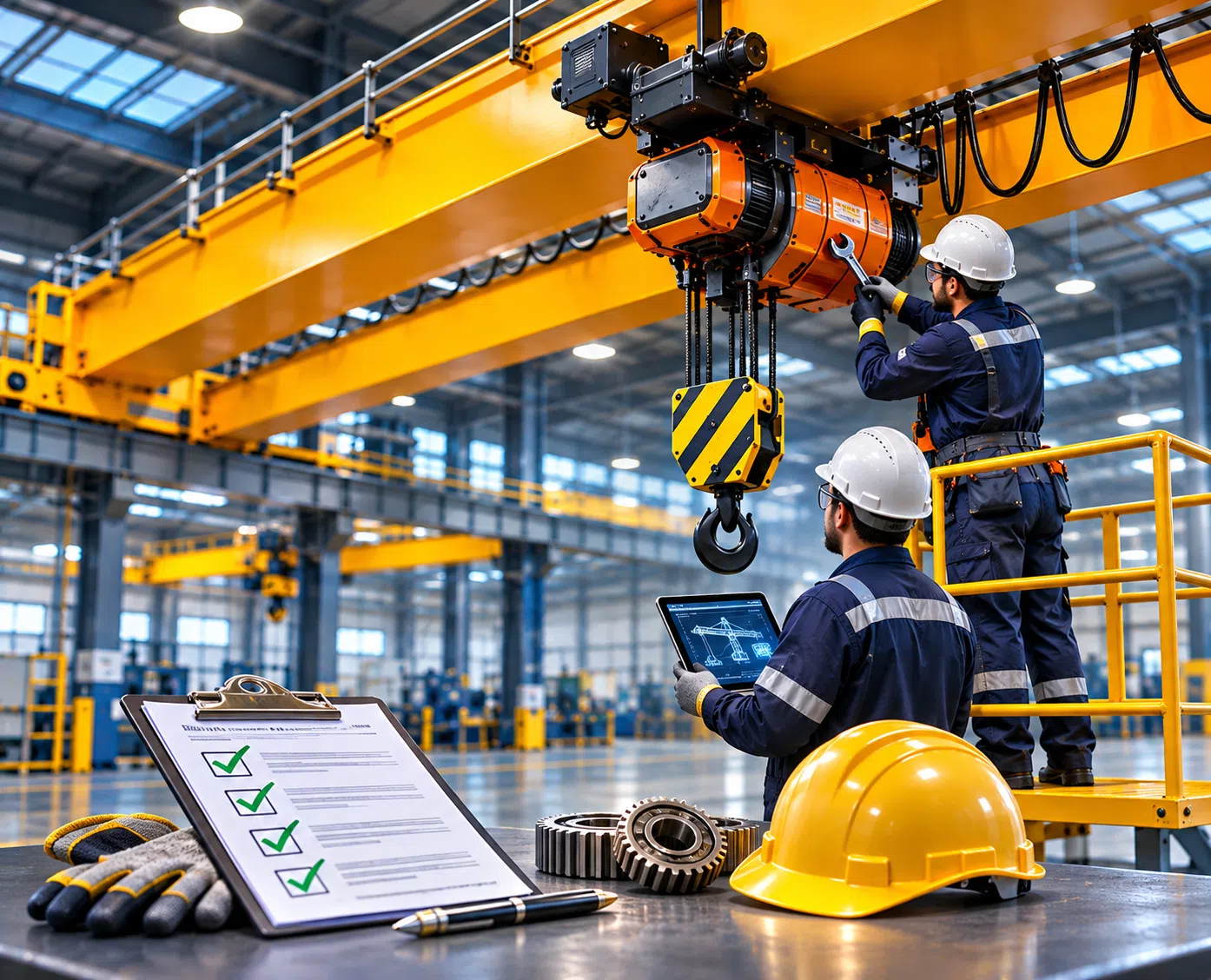
Installing industrial cranes requires specialized engineering expertise to ensure a prior structural check of the capacity of the building's columns and beams, the use of laser surveying equipment to adjust rail parallelism and prevent wheel wear, safe electrical connection of the insulated power supply networks, calibration of load limiters and digital safety sensors, and the static and dynamic load tests (125% and 110%) required to issue calibration certificates approved by Civil Defense and the regulatory authorities.
Contracting specialist experts secures proactive operational and investment returns:
- Protecting the structural frames of hangars and buildings from bending forces and sudden lateral torsional moments.
- Avoiding uneven wear on travel wheels and steel rails, which doubles the equipment's service life by many years.
- Avoiding legal penalties and suspension of operating licenses by handing over a complete technical file that matches approved safety codes.
The Catastrophic Risks of Random, Uncertified Installation
Entrusting the installation task to parties that lack engineering qualifications leads to operational and technical disasters that strike at the core of the facility:
1. Crane Skewing and Accelerated Wear of Wheels and Rails
The absence of micro-measurements leads to variation in the distance between the axes of the two parallel rails, or to one of them tilting. This defect causes the wheel flanges to rub against the steel rail head with enormous force, throwing off metal chips, wearing out the wheels within months, and destroying the gearboxes because of the opposing lateral pressure.
2. Structural Loosening and Failure of Fastening Bolts
Industrial cranes rely on pre-tensioned high-tensile bolts to connect the girders to the end trucks and the runway bases. Relying on estimated manual tightening without calibrated torque wrenches causes the nuts to loosen gradually under continuous dynamic vibration, opening the door to the risk of parts of the crane falling.
3. Burnt-Out Control Panels and Electrical Damage
Connecting the power supply tracks (busbars) and festoon cables requires precise alignment with the current collector arms to avoid sparking or sudden power cuts. Incorrect installation causes unstable voltage and burns out the smart variable frequency drives (VFDs) and the motor windings.
4. Loss of Compliance and Insurance and Civil Defense Requirements
Insurance companies and Civil Defense authorities refuse to cover any accidents or to approve facilities that do not hold inspection reports issued by certified engineers, which leaves the facility exposed to heavy civil compensation costs and direct legal liability.
Comparative Analysis: Using Specialist Engineers Versus Unqualified Workshops
The points below show the technical, operational and investment differences between relying on certified engineering crews and resorting to low-cost solutions:
- Rail alignment accuracy and span measurements: Specialist experts rely on optical surveying and laser alignment equipment to set rail straightness to a millimeter tolerance within international limits (per CMAA/FEM), whereas unqualified teams settle for traditional measurements and hand tape measures that create deviations invisible to the naked eye.
- Structural bolt torque procedures: Engineers apply engineering tightening schedules using calibrated torque wrenches, with lock nuts and safety wire to prevent mechanical loosening, whereas ordinary labor relies on random hand tightening with no set standard.
- Calibration of safety systems and sensors: The engineering team programs the digital load cells, sets the dual limit switches, and tests the instant-stop efficiency of the electromagnetic brakes, whereas in non-specialist installation these sensors are bypassed or wired randomly in a way that defeats their protective function.
- Technical documentation and load tests: Certified companies hand over an official load test document (Static 125% and Dynamic 110%) with non-destructive testing (NDT) reports for the welds, which unqualified workshops cannot provide, exposing the facility to rejection of its operating licenses.
The Systematic Steps Experts Follow During Installation
The installation process is under close engineering supervision and consists of successive stages that allow no item to be skipped:
1. Prior Structural Check of the Hall's Columns and Beams
Verifying the readiness of the supporting structure to resist the vertical and horizontal reactions produced by crane movement at full capacity, and making sure there is no excessive deflection in the steel runway beams beyond the approved design criteria.
2. Preparing the Field Lifting Plan and Securing the Site (Lifting Plan)
Studying the positioning angles of the mobile telescopic cranes and the weights of the lifted pieces, while fully clearing the area and imposing a security cordon that prevents anyone from being present below the work zone, and applying work-at-height protocols to protect technicians.
3. Precision Alignment and Fixing of the End Trucks and Bridge
Lifting the end trucks and fixing them on the rails, followed by lifting the bridge girder and assembling it tightly, and adjusting the squareness of the bridge to the travel path to prevent any skewing of the crane during long travel.
4. Electrical Connection and Variable Frequency Drive (VFD) Programming
Installing insulated copper conductors with precision that prevents current leakage, and programming the frequency converters to control motor acceleration and deceleration smoothly, which prevents operating shocks and eliminates load swing in the air.
5. Live Load Tests and Issuing Certified Reports
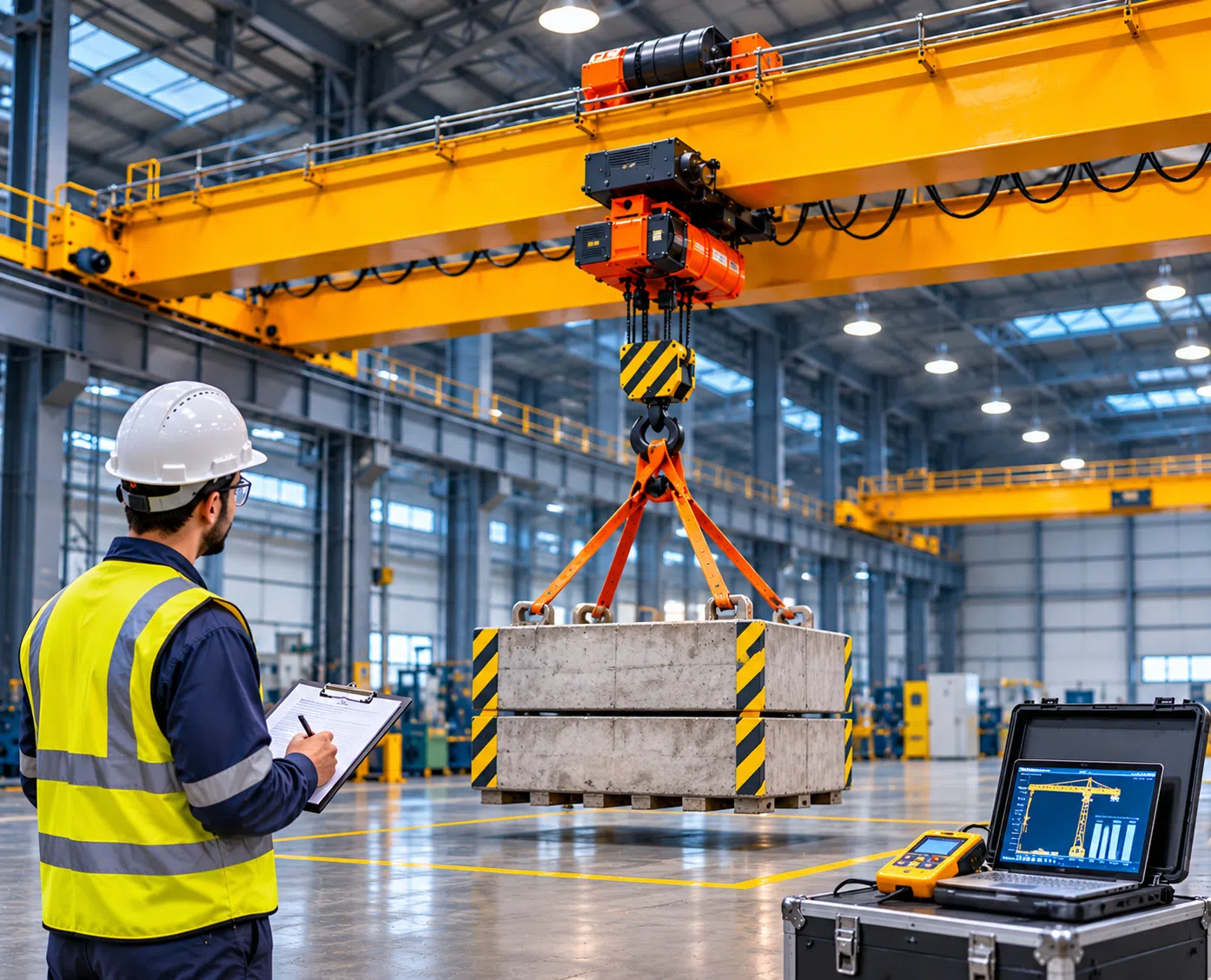
Carrying out the static load test at 125% of the rated load to confirm the bridge's structural resilience and that no permanent deformation occurs, followed by the dynamic load test at 110% to test the immediate response of the electromagnetic brakes under full operating conditions.
The Long-Term Added Value of Specialized Installation Services
Financial investment in an expert installation team brings the facility direct, lasting economic benefits:
- Lower periodic maintenance costs: Preventing abnormal wear on gears, bearings and wheels protects the facility from replacing consumable parts early, saving thousands of dollars a year.
- Continuous production lines and no sudden stoppages: Proper fixing and professional programming of the frequency converters prevent crane breakdowns during peak production shifts and customer order deliveries.
- Protecting people and ground equipment: Compliance with dual safety standards and end-of-travel limit switches ensures that loads do not fall and the crane does not hit the building, protecting the lives and the expensive machines below.
How Do You Ensure Certified Installation of Your Factory's Cranes with "Al Manarat Al Monerah"?
Al Manarat Al Monerah (almanratalmonerah.com) leads the supply, manufacture and engineering of industrial lifting equipment in Saudi Arabia, Egypt and the Middle East, putting in your hands an integrated engineering installation system that delivers the highest degree of safety and reliability:
- Certified, specialized engineering crews: An integrated team of qualified engineers and technicians to carry out complex installations according to the latest global standards (CMAA, FEM, ISO).
- The latest optical and laser measuring equipment: Inspecting and aligning runway beams and tracks with laser surveying equipment to ensure micro-level straightness that prevents wear on wheels and rails.
- Equipping and supplying genuine power supply and control systems: Integrating insulated busbars, smart variable frequency drives and encrypted wireless controls to secure flexible control and smooth movements that protect your goods.
- Load testing and issuing certified calibration certificates: Providing official calibrated weights to carry out static and dynamic load tests on site and issuing the certificates and reports certified for direct submission to Civil Defense and industrial inspection bodies.
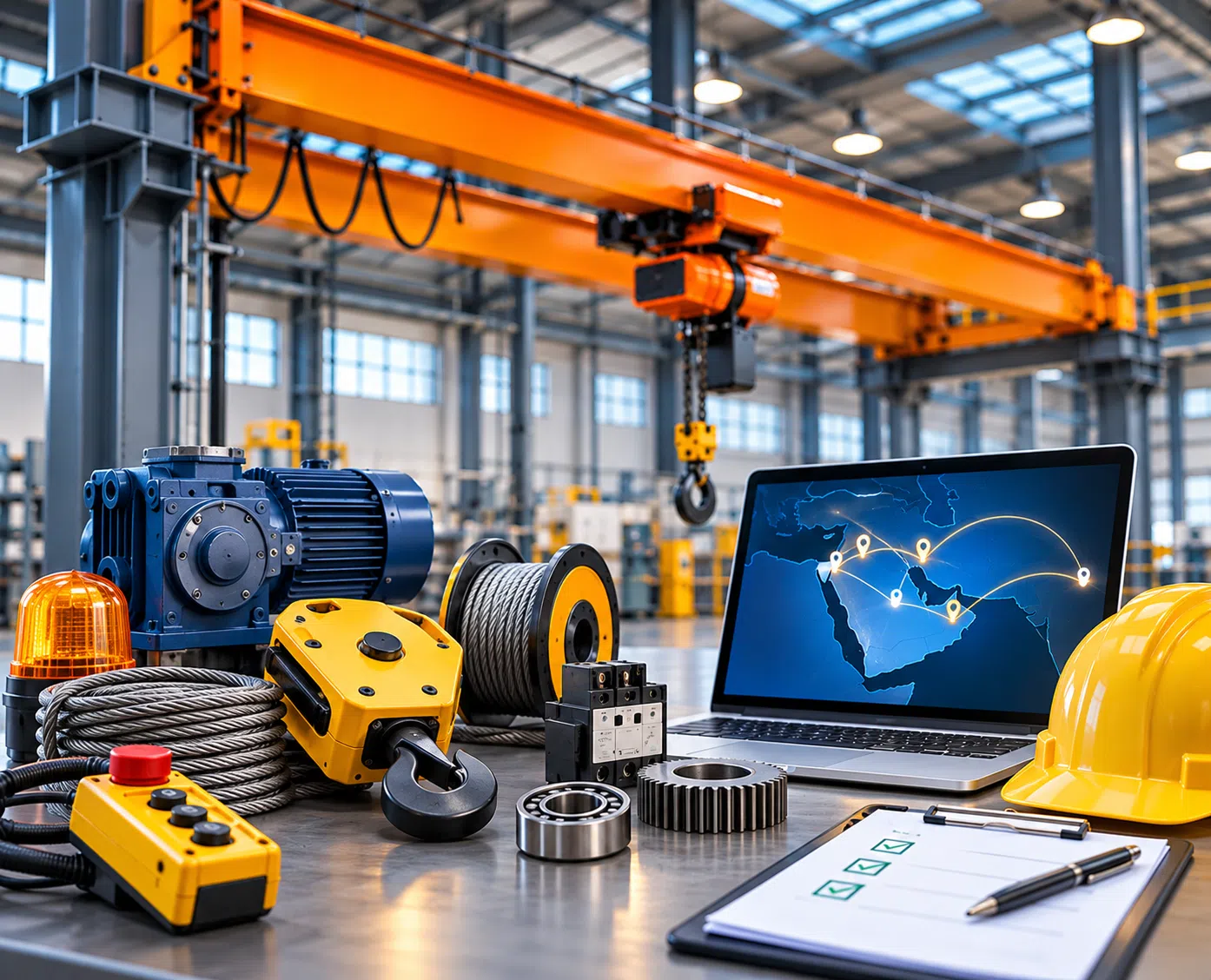
- Genuine spare parts availability and preventive maintenance contracts: Integrated local warehouses providing motors, brakes, travel wheels, lifting chains and wire ropes, to ensure an immediate response and technical support that protects your operations from stoppage.
Al Manarat Al Monerah gives you direct access to its engineering consultants to arrange a site visit and discuss the details of installing your facility's cranes to the highest technical standards, which ensure the safety of your investments and the safety of your workforce.
Frequently Asked Questions About Factory Crane Installation
What Engineering Tolerances Are Allowed for Crane Runway Straightness?
According to CMAA and FEM standards, the tolerance in the rail span (the cross distance between the two rails) must stay within the permitted limit for spans up to 15 meters, and within a tighter-specified limit for larger spans, with the further requirement that the vertical levelness of the rail head not vary by more than 2 mm between two consecutive support points, to ensure quiet movement that prevents bridge vibration.
Can the Crane Hoist Be Installed and the Electrical Connected by a General Electrician at the Factory?
This is not recommended at all. Industrial crane control systems rely on low-current control circuits, special frequency converters with high-torque specifications, programmed digital load limiters and electromagnetic brakes that require specialized training. Any error in setting the acceleration and deceleration times could cause load swing or instantly burn out the motors.
What Is the Static Load Test (125%) and Why Is It Performed Before Operating the Crane?
It is a mandatory safety test performed by lifting a weight equal to 125% of the crane's rated capacity and holding it for 10 minutes at the middle of the bridge span. Its purpose is to measure the deflection of the steel structure to confirm that it matches the design calculations, and to verify that the bridge returns fully to its straight condition with no deformation or cracks in the welds, which confirms the soundness of the crane's manufacture and installation.
Read also: How to Find Certified Crane Spare Parts Suppliers in the Middle East