
Crane Manufacturing Stages and Compliance with Global Quality and Safety Standards
Industrial lifting equipment leaves no margin for engineering error or compromise on material quality. Every vertical or horizontal movement carrying tons of material requires a rigid structure able to withstand shear, bending and continuous mechanical stress over years of heavy-duty operation in demanding work environments. Reliable crane manufacturing is not just assembling pieces of steel and fitting a hoist and motors at random. It is a series of advanced mathematical calculations and precise quality tests that safeguard the industrial facility and, above all, human lives.
How Does the Industrial Crane Manufacturing Process Work?
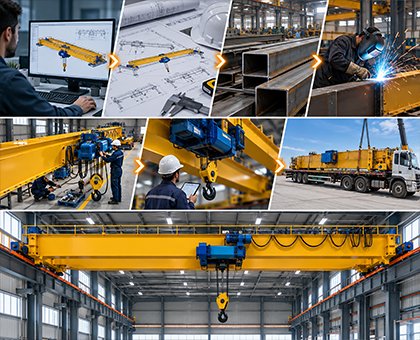
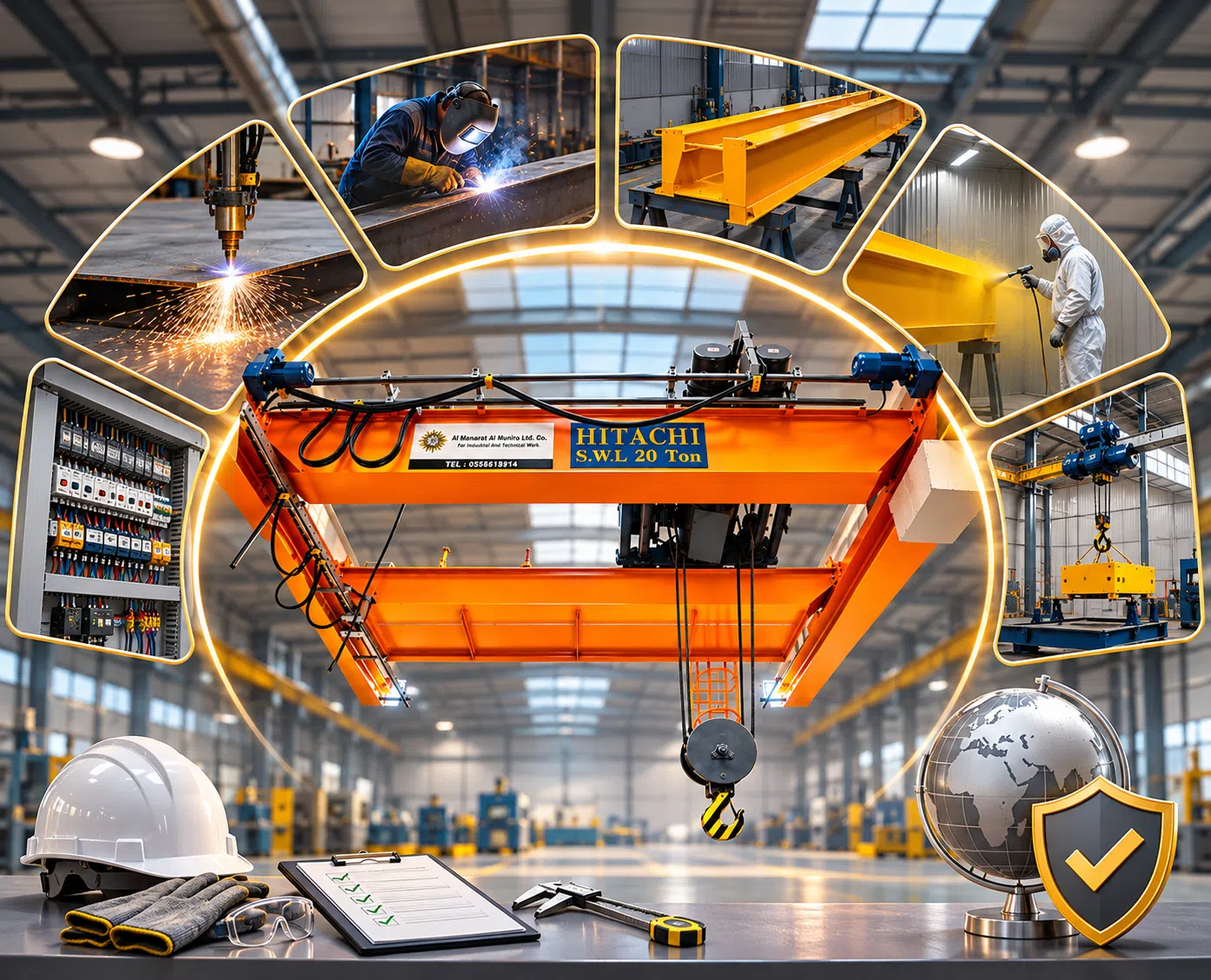
Crane manufacturing goes through six strict production stages. It begins with structural design and computer simulation of loads, followed by cutting and preparing the structural steel plates, then precision mechanical welding of the plates and girders, followed by surface treatment, sandblasting and rust-resistant epoxy coating, then assembly of the electromechanical systems, and finally on-site load testing and the issuing of calibration certificates.
These successive engineering stages ensure the following:
- Full resistance to metal fatigue caused by repeated lifting and lowering.
- Even distribution of dynamic loads over the travel wheels and runways to avoid rail wear.
- Production lines that comply with the highest safety requirements under approved international standards and certifications.
The Execution Stages in Crane Manufacturing Lines
Every manufacturing stage requires direct engineering supervision and advanced techniques to ensure the equipment is free of any hidden structural defects:
1. Engineering Design and Digital Simulation (FEA Modeling)
Before a single steel plate is cut, design engineers convert the customer's requirements and the dimensions of the plant into 3D models using specialized design software. Finite Element Analysis (FEA) is carried out to simulate stress concentration points and to calculate the natural camber allowed for the girder under the maximum possible operating load.
2. Precision Cutting of Steel Plates (CNC Cutting & Profiling)
Advanced factories rely on high-strength carbon steel plates (such as grades S275 or S355), cut by computer-guided plasma or laser machines to ensure edge straightness to within fractions of a millimeter and to prepare the bevel angles for the welding operations that follow.
3. Box Girder Fabrication and Submerged Arc Welding
The steel plates are assembled to form a closed box girder, reinforced with internal vertical diaphragms and stiffeners that prevent the structure from twisting or the thin walls from buckling under torsional moment. The main longitudinal welds are made with automatic Submerged Arc Welding (SAW) machines to secure deep penetration and a continuous, uniform weld line free of air bubbles.
4. Non-Destructive Testing of Welds (NDT Testing)
All critical joints undergo strict quality inspections without damaging the metal, through four technical methods:
- Visual Testing (VT): To detect any surface porosity or protrusions that are not acceptable from an engineering standpoint.
- Ultrasonic Testing (UT): To penetrate the depth of the weld line and confirm that it is free of internal cracks and incomplete fusion.
- Magnetic Particle Testing (MT): To detect any fine hairline cracks on or near the surface.
- Radiographic Testing (RT): Applied to cranes with extremely critical duties and huge capacities.
5. Surface Preparation and Protective Coating (Shot Blasting & Coating)
The structures are moved to sandblasting rooms and mechanically treated with steel shot to reach a standard cleanliness grade (SA 2.5) that completely removes rust layers, mill scale and impurities. The surfaces are then coated with a high-resistance zinc primer, followed by intermediate and finishing coats of epoxy and polyurethane paint that resist ultraviolet radiation and harsh chemical and industrial atmospheres.
6. Mechanical Assembly and Integration of the Electrical Control Circuits
The hoist trolley (hoist/trolley) is installed and connected to the long travel and cross travel motors. The power cable networks are laid inside flexible tracks (festoon systems) or insulated conductor bars, and the smart control panels, safety sensors and frequency inverters are connected to ensure smooth acceleration and deceleration.
Comparative Analysis: Global Crane Manufacturing Standards and Specifications
Lifting equipment is subject to global engineering codes that govern its designs and metal thicknesses. The following points show the key differences between the best-known of these standards:
- The European standard (FEM / EN): It focuses heavily on analyzing daily operating periods and defining service classes very precisely (from 1Bm to 5m), and on calculating gearbox service life according to loading hours, which allows highly efficient designs with light weight and low energy consumption.
- The American standard (CMAA Specification 70 & 74): It divides cranes into specific service classes designated by letters (Class A to Class F), and tends toward heavier steel sections and additional safety factors in the thickness of structures and gears so they can withstand the harshest heavy-duty operating environments for decades.
- The international standard (ISO 4301): It provides a unified framework for classifying lifting appliances and equipment worldwide based on the machine's usage grade and the distribution of nominal loading conditions, which makes it a standard reference compatible with the various local systems of facilities.
- Structural welding standard (AWS D14.1): The approved code governing the competence of welders and the qualification procedures followed in manufacturing material handling cranes, and it sets the acceptance limits for defects and the size of weld lines according to design stresses.
Quality Testing Protocols Before the Crane Is Delivered to the Factory
A crane does not go into field service until it has passed a set of strict standard tests:
- Static Load Test: Loading the crane with a weight equal to 125% of its maximum capacity and holding it at mid-span of the girder for a specified time, in order to measure the structural deflection and confirm that the girder returns fully straight after the load is removed, with no permanent deformation in the metal.
- Dynamic Load Test: Operating the equipment through all its motions (hoisting, lowering, and long and cross travel) under an operating load equal to 110% of the nominal capacity, to test brake performance, the response of the limit switches and the motor cooling system.
- Emergency Stop and Overload Cut-off Response Test: Confirming that power is cut and the brakes engage immediately when the stop button is pressed, and calibrating the digital weight sensor so that it cuts off upward motion at the moment the load exceeds the rated capacity.
Frequently Asked Questions About Crane Manufacturing and Engineering Quality
What is design camber and why is it built into a crane girder?
It is a deliberate upward curvature built into the steel girder during assembly to counter the crane's self-weight and the maximum weight it can carry, so that the girder becomes perfectly level when the full load is lifted instead of sagging or bending downward. This also protects the hoist trolley from drifting involuntarily toward the center.
What is the difference between sandblasting and manual cleaning of steel before crane manufacturing?
Manual cleaning with a brush removes only the brittle surface scale and leaves microscopic, damp rust under the coating, which causes it to peel after a short time. Sandblasting, by contrast, gives the steel surface a fine mechanical roughness called the anchor profile, which lets the epoxy layers bond fully to the steel and prevents rust for decades.
What technical documents and certificates should be received with a newly manufactured crane?
You should receive a complete document package that includes: the certificate of origin and conformity for the motor components, non-destructive testing reports for the welds (NDT reports), mill test certificates for the quality of the steel plates, the approved static and dynamic load test report, in addition to the electrical drawings and the preventive maintenance manual.
Read also: Specifications and Uses of a 5-Ton Overhead Crane in Workshops and Warehouses