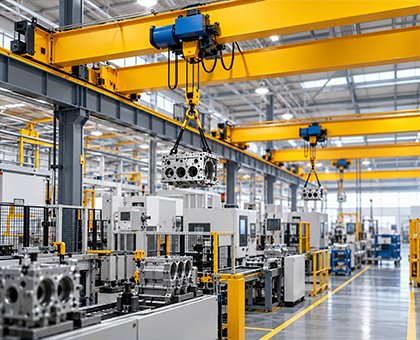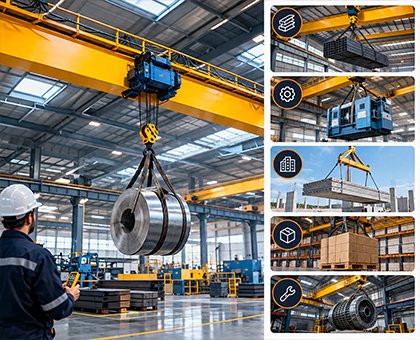

In today’s fast-paced industrial world, production efficiency and rapid task completion are key pillars of success for any industrial facility. Undoubtedly, the transport and handling of heavy materials within factories and warehouses pose a significant challenge, requiring precise and safe engineering solutions. This is where high-quality overhead cranes prove essential; they serve as the backbone of any production line that relies on the efficient and safe movement of massive loads.
Whether you are outfitting a new factory or looking to upgrade and modernize existing production lines, selecting the right lifting system is not merely a purchasing decision—it is a strategic investment in worker safety and facility productivity. In this comprehensive guide, we will walk you through everything you need to know about choosing the best overhead cranes for your specific operations and how Al-Manarat Al-Munira Industrial & Technical Works Co. Ltd. can be your trusted partner in achieving this success.
What are overhead cranes, and why does your factory need them?
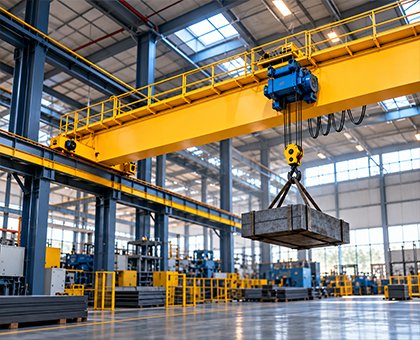
Overhead cranes are heavy-duty lifting machines installed on the ceilings of factories, workshops, or warehouses. They primarily consist of a moving bridge that travels along horizontal rails, featuring a suspended hoist that moves laterally to lift and transport heavy materials across the designated workspace.
Utilizing overhead cranes in your factory offers several vital advantages, most notably:
Saving floor space: Unlike forklifts and ground-based equipment, these cranes operate in the overhead space of the facility, leaving the floor area clear for the movement of workers and other equipment, as well as for production activities. High Safety: Reduces the risk of accidents caused by ground-level equipment colliding with workers or cargo.
Immense Lifting Capacity: Designed to handle loads ranging from a few tons to hundreds of tons with ease.
Efficiency and Precision: Ensures the transport of heavy materials to precise locations with smooth, stable movement, thereby minimizing cargo damage.
Key Types of Overhead Cranes You Should Know
Before making a purchase decision, it is important to understand that lifting systems are not "one-size-fits-all." There are various types and designs; at Al-Manarat Al-Munira, we design, manufacture, and supply the following types to meet our clients' specific needs:
1. Single Girder EOT Cranes
This type is the ideal choice for factories and workshops with limited space and height constraints. These cranes are lighter and more cost-effective than their double-girder counterparts. They are typically used for light-to-medium loads (often up to 15 or 20 tons), offering fast performance and ease of maintenance.
2. Double Girder EOT Cranes
If your facility handles extremely heavy loads or requires a very wide span, this type is the optimal engineering solution. Featuring two parallel girders, this system offers superior stability and durability. These cranes can lift massive loads and allow the hoist to reach greater heights compared to single-girder systems, making them the top choice for steel plants, metal foundries, and heavy industries. 3. Monorail Systems
These systems are designed for production lines requiring material transport along a fixed, pre-determined path (whether straight or curved). They are an excellent choice for confined spaces, offering high flexibility and cost-effectiveness.
Critical Factors for Selecting the Best Overhead Cranes for Your Factory
To ensure you maximize the return on your investment, consider the following technical and operational criteria:
Maximum Lifting Capacity
The first and most important question to answer is: What is the maximum weight to be lifted? You should select an overhead crane rated for a weight exceeding the maximum expected load by a certain margin; this prevents overloading, which could lead to catastrophic failure.
Bridge Span and Lift Height
The building width must be measured accurately to determine the appropriate crane span for covering the required workspace. Similarly, the ceiling height dictates the maximum lift height the crane can achieve; this influences the choice of crane type (single-girder vs. double-girder) to ensure the greatest possible lifting height.
Operating Environment
Is your factory environment subject to high temperatures? Is there heavy dust or the presence of flammable chemicals? The operating environment plays a major role in determining the crane's technical specifications. For instance, cranes operating in iron foundries require motors and cables capable of withstanding high temperatures, as well as additional safety systems—factors we carefully account for in our designs.
Duty Cycle and Work Intensity
Some factories use the crane only once or twice a day, while others operate it continuously, 24 hours a day. Usage intensity determines the crane's classification. Selecting a lower-than-required classification leads to rapid equipment wear and tear and the need for frequent maintenance.
The Role of Reliable Electric Hoists in Crane Efficiency
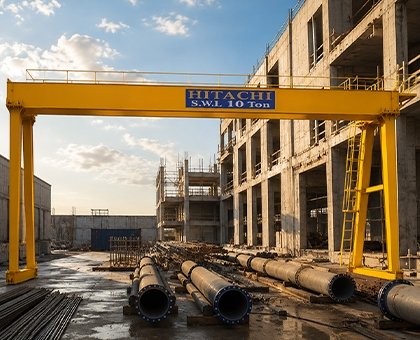
An overhead crane is incomplete without a robust and reliable electric hoist. It is crucial to select globally recognized brands with proven performance. At Al-Manarat Al-Munira, we take pride in our partnerships with major international companies; we are the exclusive distributor in Saudi Arabia for electric hoists from the leading Japanese manufacturer, Hitachi. Using Hitachi hoists ensures a long service life, lower energy consumption, and uncompromising Japanese safety standards.
Why Is Al-Manarat Al-Munira Your Top Choice in Saudi Arabia?
Since its establishment in 2012, Al-Manarat Al-Munira Industrial & Technical Works Co. Ltd. has solidified its position as a premier company specializing in the manufacturing of steel structures and lifting systems within the Kingdom. Choosing us to supply and install overhead cranes for your facility guarantees the following benefits:
Over 10 years of experience: Engineering...