
Selecting industrial lifting equipment is a critical capital decision that directly defines your factory’s productivity, safety level, and long-term operational stability. Any miscalculation in load capacity, duty class, or structural requirements can result in frequent breakdowns, production stoppages, or serious safety hazards.
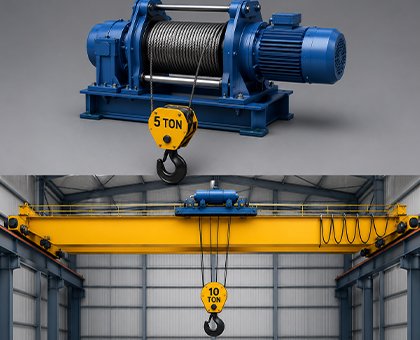
In this technical guide from Al Manarat Al Munira, we provide a clear engineering roadmap for choosing a 5-ton electric hoist and a 10-ton overhead crane, based on real industrial operating conditions.
1. Selecting a 5-Ton Hoist (Flexibility and Compact Performance)
The 5-ton capacity range is one of the most commonly used solutions in:
- Maintenance workshops
- Plastic injection factories (mold handling)
- Medium-sized warehouses
- Light manufacturing lines
It offers a strong balance between lifting power, cost efficiency, and installation flexibility.
A. Chain Hoists (Electric Chain Hoists)
Best suited for:
- Compact working spaces
- Single workstation lifting
- Vertical lifting only applications
Key advantages:
- Compact design
- Lower installation cost
- Simple maintenance
- Stable and precise lifting motion
B. Wire Rope Hoists
Best suited for:
- Continuous industrial operation
- Higher lifting heights
- Integration with overhead crane systems
Key advantages:
- Higher lifting speed
- Better duty cycle performance
- Suitable for heavier operational frequency
- Longer service life under continuous use
Critical Safety Requirement (5-Ton Systems)
A 5-ton hoist must always include:
- Electromagnetic automatic braking system
- Load-holding safety mechanism (failsafe braking)
- Emergency stop circuit protection
This ensures the load remains fully secured even during sudden power loss.
2. Selecting a 10-Ton Overhead Crane (Heavy-Duty Industrial Backbone)
A 10-ton overhead crane is typically used in:
- Steel fabrication plants
- Marble and stone industries
- Precast concrete factories
- Heavy mechanical workshops
At this level, structural engineering becomes more critical than the lifting mechanism itself.
1. Girder Design (Single vs Double Girder)
Single Girder Crane
Suitable for:
- Short spans
- Lower structural load on building columns
- Cost-sensitive installations
Limitations:
- Lower lifting height
- Reduced long-term upgrade flexibility
Double Girder Crane
Suitable for:
- Long spans (typically above ~18 meters)
- Heavy-duty continuous operations
- High lifting height requirements
Advantages:
- Superior structural stability
- Better load distribution
- Supports higher duty cycles
- Easier integration of maintenance platforms
2. Duty Class (Operating Intensity)
The duty classification defines crane lifespan more than the load rating itself.
- Class C: Medium usage
- Class D: Heavy industrial usage
- Class E/F: Continuous extreme-duty operations
Incorrect duty selection leads to:
- Premature gearbox failure
- Motor overheating
- Electrical control degradation
Control and Safety Technologies (Non-Negotiable Systems)
Modern cranes must be equipped with advanced safety and control systems to ensure operational reliability:
Variable Frequency Drives (VFD)
- Smooth acceleration and deceleration (Soft Start / Soft Stop)
- Eliminates load swing during movement
- Reduces mechanical stress on gears and motors
Overload Protection System
- Automatically stops operation when load exceeds rated capacity
- Provides audible and visual alarms
- Prevents structural overload damage
Dual Limit Switch System
- Prevents over-travel of hook and trolley
- Ensures mechanical boundary safety
- Eliminates collision risks within crane travel zones
Frequently Asked Questions
What is the difference in infrastructure requirements between a 5-ton hoist and a 10-ton crane?
- A 5-ton hoist can often be installed on existing roof structures using suspended (under-running) systems, provided the structure is certified.
- A 10-ton overhead crane typically requires independent runway beams supported by reinforced steel or concrete columns to handle dynamic loads safely.
How often should load testing be performed?
International safety standards require:
- Annual load testing
- Static test: 125% of rated capacity
- Dynamic test: 110% of rated capacity
Testing must be performed by a certified inspection authority to validate operational safety.
Conclusion
Choosing between a 5-ton hoist and a 10-ton overhead crane is not only a matter of load capacity—it is an engineering decision that affects long-term productivity, safety, and maintenance cost.
A properly selected system reduces downtime, improves workflow efficiency, and ensures safe handling of materials under demanding industrial conditions.
At Al Manarat Al Munira, we provide technical consultancy, system design, and supply solutions for industrial lifting systems tailored to your operational needs—ensuring maximum efficiency, durability, and uncompromising safety for years of continuous performance.