The production cycle in major factories, ports, and logistics facilities depends heavily on the smooth and rapid movement of heavy materials and components across production lines. Relying on physical labor or traditional machinery is no longer acceptable in an era defined by speed and extreme precision. Instead, innovation has become the main driving force. From here comes the importance of choosing integrated engineering solutions that ensure uninterrupted operations and prevent sudden downtime that increases operational costs.
Understanding the fundamental differences between the cranes and lifting systems available in the market gives your facility the ability to maximize safety levels and operational efficiency. In this advanced guide from Al Manarat Al Muneera (المنارات المنيرة), we highlight the depth of modern technologies used in moving massive loads across various industrial environments.
What Are the Main Types of Cranes and Hoists in Industrial Environments?
The engineering design of each equipment type varies depending on the available space in the facility and the required movement pattern (linear, rotational, or three-dimensional). The correct selection saves wasted space and protects the factory’s infrastructure:
Overhead Cranes: Also known as bridge cranes, they run on rails fixed to the ceiling or walls of the factory. They are the primary choice for metal fabrication workshops and automotive assembly plants.
Jib Cranes: These consist of a horizontal arm mounted on a pillar or wall that can rotate up to 360 degrees. They are ideal for individual workstations that require frequent lifting within a limited area.
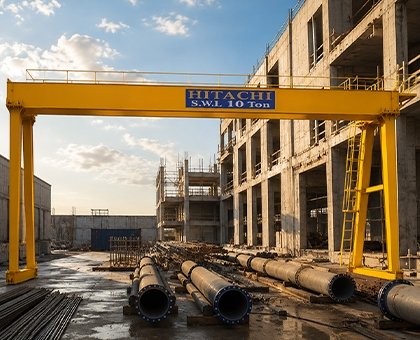
Gantry Cranes: Similar to overhead cranes, but supported by legs that move on ground rails. They are widely used in open shipping yards and ports for container handling.
Technical advantage: Modern overhead cranes free up the entire floor space for other equipment, as the “dead space” above is efficiently utilized for material handling operations.
How Have Industrial Lifting Systems Evolved Through Modern Technology?
Industrial lifting systems are no longer just cables and motors that move loads up and down. They have evolved into fully integrated smart systems connected to factory digital networks. This technological transformation has added new dimensions to administrative and engineering control:
1. Radio Remote Control Systems
These systems allow the operator to control the crane from a completely safe distance, away from hazardous zones, with an optimal viewing angle of the operation site. This eliminates the need for traditional suspended cabins in many applications and significantly reduces accident rates.
2. Variable Frequency Drive (VFD) Motors
These motors ensure extremely smooth crane operation during start and stop phases (soft start/soft stop). This mechanical harmony prevents dangerous load swinging in the air and extends the lifespan of shafts and electrical gears.
Safety Guide: How to Ensure Facility Safety When Operating Equipment
Safety in heavy industrial facilities is a critical red line that cannot be crossed, as even a minor malfunction may lead to production shutdowns lasting days. Al Manarat Al Muneera recommends applying a strict protocol that includes the following:
Periodic static and dynamic load testing: Cranes should be tested with loads ranging from 10% to 25% above their rated capacity under certified inspection authorities to ensure structural integrity.
Continuous operator training: Only personnel who pass psychological and practical tests for emergency handling should be licensed to operate lifting equipment.
Digital maintenance record keeping: Tracking recurring failures helps predict components that are close to wear-out and replace them before causing serious incidents.
Frequently Asked Questions About Equipping Factories with Lifting Systems
What is the difference between a gantry crane and a bridge crane?
A bridge crane is permanently fixed to the building structure and runs overhead, while a gantry crane has its own supporting legs and moves on ground rails, making it suitable for outdoor yards and flexible applications.
How do industrial lifting systems reduce energy consumption?
Modern systems equipped with regenerative drives capture the kinetic energy generated during lowering of heavy loads and convert it into electrical energy that is fed back into the factory’s internal power grid.
Conclusion
Ultimately, investing in advanced cranes, hoists, and modern lifting systems is not just an additional cost, but a fundamental pillar for building a safe and sustainable industrial environment. A smart choice based on a precise understanding of your factory’s operational needs protects you from unexpected losses and positions your facility among leading production companies. At Al Manarat Al Muneera (المنارات المنيرة), we always recommend seeking specialized engineering consultation before making any equipment decisions, to ensure tailored solutions that serve your production goals and remain reliable for many years.