
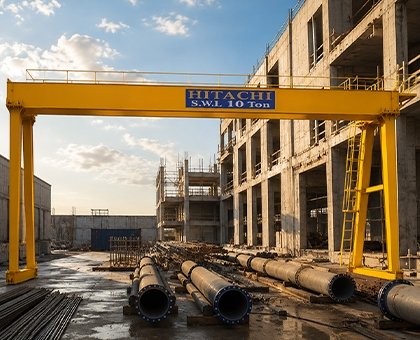
Saudi Arabia continues to advance steadily toward becoming a major industrial powerhouse and a global logistics hub, driven by large-scale national development projects and the expansion of industrial cities across the Kingdom. Within this highly competitive industrial landscape, material handling engineering and heavy-lifting automation have become essential components that determine operational efficiency in factories, shipyards, and large-scale warehouses.
Any decision related to selecting lifting and handling systems is a long-term strategic investment that directly impacts profitability, production continuity, and workforce safety.
With the growing demand for lifting equipment, the Saudi market requires businesses to work exclusively with engineering companies that possess certified manufacturing capabilities and internationally recognized standards to ensure safe operation and eliminate costly unplanned downtime. In this guide from Al Manarat Al Munira, we highlight the key criteria that distinguish leading crane manufacturers in Saudi Arabia and explain how to evaluate the best crane suppliers in Saudi Arabia to protect your capital investments.
The Added Value of Crane Manufacturers in Saudi Arabia
Partnering with local manufacturers that offer custom engineering solutions provides significant advantages compared to importing standard equipment from overseas. These benefits include:
Building Code-Compliant Designs
Specialized engineers review your facility’s structural drawings to ensure that the crane span and support system are fully compatible with the load-bearing capacity of columns and structural beams.
Custom Solutions for Critical Applications
Manufacturers can provide low-headroom cranes to maximize vertical space in facilities with limited ceiling heights, as well as explosion-proof lifting systems for sensitive chemical and petrochemical environments.
Full Compliance with Saudi Standards (SASO)
Local manufacturing facilities ensure that steel structures, welding procedures, and production processes meet the highest Saudi quality and safety requirements.
Working with an approved local manufacturer also reduces lengthy shipping delays and allows customers to inspect equipment and verify weld quality through Non-Destructive Testing (NDT) before final delivery.
How to Evaluate Crane Suppliers and Authorized Dealers in Saudi Arabia
When reviewing technical and commercial proposals from crane suppliers in Saudi Arabia, cost should never be the sole deciding factor. Instead, focus on the following essential criteria:
1. Quality and Brand Reputation of Critical Components
Examine the specifications of the electric hoist, motors, and control systems. Equipment utilizing reputable German or Japanese technologies often delivers longer service life and significantly lower failure rates.
2. Technical Support and Emergency Response Capabilities
Ensure that the supplier maintains a genuine service network within Saudi Arabia and can dispatch field engineers promptly whenever operational issues arise. Fast response times help minimize disruptions to warehouse and manufacturing operations.
Sustainability and Protection Against Saudi Arabia’s Harsh Climate
At Al Manarat Al Munira, we understand that crane longevity depends heavily on protection against the challenging environmental conditions of the Gulf region. Leading manufacturers incorporate critical engineering features such as:
Advanced Thermal Insulation for Motors
Crane motors equipped with Class F or Class H insulation can withstand extreme summer temperatures while protecting electrical windings from overheating.
High International Protection Ratings (IP Ratings)
Control panels and motors should feature a minimum protection level of IP55 for indoor facilities, while outdoor applications, ports, and desalination plants often require IP65 or IP66 protection against dust and moisture.
Variable Frequency Drive (VFD) Technology
Integrating VFD systems enables smooth acceleration and deceleration, eliminating dangerous load swinging while reducing wear on mechanical gears and drive components.
Frequently Asked Questions from Project Engineers and Supply Chain Managers
What load testing procedures are required before a crane enters service?
Industry regulations require newly installed cranes to undergo a comprehensive load-testing process. This typically includes a static load test at 125% of the crane’s rated capacity to verify structural integrity, followed by a dynamic load test at 110% of rated capacity to validate braking systems and control performance before certification is issued.
Why are preventive maintenance (PPM) contracts important?
Preventive maintenance agreements ensure routine inspections, lubrication of wire ropes and gear systems, and early detection of wear. This proactive approach helps prevent unexpected breakdowns, maximize equipment lifespan, and maintain uninterrupted operations.
Conclusion: Building Safer and More Efficient Operations with Al Manarat Al Munira
Ultimately, investing the time and effort to carefully evaluate crane manufacturers in Saudi Arabia and partnering with trusted crane suppliers in Saudi Arabia that comply with international engineering standards is a strategic decision that protects valuable assets and ensures workforce safety.
Choosing low-cost solutions without proper engineering support often leads to significant financial losses caused by recurring downtime and operational disruptions.
At Al Manarat Al Munira, we proudly offer our extensive technical expertise and engineering consultancy services to help clients assess site requirements, define operational needs, and implement advanced industrial lifting solutions. Our mission is to support your ambitious projects throughout the Kingdom with reliability, efficiency, and uncompromising safety for years to come.