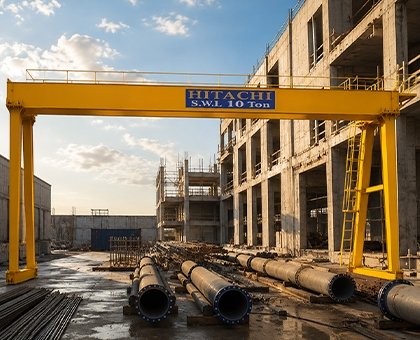
The efficiency of production lines and modern logistics facilities in the city of Jeddah depends largely on the smooth and rapid movement of materials and heavy loads within manufacturing halls and warehouses. At the heart of this mechanical system, intelligent lifting units represent the beating core that provides workshops and factories with instant lifting power at the push of a button. With the significant industrial expansion taking place in the western region in line with Saudi Vision 2030, decision-makers understand that selecting the right equipment is only half the equation, while the other and more critical half lies in ensuring sustainable protection of that equipment against unexpected failures.
Neglecting the inspection of lifting systems or dealing with unqualified providers can lead to costly operational downtime that halts loading and unloading activities at ports and warehouses, or—God forbid—result in accidents that affect the safety of personnel. In this guide from Al Manarat Al Muneera , we present the technical criteria for choosing the best electric hoist supplier in Jeddah, along with a roadmap for implementing crane maintenance protocols in Jeddah with maximum efficiency and absolute safety.
First: How to Choose the Best Electric Hoist Supplier in Jeddah?
The electric hoist (mechanical lifting unit) is directly responsible for vertical lifting and moving of heavy loads, and it can be used as a standalone device or integrated as a key component in overhead and bridge cranes. To achieve the smartest investment for your business, suppliers should be evaluated based on the following standards:
Providing globally trusted brands: Look for suppliers offering established Japanese or German technologies (such as Hitachi and Demag), as these brands are known for heavy-duty resistance and extremely low failure rates.
Correct duty cycle classification: Ensure the supplier accurately defines the hoist duty class (such as Class C for medium operation or Class D for heavy-duty loads). Hoists designed for intermittent use fail quickly if exposed to continuous production lines operating 24/7.
Suitable lifting media options: The ability to provide compact chain hoists for tight spaces and workshops, or wire rope hoists designed for massive loads and high lifting heights.
Ensure the electric hoist is equipped with Variable Frequency Drive (VFD) systems, which guarantee smooth starting and stopping of loads, preventing dangerous swinging and protecting mechanical gears from premature wear.
Second: Challenges and Foundations of Crane Maintenance in Jeddah (Coastal Environment)
The coastal nature of the Red Sea “Bride of the Sea” imposes severe chemical and environmental challenges on steel structures and electrical panels of heavy equipment, due to high humidity levels and salt-laden air. Protecting your equipment requires a strict preventive maintenance schedule that includes:
1. Steel protection against corrosion and rust
Regular inspection of steel structures and overhead bridges to ensure the integrity of marine epoxy coating layers resistant to salinity, along with periodic lubrication of wire ropes to prevent dry friction and early wear of steel strands.
2. Smart electrical inspection and IP rating calibration
Due to high humidity, control panels and contactors must be inspected to ensure tight enclosure sealing with protection standards not less than IP55 for indoor environments, and up to IP65 or IP66 for outdoor yards and ports, to prevent moisture or fine dust ingress that could cause sudden electrical short circuits.
3. Safety testing and braking systems
Calibration of electromagnetic brakes that hold and secure loads automatically within a fraction of a second when the operator releases the control button or in case of sudden power failure, along with inspection of electronic overload limiters to prevent lifting loads beyond the crane’s rated capacity.
Frequently Asked Questions by Maintenance Engineers and Procurement Managers
What is the mandatory load test protocol after major maintenance?
Saudi Occupational Safety and Health regulations (SASO) require that cranes must not be returned to commercial operation after major maintenance unless they pass a dual load test: a static test at 125% of rated capacity to ensure structural integrity of welds and beams, followed by a dynamic test at 110% to verify brake performance and issue an official calibration certificate.
How does contracting with a local supplier in Jeddah ensure production continuity?
A single main crane failure can translate into massive financial losses per hour of downtime. Contracting with an electric hoist supplier in Jeddah that maintains spare parts warehouses and emergency engineering teams capable of reaching your site immediately is the only guarantee to eliminate production downtime.
Conclusion
Ultimately, building a smart and sustainable logistics system within your facility starts with carefully selecting the best electric hoist supplier in Jeddah who provides equipment compliant with global standards, and ends with investing in crane maintenance contracts in Jeddah with certified partners who possess the technical capability and qualified field teams.
A wise economic perspective recognizes that low cost without after-sales service and fast technical support is a future trap that drains financial resources through emergency maintenance and lost safety. At Al Manarat Al Muneera , we put our full engineering consulting and field expertise at your disposal to help you assess sites, accurately define your needs, and supply and maintain the most complex industrial lifting systems—so your operations and ambitious projects in Jeddah move forward with stability, efficiency, and absolute safety for years to come.