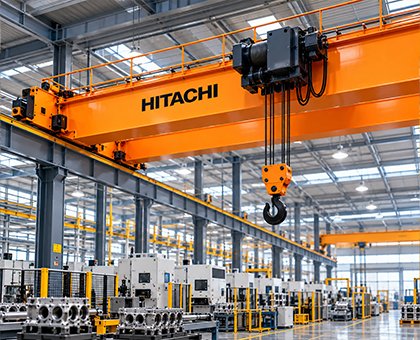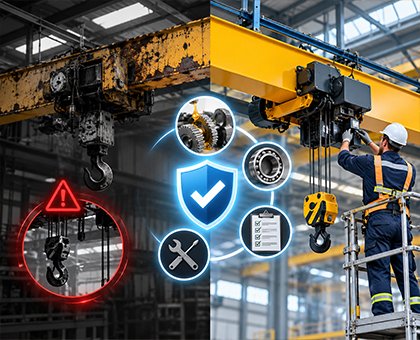

Lifting systems and material handling equipment are critical capital assets in large factories, central workshops, and expansive logistics warehouses. At the heart of these mechanical systems, operating overhead cranes requires a precise integration between mechanical safety components and intelligent digital control systems. Neglecting the inspection of even the smallest consumable lifting components, or relying on traditional control methods that limit the operator’s visibility, represents a serious operational risk. Such negligence does not only lead to unexpected breakdowns that halt material flow, but also directly threatens workforce safety.
To achieve a completely accident-free working environment and keep pace with factory digitalization, it has become essential to focus on direct safety elements and flexible control systems. In this advisory guide from Al Manarat Al Munira, we highlight the technical foundations of wire rope inspection and maintenance for cranes, as well as the major operational advantages of integrating wireless remote control systems for overhead cranes to ensure safe heavy-duty handling operations.
First: Crane Wire Rope (The First Line of Defense and Mechanical Safety Element)
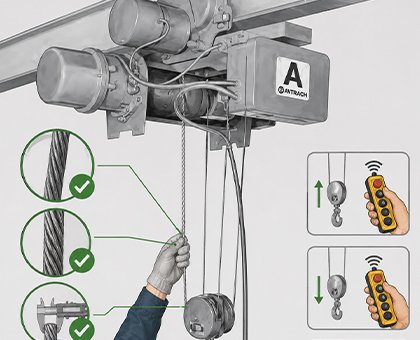
The steel wire rope is the critical mechanical component directly responsible for lifting and securing heavy loads during vertical and horizontal movement. Due to continuous tension, bending, and torsional stress, strict inspection protocols must be applied without delay:
Daily visual inspection:
Before starting each shift, the crane operator must ensure that the wire rope is free from sharp bends (kinking) or structural deformation such as “birdcaging,” which indicates an imminent cable failure.
Broken wire strand detection:
According to Saudi Standards, Metrology and Quality Organization (SASO) regulations, if the number of broken steel wires in a single lay exceeds the allowable limits defined in international codes (such as ASME B30.2), the crane must be immediately taken out of service and the wire rope must be replaced—not repaired or welded.
Diameter wear measurement:
Wire ropes gradually lose diameter due to continuous friction on the hoisting drum grooves. If the diameter reduction exceeds 7% of its original size, immediate replacement with an original and certified spare part becomes mandatory.
💡 Maintenance tip: Regular lubrication schedules using specialized wire rope greases prevent dry friction and chemical oxidation, providing strong protection against corrosion and extending rope lifespan by more than 30%.
Second: Remote Control for Overhead Cranes (Digital Control and Human Safety)
The shift from traditional operator cabins or pendant control systems to wireless remote control systems represents a major leap in industrial safety engineering. This technology provides immediate operational advantages:
Optimal visibility and safe distance:
Wireless remote control allows the operator to stand at a completely safe distance from the suspended load while maintaining full visibility of the working area, reducing blind spots and eliminating exposure to danger zones.
Fast response and signal security:
Industrial-grade remote systems operate on encrypted frequencies that prevent interference with other factory equipment and include emergency stop (E-Stop) buttons that instantly cut power in case of danger.
High resistance to harsh environments:
Remote control devices are designed with protection ratings of at least IP65, ensuring resistance to dust, mechanical impact, and extreme summer temperatures.
Load Test Protocol After Wire Rope Replacement
Al Manarat Al Munira emphasizes that replacing a steel wire rope requires mandatory load testing before the crane is returned to commercial operation. This ensures proper installation on the drum and secure end termination:
Static test (125% capacity):
A load exceeding the rated capacity by 25% is lifted and held in place for a specified period to verify structural integrity and ensure no slippage or deformation occurs.
Dynamic test (110% capacity):
The load is moved in all directions (lifting, lowering, longitudinal, and transverse movement) to verify brake responsiveness, limit switches, and eliminate mechanical slippage.
Frequently Asked Questions by Maintenance Engineers and Project Managers
How do Variable Frequency Drives (VFD) protect crane wire ropes?
Equipping crane control panels with VFD systems ensures extremely smooth acceleration and deceleration (soft start/soft stop). This eliminates sudden mechanical shocks caused by rapid load lifting, protecting the wire rope from sudden stress, reducing gear wear, and extending overall system life.
What happens if the wireless remote control fails or its battery runs out while a load is suspended?
Professional industrial systems are designed with a fail-safe safety protocol. In case of signal loss, battery failure, or remote damage, the electromagnetic brakes automatically engage instantly, holding the load securely in mid-air without any drop or slip until backup control is activated or safe manual intervention is performed.
Conclusion
Ultimately, technical analysis of industrial asset safety confirms that the intelligent integration between continuous preventive inspection of crane wire ropes and the adoption of wireless remote control systems is the foundation for protecting capital assets and achieving zero workplace accidents. Investing in certified spare parts and modern digital control systems shields your facility from costly emergency repairs that can significantly impact operational profitability.
At Al Manarat Al Munira, we provide our full engineering and field consultancy expertise to support you in site inspection, precise wire rope selection, and the supply and installation of advanced wireless control systems—ensuring your production and material handling operations continue moving toward excellence with stability, efficiency, and absolute safety for many years to come.