
Industrial facilities today face a continuous challenge: how to increase daily production rates while reducing operational costs and ensuring a safe working environment. Success in the market is no longer determined only by the quality of the final product, but is now closely linked to how fast and smoothly raw materials move through production lines and workshops. Any delay in transporting heavy loads represents a direct waste of time and effort, which ultimately reduces the competitiveness of the facility.
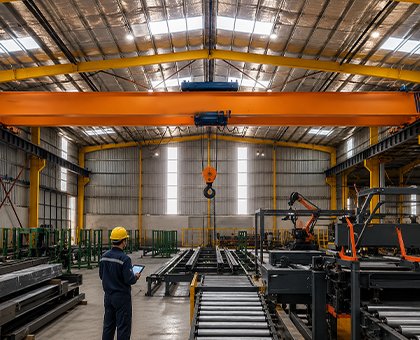
From here, the strategic importance of integrating smart equipment into the internal logistics system becomes clear, as modern factory cranes play a key role in reshaping the concept of productivity. In this article from Al Manarat Al Munira, we explore in depth the operational and investment returns achieved by facilities when adopting advanced lifting solutions.
How Do Factory Cranes Speed Up Production?
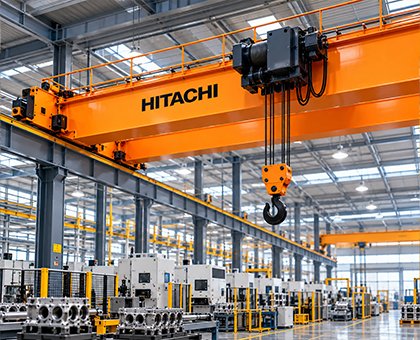
Time is the most valuable currency in modern manufacturing, and relying on traditional or manual methods to move heavy components is a serious drain on this resource. Using factory cranes completely changes this equation by improving material flow through several key aspects:
Reducing internal transport time:
Cutting the time required to move heavy components between production stations from hours to just minutes with minimal effort.
Utilizing vertical space:
Overhead cranes allow materials to be organized and stored vertically, freeing up valuable floor space for movement and other equipment inside the factory.
Flexibility in handling complex loads:
The ability to move irregularly shaped objects and heavy critical loads smoothly and safely in ways that ground transport systems cannot achieve.
Logistics studies indicate that automating lifting and internal transport operations in industrial workshops increases overall operational efficiency (OEE) by 25% to 40%.
Return on Investment (ROI) from Modern Factory Cranes
Some may initially view the cost of installing a complete lifting system as a heavy financial burden. However, a closer economic analysis shows that this investment quickly pays for itself and generates long-term indirect benefits through:
1. Reduced labor costs and human waste
Instead of assigning a full team of workers to perform physically demanding transport tasks that consume time and cause fatigue, a single operator using a remote control system can complete the job in seconds with high precision. This allows human resources to be redirected toward more valuable technical and production tasks.
2. Reduced material and product damage
Manual lifting or the use of non-specialized equipment often leads to dropped materials, scratches, or damage to finished products. Modern lifting systems provide smooth and fully controlled movement, ensuring products reach the next station without any mechanical damage.
Improving Workplace Safety: Protecting Your Human Capital
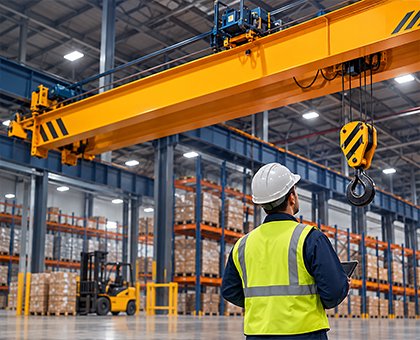
Workplace injuries caused by improper lifting of heavy loads are among the leading causes of worker absenteeism and reduced morale in manufacturing environments. Al Manarat Al Munira highlights that providing standard-compliant factory cranes contributes to:
Eliminating physical strain injuries:
Completely preventing back and muscle injuries caused by manual attempts to move overweight loads.
Keeping workers away from hazardous zones:
Thanks to wireless control technologies, operators can manage loads from a completely safe distance, away from high temperatures or hazardous chemicals.
Frequently Asked Questions About Operational Efficiency of Equipment
How does factory crane maintenance affect production continuity?
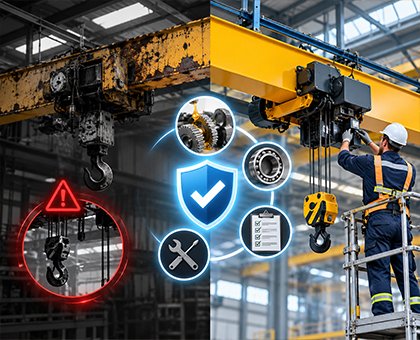
Planned preventive maintenance prevents unexpected breakdowns that could lead to complete factory shutdowns. Replacing consumable parts before failure ensures uninterrupted production flow without costly downtime.
What is the expected lifespan of modern factory cranes?
The operational lifespan ranges between 20 to 30 years, provided that the equipment is used within its designated duty class and that regular inspections and lubrication of mechanical components are performed under the supervision of specialized engineers.
Conclusion
Ultimately, factory cranes can no longer be viewed as auxiliary tools; they are a core structural element that defines a facility’s ability to grow and compete in an increasingly demanding market. Integrating advanced lifting cranes into your operational system is a direct step toward industrial intelligence and maximizing resource utilization.
At Al Manarat Al Munira, we consistently emphasize that investing in quality and safety is the only guarantee for building a sustainable brand that achieves your business ambitions while ensuring the safety of your workforce at the same time.