
When factories and workshops look for solutions to lift and move heavy materials, attention often goes to large overhead cranes that cover the entire production hall. But what if your operation does not require lateral movement in all directions, and instead needs a controlled, fixed path connecting sequential production stations? This is where smart, space-efficient engineering solutions come in—designed specifically for linear material handling with high efficiency and minimal effort.
Monorail cranes are the ideal choice for facilities seeking operational efficiency and intelligent use of narrow spaces or long corridors. In this comprehensive guide from Al Manarat Al Munira Company, we take a deeper look at how these systems work, their applications, and the technical advantages that make them a strong investment for industrial operations.
What Are Monorail Crane Systems?
Unlike conventional overhead cranes that move on two parallel beams, monorail crane systems operate on a single steel rail (single runway). This rail is typically suspended from the building structure or mounted on dedicated support columns.
A trolley carrying the hoist and hook travels along this single rail, enabling vertical lifting and controlled horizontal movement along a fixed route. This provides high precision in transporting loads between predefined points.
Monorail systems are generally divided into two main types based on track geometry:
- Straight Monorails:
- These are simple linear systems that transport materials from point A to point B in a straight line. They are widely used in assembly lines and sequential production processes.
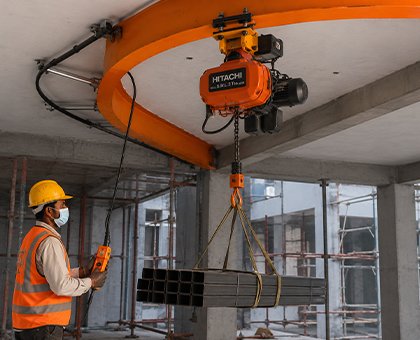
- Curved Monorails:
- These advanced systems are engineered to follow curved or circular paths, allowing them to bypass obstacles and machinery within the factory layout, offering exceptional routing flexibility.
Engineering Advantage:
Monorail cranes can be integrated with smart switching systems, allowing loads to be transferred between intersecting tracks without unloading, significantly improving workflow continuity.
Key Industrial Applications of Monorail Cranes
Thanks to their compact and flexible design, monorail cranes are widely used in industries that require precision, repetition, and efficient material flow:
1. Painting, Galvanizing, and Heat Treatment Lines
In these facilities, metal parts move through sequential tanks (cleaning, coating, drying). The monorail crane immerses components into each tank and transfers them automatically along the line, reducing human exposure to chemicals and high temperatures.
2. Automotive and Heavy Equipment Workshops
Monorail systems are used to lift engines and heavy vehicle components and move them through narrow maintenance corridors where forklifts or large overhead cranes cannot operate efficiently.
Industrial and Economic Benefits of Monorail Crane Systems
Choosing a monorail system for your workshop or production facility offers several direct operational and financial advantages:
- Lower installation cost:
- Since it requires only a single rail system without large bridge structures, fabrication and installation costs are significantly lower than traditional overhead cranes.
- Maximum floor space utilization:
- The entire system is suspended from the ceiling, leaving the factory floor completely free for workers, machinery, and storage operations.
- Simplified maintenance and operation:
- Fewer mechanical components mean fewer breakdowns, faster maintenance cycles, and minimal disruption to production lines.
Frequently Asked Questions
What is the maximum load capacity of monorail cranes?
Typically, monorail cranes handle loads ranging from 1 ton up to 15–20 tons in heavy-duty custom designs. The actual capacity depends on the structural strength of the building or supporting framework.
Can monorail crane systems be modified or extended in the future?
Yes. One of the major advantages of monorail systems is scalability. Additional rail sections can be installed to extend the system or connect new production areas. Extra trolleys can also be added to increase throughput.
Conclusion
Ultimately, monorail crane systems prove that intelligent engineering is not defined by size, but by how precisely it meets operational needs. Investing in a monorail crane system is a step toward lightweight industrial automation, ensuring fast, safe, and efficient material handling.
At Al Manarat Al Munira Company, we always recommend conducting a structural analysis of the building ceiling before installation to ensure proper load distribution and long-term mechanical reliability that supports your production goals for years to come.
Best Crane Company in Saudi Arabia