
Operations and procurement departments in factories and maintenance workshops constantly face the challenge of selecting the most suitable material handling equipment for their daily operations. Industrial engineering is not only about choosing the strongest machine available in the market; it is always about achieving the perfect balance between cost efficiency, productivity level, and the working environment. An unplanned decision may either lead to wasting a large budget on overly advanced technology that is not needed, or on the contrary, relying on simple equipment that cannot keep up with fast-paced production demands.
Between traditional mechanical simplicity and modern digital lifting systems, two main options dominate the heavy load handling market. In this consulting guide from Al Manarat Al Muneera Company, we present a comprehensive technical comparison between manual hoists and wire rope electric hoists, to determine which represents the smartest investment for your facility.
First: Manual Hoists (Simplicity and Mobile Reliability)
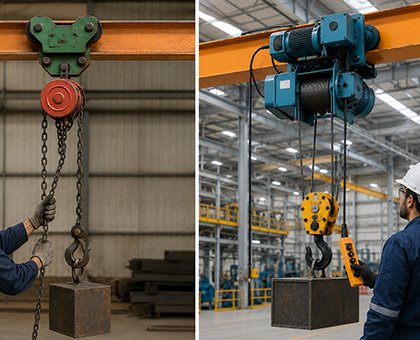
Manual hoists (such as chain blocks or manual chain hoists) operate on the principle of amplifying human force through a simple and robust gear system. This classic design gives them several operational advantages that make them essential in specific situations:
Complete independence from power sources:
They operate efficiently in remote sites, under construction areas, or during power outages, requiring only human effort from the operator.
Compact weight and high portability:
They can be carried in a toolbox and installed on temporary beams within minutes, offering unmatched mobility and flexibility.
Low purchase cost:
They are the most economical solution in terms of initial investment, and they require almost no maintenance due to the absence of electrical components.
Despite their reliability, manual hoists require significant physical effort and operate at very slow lifting speeds, making them unsuitable for continuous high-speed production lines.
Second: Wire Rope Electric Hoists (Digital Power for Heavy-Duty Operations)
On the other side, wire rope hoists represent the peak of modern industrial lifting efficiency in large factories and ports. These electric systems are designed to solve complex lifting challenges with advanced technical features:
1. High lifting capacity and fast operating speeds
They can handle extremely heavy loads reaching hundreds of tons with high-speed lifting performance, ensuring uninterrupted material flow within production lines.
2. Precision control and digital safety systems
Equipped with Variable Frequency Drives (VFD), operators can move sensitive loads with smooth millimeter-level precision and zero load swing. They are also supported by electromagnetic brakes that automatically activate in emergency situations.
Detailed Comparison in Key Points
To provide a clearer perspective, the key differences between both systems can be summarized as follows:
Power source and operation:
Manual hoists rely entirely on human physical effort, while wire rope hoists are powered by strong electric motors (single or three-phase) controlled by a push button.
Speed and production capacity:
Electric hoists offer high-speed continuous operation suitable for heavy-duty production, while manual hoists are slow and better suited for occasional or light tasks.
Cost and maintenance:
Manual hoists have very low initial cost and almost zero maintenance requirements, while wire rope hoists require higher investment and scheduled technical maintenance.
Accuracy and safety:
Electric systems provide precise digital control that eliminates load swinging, while manual hoist accuracy depends entirely on the operator’s skill and experience.
Frequently Asked Questions by Procurement Engineers
When should I choose manual hoists instead of electric systems?
Manual hoists are ideal for enclosed maintenance rooms, periodic service stations where lifting occurs once or twice per month, or early-stage construction sites before electrical power is fully available.
What is the expected lifespan of modern wire rope hoists?
Their lifespan ranges from 15 to 25 years, provided that the correct duty class is respected, overloads are avoided, and proper lubrication and maintenance schedules are followed consistently.
Conclusion
Ultimately, there is no universally “best” equipment—only what is most suitable for your operational and financial needs. Investing in manual hoists ensures flexibility and low cost for light and remote maintenance tasks, while wire rope electric hoists remain the backbone of high-volume industrial production, enabling efficiency, precision, and safety at scale.
At Al Manarat Al Muneera Company, we always recommend carefully analyzing daily operating hours and load requirements before making a purchase decision, ensuring you obtain a sustainable engineering solution that supports your business goals for many years to come.
Safety Standards in Cranes for Desalination Plants and Explosion-Proof Applications