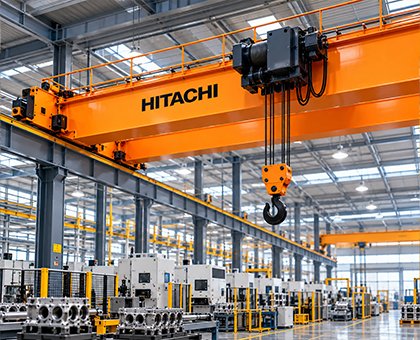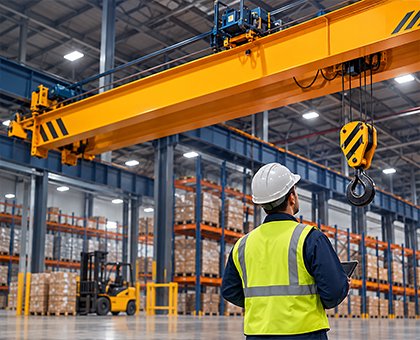

The city of Riyadh is rapidly accelerating its industrial and logistics development, positioning itself as one of the most attractive regional and global investment hubs in line with Saudi Vision 2030. At the heart of this intensive growth, project managers and operations engineers recognize that heavy lifting and material handling systems are the backbone that ensures continuous production and smooth material flow.
Owning high-quality lifting equipment is only half of the equation. The other, more critical half lies in having a reliable local technical partner who ensures the sustainability of this equipment and protects it from unexpected breakdowns.
Improper selection of suppliers or assigning inspection and maintenance tasks to unqualified teams can quickly lead to costly downtime that disrupts warehouses and production lines—or worse, endanger human safety. In this guide from Al Manarat Al Muneera Company, we highlight the key investment criteria when searching for crane suppliers in Riyadh, and how to establish approved engineering protocols for overhead crane maintenance at the highest levels of efficiency and safety.
First: Investment Standards When Choosing Crane Sales Companies in Riyadh
The Riyadh market offers many supply options, but making the right purchasing decision requires a technical evaluation beyond the initial price:
1. Duty Class Compliance
Ensure the crane’s duty classification (such as Class C for medium duty or Class D for heavy duty) matches your facility’s operational requirements. Choosing a lower class to reduce cost will lead to premature motor and electrical system failure due to overload stress.
2. Quality of Mechanical and Electrical Components
Prioritize companies that supply hoist units and motors from globally recognized brands with authorized local distributors. This ensures system stability and easy availability of spare parts.
3. Compliance with Saudi Standards (SASO)
All steel structures, bridge beams, and welds must comply with Saudi safety and quality standards to ensure structural integrity and operational safety.
It is also essential that the purchase contract is turnkey (Turnkey), including shipping, on-site installation using external lifting equipment, and precise alignment of runway beams with millimeter accuracy—ensuring the supplier assumes full engineering responsibility.
Second: Key Pillars of Overhead Crane Maintenance in Riyadh
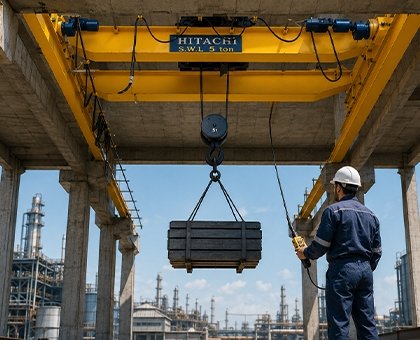
Overhead cranes operating in outdoor environments in Riyadh—such as marble factories, precast concrete plants, and large warehouses—are exposed to harsh climatic conditions, including high summer temperatures and frequent dust storms.
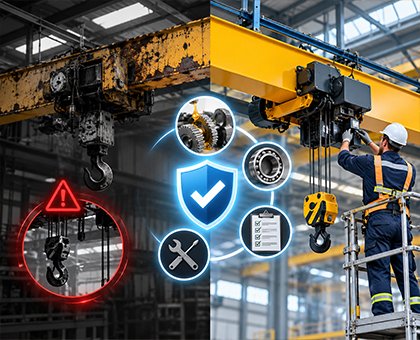
A strict Preventive Planned Maintenance (PPM) program should include:
1. Regular Mechanical and Visual Inspection
- Inspection of wire ropes or chains for wear, broken strands, or deformation
- Checking wheel wear caused by runway rail friction
- Regular lubrication of gears to prevent dry friction and mechanical damage
2. Electrical Systems and Safety Calibration
- Inspection of control panels and contactors for loose connections caused by vibration
- Calibration of overload limiters and limit switches to ensure immediate response in emergencies
Return on Investment from Predictive Maintenance
Al Manarat Al Muneera emphasizes that the true cost of equipment is not only its purchase price, but also its lifecycle operating cost. Regular maintenance contracts provide:
- Zero unplanned downtime: Early detection of wear in consumable parts (such as brake pads or electromagnetic brakes) prevents sudden production stoppages that may cost thousands per hour.
- Extended equipment lifespan: Maintaining runway alignment and smooth motor operation through VFD systems reduces structural stress and mechanical fatigue.
Frequently Asked Questions
What is the required load testing protocol after major maintenance?
When maintenance affects structural components or lifting systems, safety regulations require a dual load test:
- Static test: 125% of rated capacity to verify structural integrity
- Dynamic test: 110% of rated capacity to ensure brake performance before issuing operational certification
How do certified companies protect crane electrical panels from Riyadh dust?
Professional maintenance providers apply protection standards of IP55 for indoor environments and up to IP65/IP66 for outdoor sites, ensuring complete sealing against dust and moisture ingress that could cause electrical failures.
Conclusion
Ultimately, strategic planning for your industrial facility begins with careful selection of crane suppliers in Riyadh and extends to long-term investment in overhead crane maintenance contracts with qualified engineering partners.
A low-cost purchase without after-sales service and technical support often becomes a costly trap that drains budgets through emergency repairs and production stoppages.
At Al Manarat Al Muneera Company, we provide our full engineering and consulting expertise to support site evaluation, precise requirement definition, and the supply and maintenance of advanced industrial lifting systems—ensuring your operations in the heart of the capital move forward with stability, efficiency, and absolute safety for years to come.