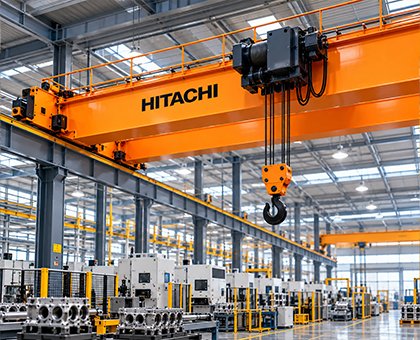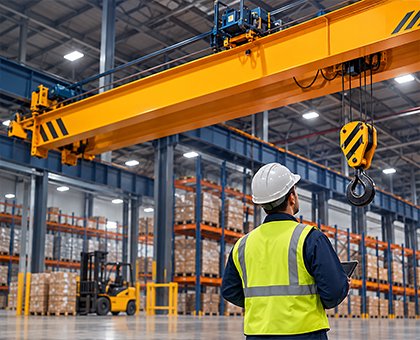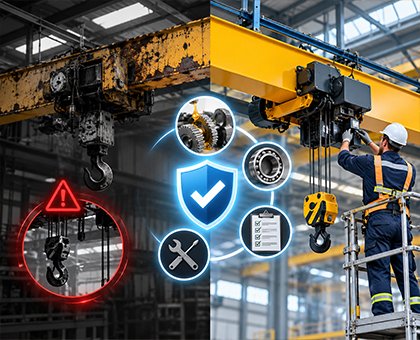

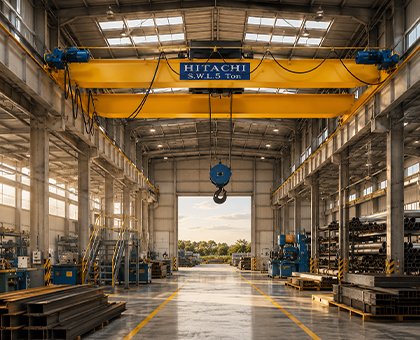
In open cargo yards, ports, marble factories, and ready-mix concrete plants, there is always a need for flexible and independent lifting solutions that do not rely on building structures. Traditional overhead cranes require strong concrete walls and columns for support, which are not available in open areas or temporary projects. From this engineering challenge, mechanical engineering introduced an innovative solution: cranes that carry their own structure and supports while moving freely to handle the most complex lifting operations.
Gantry cranes (also known as bridge-type cranes) are considered the standard and most efficient solution to fill this operational gap in heavy industry and logistics sectors. In this guide from Al Manarat Al Munira, we will explore in detail the nature of these cranes, their key applications, and the exceptional advantages that make them an essential choice in the industrial market.
What Are Gantry Cranes and How Do They Work?
Gantry cranes feature a unique structural design where the crane consists of a horizontal bridge supported by strong side legs mounted on wheels. The entire system moves on ground-level rails or, in some advanced versions, on large rubber tires, allowing it to operate in any open space without requiring overhead support structures. These cranes are classified into several types depending on operational needs:
Full Gantry Cranes:
The most common type, supported by two legs and moving on long ground rails, suitable for large-scale outdoor operations.
Semi-Gantry Cranes:
One side is supported by a ground-mounted leg, while the other side runs on an elevated rail attached to a factory wall. This design is ideal for saving space while maintaining dual operational functionality.
Portable Gantry Cranes:
Lightweight cranes equipped with mobility wheels, used in small workshops and maintenance stations for easy manual relocation.
Operational advantage:
The ability to install gantry cranes in open outdoor yards makes them the first and often only choice for shipyards and global container terminals.
Key Industrial Applications of Gantry Cranes
Thanks to their high flexibility and ability to handle extremely heavy loads reaching hundreds of tons, gantry cranes play a central role in many critical industrial sectors:
1. Container terminals and ports
Gantry cranes are the backbone of global trade operations, where large rubber-tyred gantry cranes (RTG) and rail-mounted gantry cranes (RMG) are used for unloading ships, transporting containers, and organizing them in port yards with high precision and speed.
2. Precast concrete and marble factories
In these environments, massive stone blocks and heavy concrete elements are transported from casting and cutting areas to storage yards or loading zones, requiring extremely stable equipment and clear operator visibility.
What Are the Advantages of Investing in Advanced Gantry Cranes?
Owning a gantry crane system provides industrial and logistics facilities with significant operational and financial benefits that directly improve profitability:
No need for expensive infrastructure:
Eliminates the need for building concrete columns or steel support structures, as the crane can be installed directly on any prepared ground surface.
Easy relocation and modification:
If the business or factory is moved to a new site, gantry cranes can be dismantled and reinstalled with relative ease compared to fixed overhead cranes.
High safety levels in outdoor environments:
Modern systems are equipped with wind sensors (anemometers) that automatically stop and secure the crane when wind speeds exceed safe operating limits.
Frequently Asked Questions About Gantry Cranes
What is the main difference between an overhead crane and a gantry crane?
An overhead crane is fixed to the building’s walls and ceiling and operates on elevated rails only, while a gantry crane has its own supporting legs and moves on ground-level rails, making it suitable for open outdoor environments.
How are gantry cranes protected from harsh weather conditions?
Outdoor gantry cranes are equipped with enclosed air-conditioned operator cabins, anti-corrosion multi-layer paint systems, and protective covers for motors and gear assemblies designed to meet international IP protection standards against rain and dust.
Conclusion
Ultimately, gantry cranes represent the peak of flexibility and strength in heavy material handling systems, making them the ideal investment for facilities seeking efficiency without being restricted by building structures. Choosing the correct specifications for gantry cranes ensures uninterrupted operations even in harsh environmental conditions while safeguarding the movement of goods and materials from disruption.
At Al Manarat Al Munira, we always recommend analyzing wind conditions and maximum load requirements at your site before purchasing, to ensure a fully integrated engineering system that delivers maximum productivity, safety, and long-term operational reliability.