
Modern industrial facilities and logistics warehouses face continuous challenges in improving operational efficiency and keeping up with rapidly increasing production demands. At the core of these systems, overhead cranes and lifting equipment represent the main artery that determines material flow speed and daily productivity levels. After years of continuous operation under heavy loads, material handling engineering is faced with two critical options: either risk operating outdated equipment that drains budgets through emergency maintenance, or invest intelligently in upgrading existing lifting systems and modernizing them with the latest digital technologies.
Making the decision to upgrade or establish a new lifting system is not a simple mechanical step; it is a complex engineering process directly linked to workplace safety standards and capital sustainability. In this guide from Al Manarat Al Munira, we highlight the technical dimensions that make hiring a specialized overhead crane installation contractor a strategic necessity for securing your assets and maximizing factory efficiency.
First: The Engineering Value Provided by a Certified Overhead Crane Installation Contractor
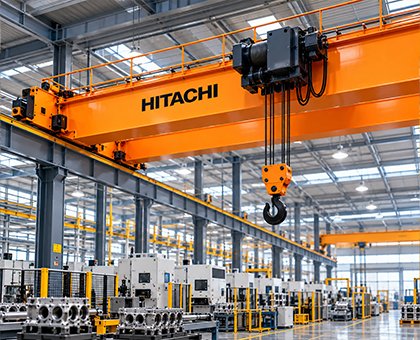
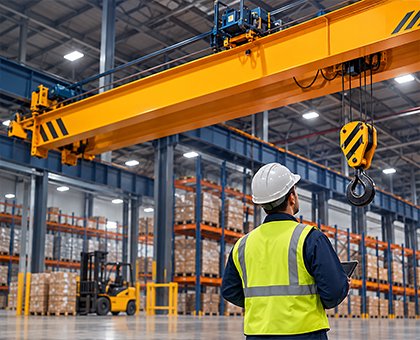
The process of installing and aligning overhead crane bridges on runway rails inside industrial halls requires extreme precision and extensive field experience. A specialized contractor provides critical structural and operational advantages, including:
Runway alignment precision:
The contractor ensures millimeter-level alignment of crane rails and tracks to prevent side friction that could cause premature wheel wear or excessive stress on horizontal travel motors.
Structural load assessment of the building:
Evaluating the load-bearing capacity of existing factory columns and steel trusses to ensure they can safely support the crane’s dead weight as well as dynamic stresses generated during maximum load operations.
Turnkey execution services:
Full project management from logistics handling of heavy components, mobilization of external hydraulic cranes for bridge lifting, to final electrical integration—without disrupting factory operations.
Second: Crane Retrofitting as a Smart Economic Alternative to New Equipment
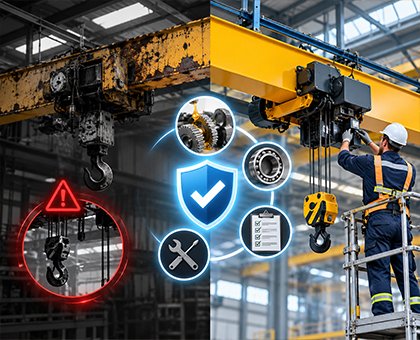
In many cases, the steel structures and crane girders remain in excellent condition, while the main issues lie in outdated electrical systems or worn-out hoist units. Here, crane retrofitting becomes a cost-effective solution that can save up to 50% of the cost of purchasing a new crane, through upgrades such as:
Hoist replacement:
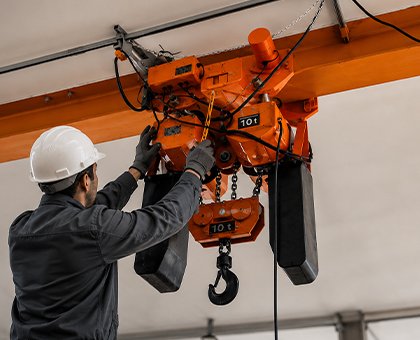
Replacing the old hoist unit with modern digital systems (wire rope or chain hoists) from globally recognized brands, giving the crane a renewed operational life with near-zero failure rates.
Integration of Variable Frequency Drives (VFD):
Upgrading electrical control systems to smart VFD technology, ensuring extremely smooth acceleration and deceleration, eliminating dangerous load swinging and protecting mechanical gears from shock loads.
Automation and remote control systems:
Replacing outdated cabins or wired controls with advanced radio remote control systems that allow operators to safely manage loads from an optimal viewing distance.
Mandatory Calibration and Load Testing Protocols (Load Test)
Al Manarat Al Munira emphasizes that certified contractors must subject cranes—whether newly installed or retrofitted—to strict load testing in compliance with Saudi standards (SASO) before commissioning:
Static test (125% capacity):
The crane is loaded with 25% above its rated capacity while stationary to verify structural integrity and ensure no permanent deformation occurs in steel girders.
Dynamic test (110% capacity):
The load is moved in all operational directions to verify brake responsiveness, overload limiters, and limit switch functionality.
Frequently Asked Questions by Maintenance Engineers and Plant Managers
How do Preventive Maintenance Contracts (PPM) contribute to successful upgrades?
Engaging a certified engineering provider for scheduled preventive maintenance ensures monitoring of wear levels in upgraded gears, proper lubrication of cables, and regular brake system calibration. This helps detect early signs of deterioration and replace consumable parts before failure occurs, achieving near-zero unexpected downtime.
What thermal insulation specifications are required for motors and panels during installation?
Due to harsh climate variations and high summer temperatures, professional overhead crane contractors specify motors with advanced insulation classes (Class F or H), along with electrical panels protected to IP55 standards for indoor environments and up to IP65 or IP66 for outdoor and port applications to prevent dust and moisture ingress.
Conclusion
Ultimately, technical and financial analysis of capital equipment confirms that hiring a qualified overhead crane installation contractor and investing in modernizing outdated lifting systems is a strategic decision that protects your major capital assets and ensures worker safety. Choosing low-cost, unqualified installation services is a financial trap that leads to increased maintenance costs and safety risks.
At Al Manarat Al Munira, we provide our full engineering and field consultancy expertise to support you in site evaluation, logistics planning, and the supply, upgrade, and maintenance of advanced industrial lifting systems—ensuring your operations move forward with stability, efficiency, and absolute safety for years to come.