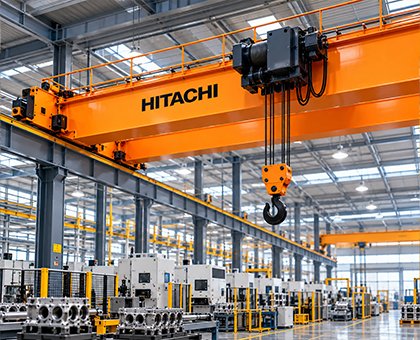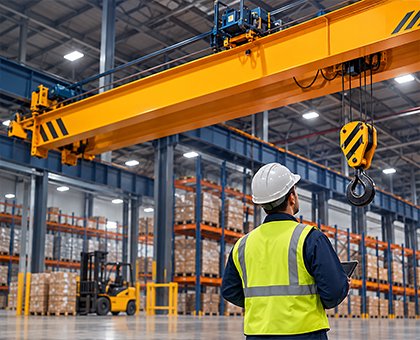

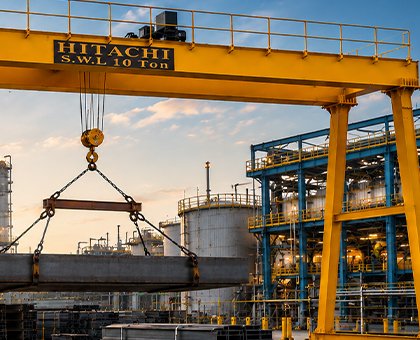
The cities of Jubail and Yanbu Industrial Cities represent the primary economic backbone and sovereign pillar of the petrochemical, refining, and heavy industrial sectors in the Kingdom of Saudi Arabia. Within these massive industrial hubs—governed by strict operational standards and non-stop production schedules—lifting and material handling systems function as the vital arteries that ensure uninterrupted production flow.
Handling critical mechanical components or massive steel structures in complex chemical environments requires exceptional engineering solutions that go far beyond standard commercial lifting equipment.
Any technical failure or unexpected shutdown in material handling systems within Royal Commission industrial cities immediately translates into direct financial losses and significant pressure on supply chains. In this specialized guide from Al-Manarat Al-Muneera Company, we outline the key engineering specifications governing overhead cranes in Jubail, along with the technical and preventive standards required when contracting crane companies in Yanbu.
First: Engineering Specifications for Overhead Cranes in Jubail
The operational environment in Jubail Industrial City is characterized by heavy-duty workloads and extremely large load capacities, which requires highly specific mechanical design requirements for overhead cranes to ensure durability and safety.
1. Heavy-Duty Service Classes (Class E & F)
Cranes must be engineered to operate under the most severe conditions, with continuous 24/7 duty cycles and no degradation in motors, gear systems, or mechanical performance.
2. Variable Speed Control Systems (VFD)
Equipping cranes with Variable Frequency Drives ensures extremely smooth acceleration and deceleration, eliminating load swing and protecting both sensitive equipment and the structural integrity of the facility from dynamic stress.
3. Compliance with International Standards and Royal Commission Codes
Steel structures and welds must be designed and manufactured according to international standards such as FEM (European) or CMAA (American) to ensure compliance with strict inspection requirements.
In steel melting and processing plants in Jubail, cranes must be equipped with dual braking systems to ensure instant and absolute load holding in case of sudden power failure.
Second: Requirements for Contracting Crane Companies in Yanbu
Yanbu Industrial City presents additional environmental challenges due to its coastal location on the Red Sea. High humidity, salt-laden air, and hazardous petrochemical environments require highly specialized crane solutions.
When evaluating crane companies in Yanbu, ensure they are capable of providing the following:
1. Explosion-Proof Crane Systems
In hazardous classified zones (Zone 1 & Zone 2), all electrical components and control panels must be enclosed in flameproof steel housings that prevent any electrical spark from escaping into the surrounding atmosphere. Hooks and wheels must be made of non-sparking bronze alloys.
2. Advanced Marine and Chemical Corrosion Protection
Due to high salinity, steel structures must be treated with heavy-duty marine epoxy coatings. Lifting ropes and chains should be upgraded to stainless steel grade 316 to ensure long service life and corrosion resistance.
Safety and Commissioning Load Test Protocols
Al-Manarat Al-Muneera emphasizes that cranes in industrial cities cannot be operated without passing official site load testing:
- Static Test (125%): The crane is loaded with 125% of its rated capacity while stationary to verify structural integrity and weld strength.
- Dynamic Test (110%): The load is moved in all directions (lifting, transverse, and longitudinal travel) to verify brake responsiveness and overload protection systems.
Frequently Asked Questions by Operations and Safety Engineers
Why are preventive and predictive maintenance contracts (PPM) important in Jubail and Yanbu?
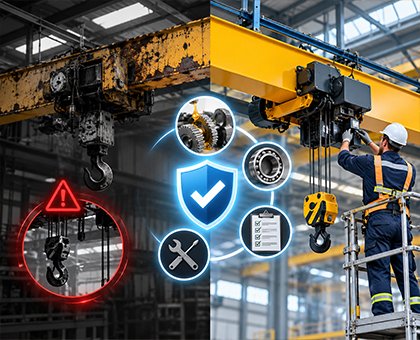
Contracting an authorized maintenance provider ensures regular inspection of motor temperatures, cable lubrication, and safety sensor calibration. This allows early detection of wear in consumable parts before actual failure occurs, ensuring zero unplanned downtime in petrochemical facilities.
What IP protection rating is required for outdoor cranes in Yanbu?
Due to direct exposure to humidity, salt spray, and airborne dust, crane motors and electrical systems must have a minimum protection rating of IP55 for enclosed areas, and IP65 or IP66 for outdoor yards, ports, and coastal terminals.
Conclusion
Ultimately, investing in overhead cranes in Jubail with proper industrial specifications and contracting crane companies in Yanbu with proven expertise in explosion-proof and corrosion-resistant technologies is a strategic decision directly tied to asset protection and workplace safety.
Relying on low-cost solutions that are not environmentally engineered leads to frequent breakdowns and high maintenance costs. At Al-Manarat Al-Muneera Company, we provide our full engineering and consulting expertise to support site evaluation, technical specification, and supply of advanced industrial lifting systems—ensuring your industrial facilities operate with maximum stability, efficiency, and absolute safety for years to come.