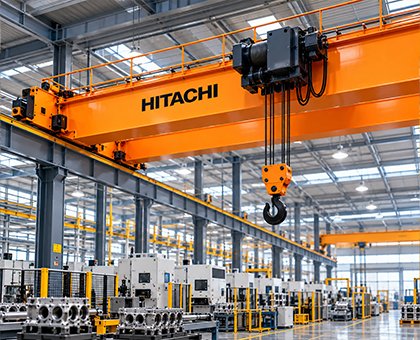

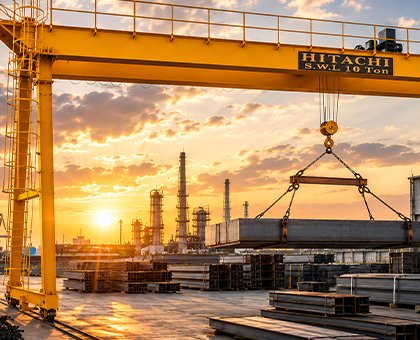
Large-scale national projects and mega industrial complexes—such as power plants, petrochemical facilities, and shipbuilding yards—are characterized by extremely complex operational environments that go far beyond conventional work conditions. In these massive facilities, engineering does not stop at structural design; it extends to the finest details of logistics systems and material movement.
Attempting to handle oversized mechanical components or irregularly shaped and critically heavy structural elements using standard lifting equipment often leads to failure—or worse, poses serious risks to the safety of the entire facility.
Hence, there is a growing need to develop lifting systems and handling engineering solutions that are custom-designed from the ground up to meet the unique challenges of each project. In this strategic guide from Al-Manarat Al-Muneera Company, we highlight the engineering concept behind customized industrial lifting solutions and review the governing standards for equipping and operating cranes for major industrial projects with maximum efficiency and absolute safety.
What Are Customized Industrial Lifting Solutions and When Do You Need Them?
Customized Lifting Solutions refer to an integrated engineering process that starts with analyzing the site geography, building structure, and dynamic load stresses, and ends with manufacturing a unique lifting system that is not available in standard market models.
Clear operational indicators that require this approach include:
- Critical architectural spaces: such as very low ceilings requiring low headroom hoists to fully utilize every available vertical centimeter.
- Complex-shaped loads: such as tall distillation columns or wind turbines, which require double-girder cranes and multi-point lifting systems to ensure load balance.
- High-risk working environments: such as chemical plants and gas storage facilities that require explosion-proof cranes with complete anti-spark protection.
A custom-designed crane ensures 100% compatibility with operational requirements and eliminates the need for costly structural modifications to existing factory buildings.
Specifications of Large Industrial Project Cranes: Engineering Power and Stability
Operating cranes in mega industrial projects requires extremely high technical specifications to ensure performance stability during continuous operation that may last for days without interruption.
Al-Manarat Al-Muneera highlights the most important specifications:
1. Heavy-Duty Service Classes (Class E & F)
These cranes are engineered to operate in the harshest environmental and operational conditions, with a duty cycle exceeding 20 lifting operations per hour, often near full load capacity, without any degradation in motor or gearbox performance.
2. Smart Control Systems and Motion Automation
Modern large-scale cranes are no longer manually operated only; they are equipped with PLC systems and Variable Frequency Drives (VFD) that enable programmable motion paths and ensure extremely smooth start/stop operations, eliminating load swing completely.
Safety and Occupational Protection Protocols: A Critical Pillar for Mega Projects
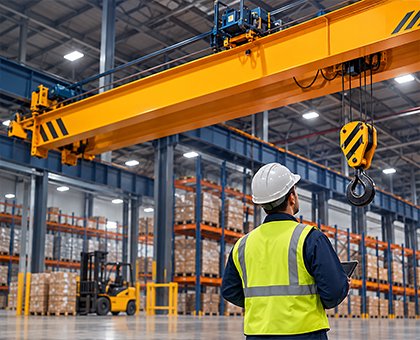
Safety of personnel and protection of capital assets are the foundation of any large-scale project. Even minor operational errors can cause complete shutdowns of production lines.
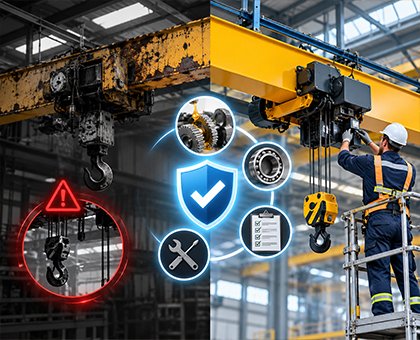
Integrated crane safety systems include:
- Dual braking systems: mechanical and electromagnetic brakes working alternately to ensure instant and absolute load holding even during sudden power failure.
- Condition monitoring systems: smart sensors that continuously monitor motor temperature, brake wear, and gearbox vibration, sending real-time reports to control rooms to predict failures before they occur.
- Multi-stage overload limiters: systems that completely prevent operation and trigger visual and audible alarms if load limits are exceeded.
Frequently Asked Questions by Project Engineers
What are the steps for developing customized industrial lifting solutions?
The process begins with a site visit by Al-Manarat Al-Muneera engineers to collect measurements and assess structural conditions, followed by 3D engineering design and stress simulation, then manufacturing, load testing, and final installation.
How do we ensure spare parts availability and technical support for custom-designed cranes?
Working with trusted engineering partners ensures long-term maintenance contracts, availability of original spare parts manufactured specifically for the equipment, and 24/7 technical support to guarantee uninterrupted operations.
Conclusion
Ultimately, investing in customized industrial lifting solutions and deploying large-scale crane systems with precise engineering specifications is not merely an operational choice—it is a strategic decision directly tied to project success, asset protection, and workforce safety.
Proper engineering always begins with a deep understanding of site-specific requirements and designing systems tailored precisely to them.
At Al-Manarat Al-Muneera Company, we provide our long-term engineering and consulting expertise to support the design, implementation, and supply of advanced industrial lifting systems, ensuring your projects move toward excellence with stability, efficiency, and absolute safety for years to come.