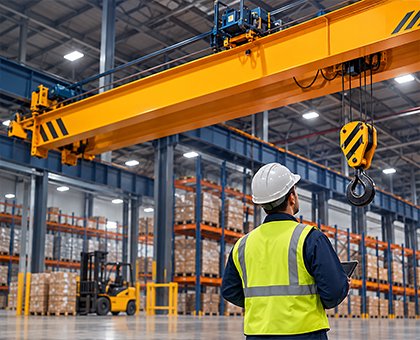

The modern industrial revolution has brought fundamental transformations across all production lines. Material handling and lifting operations are no longer just a means of moving heavy objects from one point to another; they have become a core indicator of how intelligent and efficient an entire facility is.
Delays in handling critical loads or unexpected failures in conventional lifting systems are no longer acceptable in an era defined by extreme speed and cost-per-minute efficiency. As a result, global companies have been competing to develop engineering solutions that combine absolute durability with digital intelligence to serve factories and ports with unprecedented performance.
When it comes to adopting leading technologies that ensure sustainability and zero-harm operations, attention naturally turns to globally trusted names that have proven their reliability in the harshest working environments. In this advanced guide from Al-Manarat Al-Muneera Company, we highlight the technical depth of chain hoists and explore the exceptional capabilities that make German Demag cranes a preferred choice for industrial giants worldwide.
Chain Hoists: Compact Efficiency and High Flexibility for Smart Stations
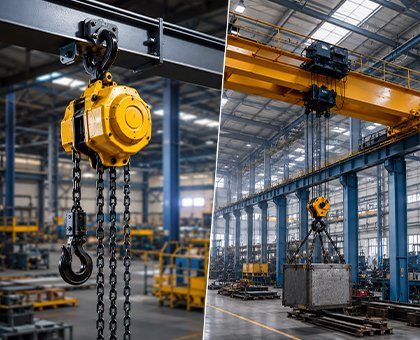
Chain hoists represent one of the most efficient engineering solutions for serving individual workstations, assembly lines, and specialized maintenance workshops. Their compact design allows them to operate in confined spaces while delivering exceptional lifting torque through high-strength, wear-resistant steel chains.
Key Advantages of Chain Hoists:
- Precise vertical load control: The chain mechanism ensures perfectly vertical lifting without lateral deviation, which is critical when handling molds, dies, or sensitive machinery components.
- Low maintenance requirements: The simple mechanical design makes inspection and lubrication easier, and chain lifespan often exceeds that of traditional wire ropes in dusty industrial environments.
- Easy integration and installation: Chain hoists can be easily mounted on jib cranes, monorail systems, or portable gantry cranes, providing instant lifting capability at the push of a button.
Modern chain hoists are equipped with chain containers made from flexible, high-durability materials, preventing chain tangling and maintaining a safe and clean working environment.
Demag Cranes: German Engineering Excellence for Heavy Industry
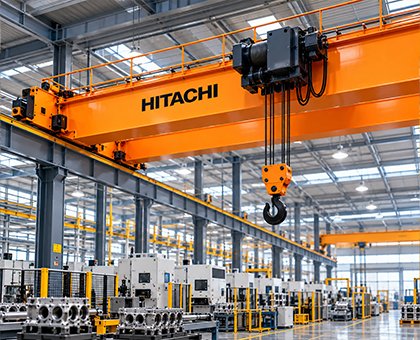
If chain hoists are the ideal solution for compact stations, then Demag cranes represent the gold standard for managing large industrial spaces and heavy-duty loads in major factories and ports.
The Demag name has long been associated with engineering innovation, where cranes are not just lifting devices but fully integrated digital material handling systems connected to smart factory networks.
1. Intelligent Control and VFD Technology
Demag crane systems feature highly smooth speed control using Variable Frequency Drives (VFD), enabling soft start and soft stop operations. This eliminates dangerous load swinging and significantly extends the lifespan of mechanical components such as shafts and gears.
2. Low Headroom Design
Demag hoist systems are engineered to minimize wasted vertical space under the ceiling, maximizing lifting height. This is particularly beneficial for factories with limited building height, allowing full utilization of vertical space.
Safety and Occupational Protection in Advanced Systems
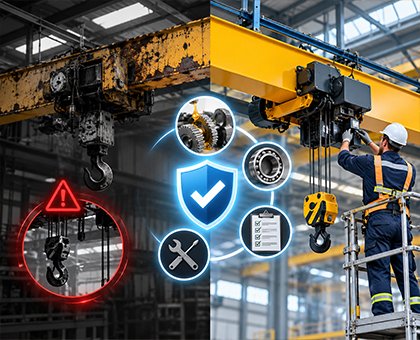
Protecting human capital and mechanical assets is a non-negotiable priority in heavy industry. Al-Manarat Al-Muneera highlights that integrating global technologies provides a dual-layer safety system that includes:
- Automatic emergency braking systems: Electromagnetic brakes instantly lock the load in case of power failure or emergency stop activation.
- Electronic overload limiters: Prevent any lifting attempt beyond the rated capacity, protecting both the crane structure and the building from dangerous stress.
- Digital monitoring and diagnostics: Modern systems track operating hours and remotely analyze performance data, enabling predictive maintenance before failures occur.
Frequently Asked Questions by Industrial Managers
When should chain hoists be used instead of wire rope hoists?
Chain hoists are ideal for light to medium loads (typically under 5 tons), especially in compact workshops requiring high precision positioning. Wire rope hoists are better suited for heavy loads and high lifting heights in open industrial areas and ports.
Why are Demag cranes considered a long-term profitable investment despite higher initial cost?
Their German engineering ensures a lifespan that often exceeds traditional cranes by more than double, with extremely low failure rates and energy-efficient systems. This significantly reduces downtime, which can otherwise cost thousands of dollars in production losses.
Conclusion
Ultimately, the rapid evolution of material handling technologies shows that investing in advanced systems such as intelligent chain hoists or adopting German-engineered Demag cranes is not an additional cost—it is a fundamental pillar for building a safe, efficient, and future-ready industrial environment.
The right engineering decision, based on a precise understanding of your facility’s material flow, protects you from unnecessary operational costs and positions your factory among leading production facilities.
At Al-Manarat Al-Muneera Company, we always recommend consulting specialized engineering experts to define duty classes and load requirements before making equipment decisions, ensuring tailored solutions that serve your operational goals for years to come with absolute stability and safety.