
Warehouses and storage facilities act as the vital arteries that supply industrial and commercial sectors. The efficiency of any organization heavily depends on the speed and smoothness of internal material flow and product handling. In today’s highly competitive digital and logistics-driven environment, relying on traditional manual handling methods is no longer acceptable. Manual operations consume time and labor while increasing the risk of costly damage and inefficiencies. Any delay in loading, unloading, or organizing goods inside a warehouse directly translates into financial losses and reduced market reputation.
Therefore, the modern trend focuses on transforming storage areas into intelligent, fully engineered systems. In this article from Al Manarat Al Muneera Company, we explore the importance of integrating advanced material handling equipment and how selecting warehouse cranes with proper engineering specifications can significantly improve operational efficiency and safety.
Core Principles for Selecting Material Handling Equipment in Modern Warehouses
Investing in warehouse infrastructure requires a forward-looking approach that goes beyond current operational needs and considers future expansion plans. Material handling equipment comes in multiple forms, each serving a specific role within the internal logistics system:
- Automated Systems (Automation & Conveyors):
- Including smart conveyor belts and Automated Guided Vehicles (AGVs), these systems transport goods between packaging, sorting, and storage zones through fixed pathways, reducing congestion and improving workflow efficiency.
- Reach Trucks & High-Rack Handling Equipment:
- Compact and flexible forklifts designed to operate in narrow aisles, allowing vertical stacking of pallets at significant heights to maximize warehouse space utilization.
- Lifting and Suspension Systems:
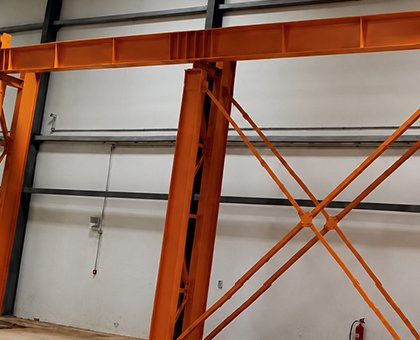
- Integrated with building steel structures, these systems provide independent vertical lifting capacity, improving safety and accelerating daily operations.
Operational studies show that proper material flow design using modern handling systems can reduce wasted time in locating and retrieving goods by more than 35%.
Warehouse Cranes: The Smart Solution for Heavy and Critical Loads
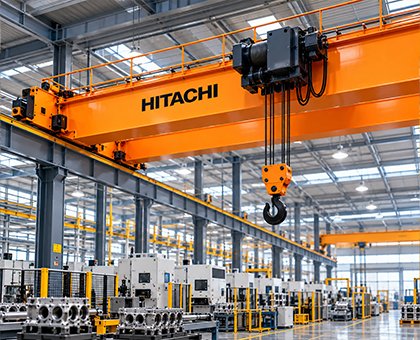
While ground-based equipment handles light and medium loads, there is a strategic need for overhead warehouse cranes when dealing with heavy, bulky, or long materials such as steel sections, pipes, manufacturing components, and heavy machinery.
1. Maximum Utilization of Floor Space
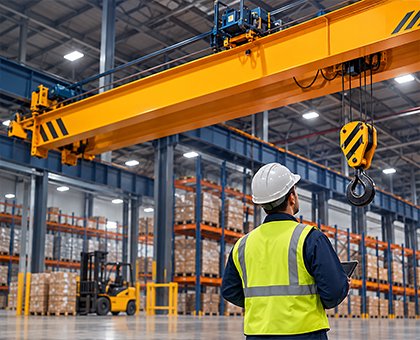
Overhead cranes operate in elevated tracks, using the “dead space” above the warehouse floor. This keeps the ground area fully free for workers and equipment movement, significantly reducing collision risks and improving safety.
2. Smooth Movement with Millimeter Precision
Modern cranes are equipped with intelligent control systems and Variable Frequency Drives (VFDs), enabling smooth acceleration and deceleration (Soft Start / Soft Stop). This eliminates load swinging, protecting racks, goods, and nearby structures from impact damage.
Enhancing Safety Standards and Protecting Human Capital
Warehouses are inherently high-risk environments if not properly equipped. According to Al Manarat Al Muneera, integrating smart material handling systems and electric cranes helps achieve:
- Elimination of back and musculoskeletal injuries:
- Machines handle all heavy lifting tasks, improving worker health and productivity.
- Wireless remote control systems:
- Operators can safely control loads from a distance with full visibility of movement paths.
- Built-in safety systems:
- Overload limiters automatically prevent crane operation if the load exceeds rated capacity, protecting both equipment and building structure.
Frequently Asked Questions from Warehouse Managers
How do you choose the correct duty class for warehouse cranes?
Warehouse operations typically involve frequent and repetitive lifting cycles, making Class C or Class D duty ratings the ideal choice. These classes ensure strong motor performance and reduced maintenance downtime.
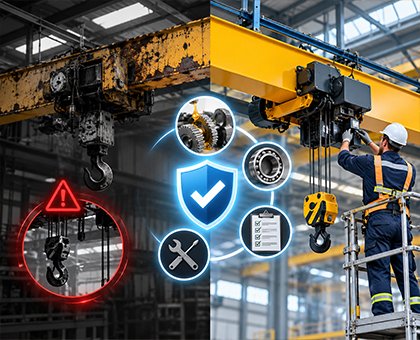
Why is regular inspection of wire ropes and brakes important in warehouse cranes?
Periodic inspections (monthly and quarterly) help detect early wear in steel wire ropes and reduce braking efficiency before failure occurs. This prevents unexpected downtime that could result in significant financial losses and operational disruption.
Conclusion
Ultimately, equipping warehouses with modern material handling systems and installing properly engineered overhead cranes is no longer optional—it is a strategic investment decision that directly impacts profitability, safety, and operational continuity.
Choosing the right equipment based on your space, load requirements, and workflow design ensures smooth logistics operations and long-term competitiveness. At Al Manarat Al Muneera Company, we provide full engineering consultation, design, and supply solutions for customized lifting systems that guarantee safe, efficient, and uninterrupted warehouse operations.